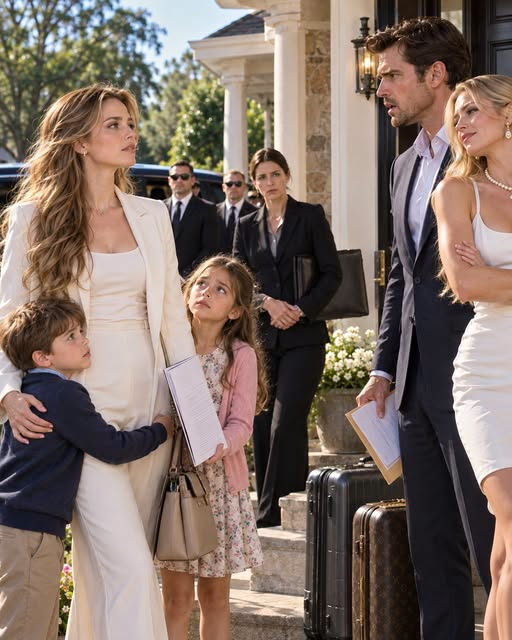
Luca stared at the last page in Rachel’s hand as though refusing to believe the words could become real simply because they were printed in black ink.
“What problem?” he asked.
Rachel closed the portfolio.
“That is a conversation we should have somewhere your children cannot hear.”
Luca glanced at Fiona and Leo.
For the first time since I had arrived, he seemed to remember that they were standing there.
Fiona was still holding my hand.
Leo had moved closer to my side, his shoulder pressed against my coat.
Chloe looked from the children to Luca and then back at the documents.
“What did you file with the bank?” she asked.
Luca ignored her.
“Jessi, this is ridiculous.”
I looked at him.
“Is it?”
“You know how businesses work.”
“I know how trust works.”
His jaw tightened.
Rachel stepped between us just enough to make the conversation feel official.
“Mr. Mercer, the property on Maplewood Lane is held through the Sterling Family Trust.”
“I know what the deed says.”
“No,” Rachel replied. “You know what you wanted it to say.”
She opened the portfolio again.
“The trust acquired this property before your marriage. Mrs. Vance is the current beneficiary and legal owner under the terms of the trust.”
Luca looked at me.
“You knew?”
“I learned today.”
That answer seemed to confuse him more than anything else.
“How?”
“My aunt’s estate.”
He looked at Rachel.
“Margaret?”
“Yes.”
His face changed.
He had heard the name many times.
Margaret Sterling had been the relative everyone in my family quietly referred to as Aunt Margaret, though she was actually my mother’s older cousin.
She had never liked Luca.
I used to think it was because she was difficult.
Now I wondered how much she had seen that I had been too trusting to notice.
Rachel took another document from the portfolio.
“She left instructions with her estate counsel several years ago.”
Luca frowned.
“Instructions about me?”
“About what would happen if you attempted to dispose of trust property or misrepresent your ownership of it.”
Chloe stared at him.
“You told me this house was yours.”
Luca snapped, “It was always going to be.”
That sentence hung between us.
Not because it was dramatic.
Because it was honest.
I looked down at Fiona.
Her eyes were fixed on the pearl earrings Chloe was wearing.
“Mom,” she whispered, “those are Grandma’s pearls.”
I swallowed.
“They were Grandma’s.”
Chloe touched one earring.
She suddenly seemed embarrassed by it.
“I thought Luca bought them.”
“He didn’t,” I said.
She took them off.
One at a time.
She placed them in her palm and held them out toward me.
I didn’t reach for them.
“Keep them there,” I said.
She looked surprised.
“Why?”
“Because Rachel will document everything before you leave.”
Rachel nodded to one of the security officers.
He stepped forward and photographed the earrings.
Chloe stared at him.
“You think I’m stealing jewelry?”
“I think we are going to be very precise from now on,” Rachel said.
Luca stepped down from the porch.
“This is getting out of hand.”
“No,” Rachel said. “It is finally getting into hand.”
I almost smiled.
But Fiona was watching me.
So I kept my expression calm.
Rachel handed me a second folder.
“This is the estate summary.”
I opened it.
The first page showed the number I had barely managed to comprehend at Franklin & Meyers.
$24,000,000.
Below it was the description of the Sterling Tower interest.
Controlling ownership.
Manhattan.
Multiple commercial tenants.
A property management structure that generated more money in a year than I had ever imagined seeing in my bank account.
Luca saw the heading.
His face lost its color.
“What is that?”
I closed the folder.
“My inheritance.”
He stared at me.
“What inheritance?”
“My aunt’s.”
“How much?”
I looked at him for a long moment.
“Twenty-four million dollars.”
Chloe’s mouth opened slightly.
Luca didn’t speak.
I could almost see him trying to rebuild the last eleven years in his head.
Every time he had told me not to worry about money.
Every time he had complained that my editing work was barely worth mentioning.
Every time he had asked why I kept receipts.
Every time he had laughed when I said Margaret still remembered the bracelet my mother had given me.
His eyes moved back to the folder.
“You’re lying.”
Rachel answered for me.
“The estate documents have already been verified.”
Luca shook his head.
“She never had that kind of money.”
“She did,” Rachel said.
“And she owned controlling interests in several properties and companies.”
He looked at me.
“You knew she was rich?”
“No.”
“But she gave you everything?”
“Not everything.”
I watched him absorb that.
For years, Luca had measured my worth by what he could see.
A paycheck.
A car.
A house.
A name on a business card.
He had never understood that some families measured wealth by what they deliberately kept out of sight.
Rachel closed the folder.
“There is one more matter.”
Luca looked exhausted now.
“What?”
“The forms.”
His shoulders stiffened.
“What forms?”
“The ones you told your wife were routine tax documents.”
I saw the smallest movement in his face.
He remembered.
I did too.
There had been stacks of papers on our kitchen island over the years.
Luca would come home late, drop a folder in front of me, and say, “Just sign here.”
Sometimes he was already on his phone.
Sometimes he was halfway out the door.
Sometimes he kissed my forehead first.
I had trusted him.
Rachel removed several photocopies from the portfolio.
“Mrs. Vance, these are the documents your husband prepared for your signature?”
I nodded.
“Yes.”
Luca stepped forward.
“Those were business filings.”
Rachel placed them on the porch table.
“Some were.”
She placed another page beside them.
“Some were loan documents.”
Then another.
“And this one was a declaration concerning ownership interests.”
Luca’s face tightened.
I looked at the page.
My signature was at the bottom.
My stomach dropped.
“I signed that?”
Rachel nodded.
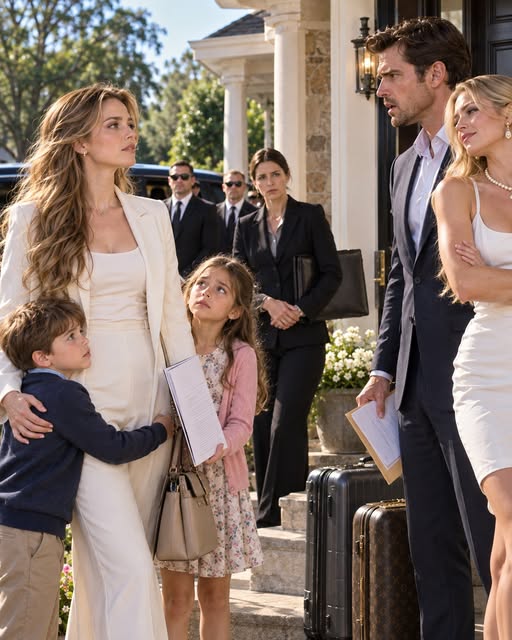
“You did.”
Luca immediately said, “You knew what you were signing.”
“No,” I said.
He looked at me.
“You read them.”
“I trusted you.”
“That isn’t the same thing.”
Rachel’s voice remained calm.
“According to the records, Mr. Mercer used your signature on these documents to represent that certain assets and income streams were jointly controlled or transferred for tax purposes.”
Luca interrupted.
“That is a legal accounting structure.”
Rachel looked at him.
“It would be, if the representations had been accurate.”
Silence settled over the porch.
Not the kind of dramatic silence people write about.
Just the uncomfortable pause that comes when everyone realizes a conversation has moved beyond an ordinary marital argument.
Chloe was the first to speak.
“You told me she had no money.”
Luca turned toward her.
“Chloe.”
“You said she didn’t understand anything about the business.”
“That’s enough.”
“You said this house was yours.”
He said nothing.
Chloe looked at me.
Then at Rachel.
Then at the suitcases.
“I thought she was the problem.”
I didn’t answer.
She lowered her eyes.
Rachel turned toward the security officers.
“Please take Mrs. Vance’s belongings inside.”
The officers moved toward the suitcases.
Luca blocked the doorway.
“No.”
Rachel stopped.
“This is private property.”
“You can’t just walk into my house.”
I looked at him.
“My house.”
His face tightened.
Rachel held up the deed.
“Your wife’s property.”
He moved aside.
The first suitcase rolled over the threshold.
It made a dull sound against the hardwood floor.
The same floor I had polished at midnight while Luca was traveling.
The same hallway where Fiona had taken her first steps.
The same stairs where Leo had once fallen asleep waiting for his father to come home.
For eleven years, I had called that place home.
Now I walked inside as its legal owner.
Fiona followed me.
Leo stayed close.
I stopped near the entry table.
There was a framed family photograph there.
Luca had taken it three summers earlier.
All four of us were standing by a lake.
He had his arm around my shoulders.
I remembered thinking that we looked happy.
I picked up the frame.
The glass was dusty.
I wiped it with my sleeve.
Then I placed it face down.
Not dramatically.
Just carefully.
Because I wasn’t ready to look at it anymore.
Behind me, Chloe said, “Luca, where am I supposed to go?”
He didn’t answer.
Rachel looked at her.
“You can leave through the front entrance.”
Chloe gave a small, bitter laugh.
“You mean the entrance to her house.”
Rachel didn’t correct her.
Chloe removed the white dress.
Not all the way.
She simply pulled a coat over it.
The gesture made the whole situation feel smaller somehow.
Less like a scandal.
More like two people realizing they had made decisions based on a story that wasn’t true.
She handed the pearls to Rachel.
“I don’t want them.”
Rachel placed them in an evidence pouch.
“I’ll return them to Mrs. Vance after the inventory.”
I nodded.
Luca remained on the porch.
He looked at me through the open door.
“Jessi.”
I stopped.
“I made a mistake.”
I waited.
“With Chloe.”
I said nothing.
“And with the divorce.”
Still nothing.
He swallowed.
“We can fix this.”
I looked at him.
“You packed my life into two suitcases.”
His eyes dropped.
“You did that in front of our children.”
“I was angry.”
“You were prepared.”
He didn’t answer.
That was the difference.
Anger passed.
Preparation required intention.
He had arranged the suitcases.
Printed the divorce papers.
Invited Chloe.
Planned to keep the children in the house.
And decided that I would have nowhere to go.
He hadn’t made one mistake.
He had made a series of choices.
Rachel stepped beside me.
“The temporary custody hearing will determine the children’s immediate schedule.”
Luca nodded.
For once, he didn’t argue.
Maybe the money had frightened him.
Maybe the paperwork had.
Or maybe he finally understood that I was no longer the woman he could dismiss with a sentence about household finances.
Whatever the reason, I didn’t need to know.
The next morning, Rachel and I went back to Franklin & Meyers.
The estate attorney walked me through everything Margaret had left.
She had arranged the inheritance years before her death.
The trust had protected the Maplewood property.
The Sterling Tower shares were structured so that control would pass to me upon her death.
The twenty-four million dollars had been divided among cash, investments, and other assets.
I asked why Margaret had never told me.
The attorney smiled sadly.
“She wanted you to build your own life.”
“I thought she didn’t trust me.”
“She trusted you enough not to make you dependent on her.”
Then he gave me a letter.
My name was written across the envelope in Margaret’s handwriting.
I opened it that afternoon.
She wrote that she had watched me work.
She had watched me raise my children.
She had watched Luca become more interested in being admired than in being dependable.
She had never wanted to interfere in my marriage.
But she wanted me to have one thing no one could take from me.
A choice.
I read that sentence three times.
Then I folded the letter.
For the first time since I had entered the office, I cried.
Not because I had inherited twenty-four million dollars.
Because someone had seen me before I understood what was happening to me.
The custody hearing came two weeks later.
Luca’s attorney tried to make the issue about stability.
My attorney brought records.
School attendance.
Medical appointments.
Travel schedules.
Bank statements showing that I had covered most household expenses during Luca’s slow business years.
Messages in which I had repeatedly asked him to come home for birthdays and school events.
Then came the property issue.
Luca’s attorney argued that the house had been treated as a marital residence for eleven years.
Rachel agreed.
“It was a marital residence.”
Then she placed the trust deed on the table.
“It was never his property.”
The judge reviewed the documents.
No one shouted.
No one made a speech.
The court simply treated the facts as facts.
The children stayed with me.
Luca received a structured parenting schedule.
The divorce proceedings continued.
And the house remained mine.
But the most serious problem for Luca wasn’t the house.
It was the paperwork.
An independent forensic accountant reviewed the documents he had prepared over the years.
Some were legitimate.
Some were sloppy.
Several were much more serious.
He had used representations about ownership and income that did not match the underlying records.
My signature appeared on documents I had never understood.
The accountant found that my signature had helped him present certain financial arrangements as though I had consented to them.
I had not.
The investigation took months.
There was no cinematic arrest.
No television cameras.
No grand public confession.
There were meetings.
Lawyers.
Accountants.
Requests for records.
Questions Luca couldn’t answer.
His consulting firm lost two major clients after word spread that its financial records were being reviewed.
The bank froze certain transactions pending clarification.
His mother stopped calling me.
Chloe left.
I heard she moved back to Chicago.
I never asked for details.
There was nothing left between us that required an explanation.
Luca eventually came to the house one afternoon to pick up some belongings.
He stood at the doorway.
He looked older.
Not ruined.
Just tired.
He noticed the family photograph on the entry table.
I had turned it upright again.
But I had removed the frame.
The picture was tucked into a plain wooden box.
“You kept it,” he said.
“I kept the children.”
He nodded.
After a moment, he asked, “Did you ever love me?”
The question surprised me.
“Yes.”
His eyes lowered.
“I thought so.”
“I loved the man I believed you were.”
He took a breath.
“And now?”
I looked at him.
“Now I believe what you showed me.”
He nodded slowly.
There was nothing else to say.
He picked up his box and left.
I closed the door.
Months later, the divorce became final.
I moved some of my office work into a small room overlooking the garden.
I hired help for the things I no longer needed to carry alone.
I established education accounts for Fiona and Leo.
I kept working.
That surprised people.
They assumed twenty-four million dollars meant I would stop doing everything.
But work had never been the part of my life I hated.
Being treated as though my work had no value was what hurt.
I still edited medical transcripts sometimes.
Not because I needed the money.
Because I liked knowing that something I did was useful.
Sterling Tower became another part of my life.
The first time I visited the building as its controlling owner, I stood in the lobby and looked up.
People hurried past me carrying coffee and briefcases.
No one knew who I was.
I liked that.
For eleven years, I had been married to a man who thought ownership meant saying something loudly enough until other people believed it.
Margaret had taught me otherwise.
Ownership was paperwork.
Responsibility.
History.
And sometimes a quiet signature no one noticed until it mattered.
A year after the divorce, Fiona asked me about the day we came home.
She was older then.
Old enough to understand more of it.
“Were you scared?” she asked.
“Yes.”
She seemed surprised.
“I thought you weren’t.”
“I was.”
“Then why did you smile?”
I thought about Chloe standing on the porch.
About the suitcases.
About the divorce papers.
About the deed in my purse.
“Because I finally knew something they didn’t.”
“What?”
I smiled.
“I wasn’t helpless.”
Fiona thought about that.
Then she hugged me.
That evening, I went to the entry table.
The pearl earrings were back in their box.
I opened it.
For a moment, I considered putting them on.
Instead, I closed the lid.
The house was quiet.
Not empty.
Quiet.
From upstairs came Leo’s laughter, followed by Fiona telling him to lower his voice.
I walked toward the stairs.
Behind me, the wooden box caught the late afternoon light.
I stopped.
Then I turned off the lamp and left it there.
Not hidden.
Not displayed.
Just resting on the same table where my husband had once placed his keys and told me everything in the house belonged to him.
Now the keys were mine.
And so was the door.
