The autumn wind blew a handful of damp oak leaves across the porch as the blue sedan pulled away from the curb. Lauren did not park. She never did on Sundays. She idled near our mailbox, the tailpipe puffing white exhaust into the cool afternoon air, and before the passenger door was fully closed, her tires kicked up the gravel of the lane.
My eight-year-old son, Tommy, stepped onto the grass, his yellow school backpack hanging low and off-center from his left shoulder. He walked with his arms pinned tight to his ribs, his chin tucked deep into the collar of his jacket.
I stood on the bottom step of the porch, waiting for him.
“Hey, Tommy,” I said.
His face was the color of skim milk when he looked up. His knees shook under his oversized cargo pants as he reached the gravel path that led to the steps.
“Hi, Dad,” he said.
His teeth were already digging into his thumbnail, chewing the skin until it was red and raw. He had been biting his nails more lately, but today his hands looked gray at the knuckles.
“Let me take the bag,” I said, reaching out my hand.
He flinched back against the wooden railing, his shoulder dropping three inches as if I had raised a hand to him.
“I have it,” he said. His voice was a whisper, thin and dry.
“It looks heavy,” I said. “Let us get inside where the heat is on.”
I held the front door open for him, my thumb rubbing my left temple where a sharp ache was starting to form. The hum of our old refrigerator greeted us as we stepped into the hallway, a constant, low vibration that usually felt like home. Today, the small house felt crowded with a silence we had not built.
Tommy stood in the center of the rug, his coat still zipped to his chin. He stared at the brown corduroy sofa as if it were a high fence he had to climb.
“Go ahead and take off your coat, Tommy,” I said. “I can pull up the football game.”
He did not move his arms. He stood perfectly straight, his eyes fixed on the brass floor lamp in the corner of the room.
“Are you cold?” I asked.
“No,” he said.
“Let us get those boots off then.”
I knelt on the floor to reach for his laces. Usually, he would lean against my shoulder or hop on one foot, but this time he stayed completely rigid, his weight balanced precariously. When I unlaced the right boot and pulled it off, he did not bend his knee. He kept his leg locked straight, his small body trembling under the heavy cotton of his shirt.
“You can sit on the couch while I get the other one,” I said, pointing to the cushions.
He lowered his body slowly, his knees bending in small, jerky movements that reminded me of an old folding chair. The moment his trousers touched the corduroy, a sharp gasp escaped his throat.
He shot back upright, his eyes wide and dry, his hands hovering over his lower back.
“Tommy?” I asked. “What is it? Did something poke you?”
“Nothing,” he said.
He stood near the coffee table, his body stiff as a post, his eyes fixed on the floorboards between his feet.
“Does your back hurt?” I asked, taking a slow step toward him so I would not startle him.
“I just want to stand up for a while,” he said.
His face was shiny with a thin layer of sweat, despite the draft coming from the front door.
“Did you fall at school?” I asked.
“No,” he said. He began to bite his nail again, his eyes darting toward the window.
I walked into the kitchen, the linoleum cold under my socks, and picked up the telephone. I dialed Lauren’s number, my fingers clumsy on the keypad. She answered on the fourth ring, her voice high and bright, carrying the faint sound of music and clinking glasses in the background.
“Andrew,” she said. “He got there okay, right? I am in a bit of a rush.”
“Lauren, something is wrong with Tommy,” I said, keeping my voice as even as I could. “He cannot sit down. He just tried to sit on the sofa and gasped in pain.”
“He is making a scene, just ignore him,” she said.
“He is pale, Lauren. He is sweating and he cannot bend his knees properly.”
“He is just trying to get attention because of the weekend transition,” she said, her voice dropping into that sweet, measured tone she used when she wanted to end a conversation. “You know how sensitive he is. Do not let him start.”
“This is not a tantrum,” I said. “Did he fall? Did something happen at your house?”
“He was perfectly fine when we left,” she said. “I really have to go, Andrew. I have reservations.”
“Lauren, wait—”
The line went dead. I stood in the kitchen, listening to the flat hum of the dial tone before I set the receiver back on its cradle.
I walked back into the living room. Tommy was still standing by the window, his fingers hooking into the belt loops of his jeans, looking out at the dead leaves on the lawn.
“I am going to unpack your backpack, Tommy,” I said.
He did not turn around.
I carried the yellow bag to the kitchen table. It felt heavier than a second-grader’s bag should feel. I unzipped the main zipper, the metal teeth pulling apart with a loud rasp.
Inside was his green spelling folder, a box of raisins, and a light blue knit cap.
At the very bottom, tucked under his school notebook, was something large and solid.
I reached in and pulled out a heavy blue metal thermos. It was not the small plastic one with the red cap that I had bought him for his hot lunches. This was an industrial-grade steel bottle, scratched and dented near the rim, with a heavy black plastic stopper.
I turned it over in my hands. The base was made of brushed steel, and someone had used a pocketknife or a nail to scratch two rough letters into the blue paint.
I had never seen this bottle before in my life. Tommy did not have any friends with those initials, and Lauren did not buy secondhand gear.
I looked back toward the living room, where my son was still standing by the window, too stiff to move, his small shoulders hunched against a pain he would not name.
My fingers traced the cold metal of the unfamiliar blue thermos, and my stomach tightened.
I set the heavy blue container on the kitchen counter, the metal making a dull clink against the laminate. I walked back into the living room where Tommy still stood near the television, his arms locked straight down at his sides.
“Tommy, look at me,” I said.
He kept his eyes on the carpet, his small chest rising and falling in rapid, shallow breaths. He was chewing on the edge of his thumb, his fingernail already worn down to the pink skin.
“Let me see your stomach,” I said, stepping closer. “Just lift up your shirt for a second.”
He shrank back, his shoulders bunching up toward his ears as he took two quick steps away from me. He crossed his arms tightly over his middle, clutching his ribs as if he were trying to hold himself together.
“No,” he whispered. “It does not hurt.”
“You cannot sit down, Tommy,” I said, rubbing my left temple where a sharp ache was beginning to pulse. “Something is wrong.”
“I am just tired,” he said, his voice barely reaching my ears. “I want to stand up for a while.”
“People do not stand up because they are tired,” I said.
I reached out to gently touch his shoulder, but he flinched so hard his foot caught on the edge of the rug. He stumbled, his face turning the color of dry paper as he gasped, a tiny, sharp sound of pure physical distress.
He did not let me touch him, and he did not lower his arms from his chest.
I went back into the kitchen and picked up my phone, my fingers cold against the glass screen. I dialed my mother’s number, needing a voice that did not belong to the custody dispute.
She answered on the second ring, the background noise of her television low and familiar.
“Martha,” I said, keeping my voice down so Tommy would not hear.
“Andrew, is everything alright?” she asked.
“Tommy is here,” I said, looking through the doorway at my son’s stiff profile. “He cannot sit down. He is holding his middle and flinching if I get within two feet of him.”
I reached into my pocket and pulled out my keys, sliding my thumb over the heavy silver keychain I had carried since college. The cool metal usually helped me focus when a drafting project went wrong.
“It is probably just a stomach bug, Andrew,” she said. “The schools are full of them this time of year. Did he eat his lunch?”
“He has not eaten anything,” I said. “He is trembling.”
“Give him some ginger ale,” she said. “If he is still sick tomorrow, you can call the pediatrician. Do not overreact, honey.”
“This does not feel like a stomach bug,” I said.
“You always expect the worst,” she said. “Kids get sore muscles from gym class, or they eat something sour. Just let him rest.”
I hung up and slid the silver keychain back into my pocket, the weight of it settling against my thigh.
When I walked back into the living room, Tommy had moved to the center of the rug. He was trying to lower himself onto his side, bending his knees with an awkward, hitching motion that looked like an old man trying to navigate ice.
He got down to one knee, his teeth clenched so hard I could see the muscles in his jaw trembling.
“Tommy, stop,” I said. “Do not force it.”
He ignored me, slowly sliding his hip onto the carpet and letting his shoulder rest against the floor. He lay there on his side, his knees pulled slightly toward his chest, his hands still tucked under his chin.
I knelt beside him on the carpet, keeping my hands on my own knees so I would not frighten him.
A single tear rolled down his temple and vanished into his brown hair, followed by another. He did not sob, and his chest did not heave. He lay perfectly still, letting the silent tears wet the fabric of his sleeve.
“Does your back hurt?” I asked.
He did not answer, his eyes fixed on the baseboard across the room.
“Did something happen at your mom’s house?” I asked.
He bit his lower lip, his breathing turning ragged.
“Mom gets mad if I say things,” he whispered.
“I am your father,” I said, my voice shaking despite my best efforts to keep it steady. “You can tell me anything. We can call the doctor, or we can get some help.”
Tommy’s eyes widened, and he looked up at me with sudden, sharp panic.
“No,” he said, his voice rising. “Do not call anyone. Please.”
“We have to figure out why you are in pain,” I said.
“Mom said if people come, they will take me away,” he said, his face twisting as he struggled to keep his voice quiet. “She said they put kids in places with locks.”
“Nobody is going to take you away,” I said, though the words felt hollow in my throat.
He closed his eyes tightly, turning his face toward the cushions of the sofa to hide his wet cheeks.
The house felt too small, the air thick with things I did not know how to fix. I stood up and walked to the front door, stepping out onto the concrete porch to get a breath of the cool autumn air.
The damp smell of oak leaves hung heavy over the driveway, and the sky was turning a bruised purple.
Jim, my neighbor from three doors down, was standing near his mailbox, sorting through a handful of white envelopes. He looked up, saw me on the porch, and walked over to the edge of my driveway.
“Evening, Andrew,” Jim said, leaning his hands on his hips. “You just get Tommy back?”
“A little while ago,” I said, stepping down the porch stairs to meet him.
“I saw Lauren’s car fly out of here,” Jim said, shaking his head. “She almost took the corner on two wheels. I thought maybe there was some kind of emergency.”
“She was in a hurry,” I said.
“She usually stops to chat with my wife if she sees her,” Jim said, looking toward the empty street. “Not today. She looked like she was running from a fire.”
“She did not say much to me,” I said.
“Well, hope everything is okay,” Jim said, turning back toward his house. “Let me know if you need to borrow the leaf blower this week.”
“Thanks, Jim,” I said.
I stood in the driveway for a long minute, watching the streetlights flicker on down the block.
The blue thermos on my kitchen counter had initials that did not belong to anyone in my family. Lauren had been in a rush to leave, more frantic than she had ever been during our worst arguments.
I walked back up the porch steps, the wood creaking under my work boots.
When I opened the door, the house was completely dark except for the single lamp near the television.
The silence in the living room was louder than any alarm I had ever heard.
I led Tommy into the kitchen, his small hand cold and limp in mine. He kept his back perfectly straight as we walked, moving with a strange, hitching stride that made my chest tighten with every step.
On the kitchen table lay his green spiral-bound school notebook, the corners curled and the cardboard backing slightly torn from being shoved into his backpack. I had bought it for him at the pharmacy back in August, three days before school started, when things still seemed manageable between Lauren and me.
I reached into the cupboard and pulled out a blue plastic cup, the one with the faded cartoon dog on the side that he had used since he was five.
“Let us get some water in you, Tommy,” I said, keeping my voice low and steady.
I filled it at the tap, the old pipes under the sink rattling as the water ran cold.
Tommy stood near the edge of the linoleum, his shoulders hunched toward his ears. He was biting his fingernails again, his thumb raw and red at the cuticle, his teeth working at the edge of his skin with a frantic, quiet energy.
I held the cup out to him, trying to smile.
He reached for it with both hands, but his fingers were trembling so hard they tapped against the plastic with a rapid, hollow clicking sound.
Before he could get a firm grip, his fingers gave way and the cup tilted.
Water splashed over the laminate counter and pooled around his sneakers on the gray linoleum floor.
“I am sorry,” Tommy whispered, his voice barely carrying over the hum of the refrigerator. “I did not mean to, Dad. I am sorry.”
“It is just water, buddy,” I said, grabbing a dry dish towel from the oven handle. “We can clean it up in two seconds. No harm done.”
I knelt to wipe the floor, keeping my movements slow and deliberate so he could see I was not angry.
When I looked up, Tommy had not moved an inch. He was staring down at the damp spot on the floor, his chest rising and falling in shallow, rapid breaths that made his small frame shudder.
I stood up and rubbed my left temple, feeling the dull, familiar ache of a tension headache beginning to form behind my eyes.
“Does your stomach hurt?” I asked.
Tommy looked down at his shoes and shook his head, but his whole body tensed when I reached out to pat his arm.
“We need to figure out what is going on,” I said.
I walked into the entryway, where my mobile phone lay on the small oak table near the coat rack.
Tommy followed me, his stiff legs making a soft scraping sound on the hardwood floorboards as if he could not lift his feet.
When I reached for the phone, his eyes went wide with a sudden, sharp panic.
He lunged forward and grabbed the sleeve of my flannel shirt, his grip surprisingly tight for an eight-year-old child.
“No, please,” Tommy said, his voice cracking on the second word. “Do not call them.”
“I have to call someone who can help us, Tommy,” I said, looking down at his pale face and the dark circles under his eyes.
“Mom said if the police came, you would go to jail,” Tommy said.
He stared up at me, his eyes wide and shiny, his fingers twisting into the fabric of my sleeve.
“She said they would take you away because of the papers you signed.”
My heart hammered against my ribs, but I kept my voice flat and calm, the way I did when explaining a difficult blueprint at the office.
“That is not how the law works, Tommy,” I said. “Nobody is taking me away.”
“She said it,” Tommy insisted, his voice dropping to a desperate whisper as he looked toward the front door. “She said if I told anyone, the police would come to your house and lock you up for violating the custody rules.”
I knelt down so we were at eye level, though I had to be careful not to stand too close and crowd him.
“Your mother was mistaken,” I said, keeping my words short and precise. “The police are there to help people when they are hurt, and you are hurting.”
He chewed on his lower lip, his fingers still clutching my sleeve as if it were the only stable thing in the room.
“Are you hurt, Tommy?” I asked.
He did not answer, but his gaze drifted down toward his shoes, and his silence was heavier than any confession.
I stood back up, my mind made up, and carried the phone back into the kitchen.
I set the phone on the laminate counter and switched the line to speakerphone before dialing the emergency number.
The three digits felt heavy under my fingertips.
The line rang twice before a woman’s voice broke through the static.
“Oak Creek emergency, what is your location?”
“Twelve-eighteen Maple Street,” I said. “I need an ambulance.”
“What is the nature of the emergency, sir?” the operator asked.
“My eight-year-old son is in severe physical pain,” I said, watching Tommy stand perfectly still near the pantry door. “He cannot sit down. He is standing completely stiff and cannot bend at the waist.”
“Is he conscious and breathing normally?”
“Yes, but he is extremely pale, and his hands are shaking so much he cannot hold a cup,” I said. “He is having trouble standing, but he refuses to sit.”
“Has he suffered a fall or a physical injury today?”
“His mother told me he was just being sensitive and making a scene,” I said, my finger tracing the edge of the kitchen counter. “But this is not emotional. He is in physical agony.”
“We are dispatching an ambulance to your address now, sir,” the operator said. “Because of the nature of the call, we are also sending a local sheriff’s deputy to assist.”
“Thank you,” I said.
“Is there anyone else in the home with you?”
“Just my son and me,” I said.
“Keep him comfortable and do not try to force him to sit or lie down,” the operator said. “They should be there in fifteen minutes.”
“We will be waiting on the porch,” I said.
I ended the call and looked at Tommy, whose small body seemed to shrink even further under the kitchen lights.
“They are coming to help us,” I said. “Let us go wait where they can see us from the road.”
I opened the front door, and the cool autumn air hit us immediately, carrying the smell of damp oak leaves and wet grass.
I walked down to the bottom wooden step and sat down, keeping my back straight so Tommy could lean against my shoulder if he wanted to.
Tommy walked down the porch steps with the same agonizingly slow, wooden movements, his face tight with effort.
He did not sit.
He stood right next to the step, his hip resting lightly against my shoulder, his small body shivering in the October breeze.
At ten minutes to seven, a white cruiser with the sheriff’s emblem on the door turned into the driveway, its tires crunching on the gravel.
The headlights cut through the dusk, and the driver’s side door swung open.
Deputy Miller stepped out, adjusting his belt as he walked toward the porch with a slow, heavy stride.
He looked at me, then his eyes drifted down to Tommy, who was standing as stiffly as a statue, his hands still tucked into his pockets.
“Evening,” Deputy Miller said, his voice carrying a slow, deliberate drawl. “You the one who called about the boy?”
“I am,” I said, standing up to meet him while Tommy tensed beside me. “This is Tommy. He arrived from his mother’s house like this.”
Miller tapped his small leather notebook with his black pen, his eyes scanning Tommy’s rigid posture and pale face.
“He cannot sit down, Deputy,” I said, my voice tight. “He has been standing like this since four o’clock.”
Miller knelt down on the gravel path, his knees making a dry cracking sound as he looked up at Tommy.
“Hey there, young man,” Miller said, his drawl softening. “Can you try to bend your knees for me?”
Tommy tried, his face twisting in a sudden wince, his breath catching in a sharp gasp before he stood straight again.
Miller’s face hardened slightly, the weariness in his eyes replacing the professional distance.
“Alright, son, you do not have to do that,” Miller said, standing back up and looking at me. “You did the right thing calling us. He is not faking that.”
The relief that washed over me was cold and sharp, but it was immediately replaced by a heavy weight in my chest.
I knew what this meant for the custody agreement, for the delicate truce Lauren and I had maintained.
By calling the authorities, I had officially declared war on the mother of my child.
The red and blue lights of the approaching ambulance began to flash against the trees at the end of the street.
I reached into my pocket and pulled out my mobile phone, knowing the custody decree required me to notify Lauren of any emergency.
My thumb hovered over her name on the screen, her contact photo a picture from three years ago when we still tried to look like a family.
I pressed the dial button, knowing there was no turning back from this call.
The blue lights of the police cruiser and the ambulance did not use sirens, but they swept across my living room wall in silent, regular rotations.
Officer Davis, a local deputy with a heavy duty belt that clicked with every step, stood near the coat rack while Paramedic Curtis knelt on the carpet by the sofa.
Curtis was a young man with very short hair and a black medical bag open beside his boots.
He did not touch Tommy right away, but looked at how my son stood with his back straight against the wall, his arms pinned to his sides.
“Tommy, can you try to sit on this cushion for me?” Curtis asked, his voice low and level.
Tommy shook his head once, his chin tucked into his collar, his thumb tucked under his other four fingers.
“He has not been able to sit since he got out of his mother’s car at four o’clock,” I said.
Curtis nodded, then looked up at Officer Davis, who was writing in a small black flip-book.
“Can you tell me where it hurts, Tommy?” Curtis asked, leaning in closer.
Tommy did not speak, his eyes darting to me and then back to the floor.
“Is it his stomach?” I asked, my hand going to my left temple, rubbing the skin until it was hot.
“We need to get him to Oak Creek Memorial right now,” Curtis said, standing up and reaching for his radio. “I want a pediatric team ready when we arrive.”
“Is it that bad?” I asked, the draft from the open door hitting my ankles.
“We need a full clinical assessment,” Curtis said, lifting the heavy medical bag.
Officer Davis stepped closer, his boots making a dry squeak on the hardwood floor.
“Mr. Kinley, do you have your custody agreement here in the house?” the officer asked.
“It is in the kitchen desk,” I said, pointing toward the doorway.
“Get it,” Davis said, “and bring it with you to the hospital.”
“Did his mother say anything else when she dropped him off?” Davis asked, tapping his pen against his palm.
“She said he was making a scene and that I should ignore him,” I said.
Davis nodded slowly, making a brief mark on his pad before tucking it into his breast pocket.
I went to the kitchen, my fingers slick against the drawer handle, and pulled out the blue folder containing the court papers.
The heavy blue metal thermos I had found earlier sat on the counter, its scratched initials catching the light from the stove.
I did not touch it, but I grabbed my coat and Tommy’s small school backpack from the chair.
When I returned to the living room, Curtis was gently guiding Tommy toward the front door, keeping him upright.
The ride in the back of the ambulance was loud, the diesel engine vibrating through the metal floorboards under my boots.
Tommy lay on his side on the narrow cot, his knees pulled slightly toward his chest, his eyes fixed on a glowing green screen above his head.
Curtis sat on the small bench opposite me, a metal clipboard resting on his blue-uniformed lap.
“How long did you say he was at his mother’s house this week, Andrew?” Curtis asked, his pen hovering over the form.
“Six days,” I said, “since last Monday morning.”
“And he was fine when you dropped him off?”
“He was running,” I said, “he carried his own backpack up her driveway.”
Tommy let out a small, shaky breath, his fingers tensing against the safety strap of the gurney.
He began to bite his index fingernail, his shoulders tensing as the ambulance bumped over a pothole.
“Tommy, did you have a fall at your mom’s house?” Curtis asked, his voice very quiet.
My son did not answer, his eyes remaining wide and fixed on the ceiling light of the ambulance.
“Did he eat lunch today, Andrew?” Curtis asked me.
“I do not know,” I said, “his mother would not tell me anything when I called.”
“What about yesterday?” Curtis asked, checking the monitor.
“I do not have contact with him during her weeks,” I said, “the agreement does not allow phone calls unless it is an emergency.”
Curtis wrote something down, the carbon paper making a dry, scraping sound as his pen moved.
“The skin on his face is very pale,” Curtis said, checking the oxygen monitor on Tommy’s finger. “We will be there in four minutes.”
“His heart rate is elevated,” Curtis noted, looking at the glowing monitor. “That usually indicates pain or fear.”
“He was biting his fingernails the whole way here,” I said, looking at Tommy’s hand.
Tommy pulled his hand back, tucking it under the thin white blanket Curtis had draped over his legs.
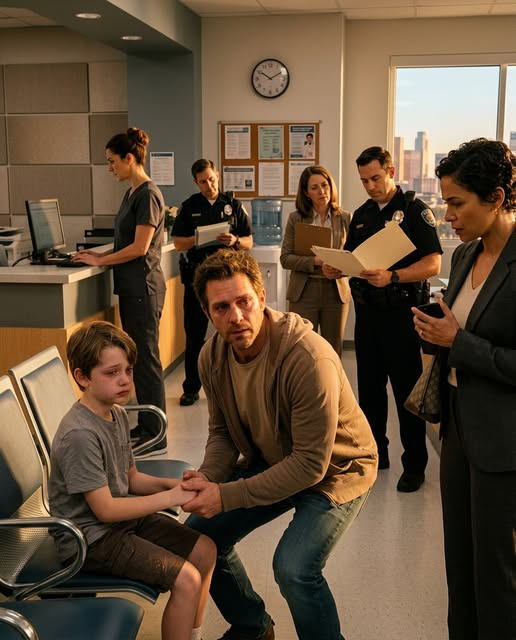
The emergency room waiting area at Oak Creek Memorial smelled of pine floor cleaner and old vinyl.
I sat in a low blue plastic chair with my custody agreement folded in my lap, its pages stiff against my hands.
Tommy had been taken through the double doors ten minutes ago, and the silence in the room was heavy.
A woman in a gray wool blazer walked through the double doors from the back hallway, her badge identifying her as Brenda, Social Services.
She did not sit down in the empty chair beside me, but stood over me, looking down at her manila folder.
“Mr. Kinley, I need to clarify the timeline of this afternoon,” Brenda said, her tone sharp and direct.
“I called the emergency line at six-forty,” I said, keeping my voice flat and even.
“And you picked him up at four?”
“His mother dropped him off at four,” I said, “on the dot.”
“Why did you wait nearly three hours to call for medical assistance if the child was in obvious physical distress?” she asked, her eyes narrowing as she flipped to the next page in her folder.
“I tried to talk to him first,” I said, “and I called his mother to ask what had happened.”
“Did she offer an explanation?”
“She told me he was just making a scene, and then she hung up on me,” I said.
Brenda wrote a note on her pad, the tip of her pen clicking twice before she spoke again.
“The mother’s attorney has already contacted our on-call worker,” Brenda said, her voice dropping to a sharp whisper.
“Lauren called a lawyer?” I asked, my fingers tightening against the paper in my lap.
“She claims you have been withholding visitation and that this is an attempt to alter the current joint schedule,” Brenda said.
“My son cannot sit down,” I said, “that is not a legal tactic.”
“She also indicated that Tommy has a history of exaggerating minor discomforts to gain attention,” Brenda said.
“That is not true,” I said, standing up to meet her eye level. “He hides his pain, he does not invent it.”
“Do you have a lawyer, Mr. Kinley?” Brenda asked, her eyes lingering on the blue folder in my hands.
“I have my custody attorney on retainer,” I said.
“I suggest you contact them,” she said.
“The medical staff is doing the physical assessment now,” she added, closing her folder with a loud snap.
She turned and walked back through the double doors, leaving me alone in the row of empty blue chairs.
I sat back down, the cold plastic of the chair chilling through my trousers as I waited.
The hallway clock near the reception desk showed ten past eight when the automatic entrance doors slid open with a hiss of cold air.
Lauren walked in, her cream-colored coat unbuttoned, her leather purse strap held high on her right shoulder.
She did not look at the receptionist but walked straight toward me, her heels clicking on the gray linoleum.
“What did you do, Andrew?” she asked, her voice high and sharp enough to make the nurse at the desk look up.
“Tommy is in the back,” I said, standing up to meet her.
“You called the police to my house,” she said, her fingers gripping her purse strap until her knuckles turned white.
“I called an ambulance because our son is hurt,” I said.
“He had a stomach ache,” she said, stepping closer, her perfume smelling of heavy vanilla and lavender. “He was fine when I left him.”
“Left him where, Lauren?” I asked, my voice dropping.
“He is eight years old, he plays rough,” she said, ignoring my question. “You are turning a minor scrape into a federal case because you cannot stand that we are divorced.”
“The paramedic said he needs a full evaluation,” I said.
“You are pathetic,” she said, looking around the lobby as if checking to see who was watching.
“The hospital has to check everything, Lauren,” I said, keeping my hands at my sides. “They are doing tests.”
“You want to destroy my reputation,” she said, her voice dropping to a harsh hiss. “You want everyone to think I am a bad mother.”
“If you cared about him, you wouldn’t have dragged him into a hospital on a Sunday night,” she said, adjusting her strap again.
The double doors opened again, and Nurse Sarah, the pediatric nurse with the small silver watch on her lapel, stepped into the hallway.
Lauren immediately changed her posture, her shoulders dropping, her face softening into a look of deep concern.
“Oh, thank goodness,” Lauren said, stepping past me toward the nurse. “Is my baby okay?”
Nurse Sarah looked between the two of us, her expression guarded.
“We are still running some tests,” Nurse Sarah said, “but we need both parents to remain in the waiting area for now.”
“I came as soon as I heard,” Lauren said, her voice trembling slightly. “My ex-husband has a tendency to panic over every little bump.”
I rubbed my left temple, my thumb catching on the edge of my glasses.
“He has been in pain for hours, Lauren,” I said, my voice shaking with a quiet anger I could barely hold back.
“He was perfectly fine when he left my house,” she said, turning her back to me.
Lauren stood there, her hair perfect, looking at me as if I were the threat.
Dr. Evans, a tall man in green scrubs, stepped between us before Lauren could say another word. He directed me back into Room 4 and closed the heavy wood door, leaving her high-pitched voice muffled in the corridor.
The air in the examination room was thin and smelled of rubbing alcohol. Tommy sat on the edge of the high vinyl table, his sneakers dangling inches above the step stool. He was biting his index fingernail, his eyes fixed on the metal trash can by the sink.
“Tommy, I am Dr. Evans,” the doctor said. He did not carry a stethoscope or any tools in his hands, keeping his palms open as he approached. “I need to look at your back for just a second. Is that alright?”
Tommy did not answer. He looked at me, his small face pale under the cold fluorescent tubes.
I walked over and stood by his right shoulder. I rubbed my left temple, trying to keep my voice even. “It is okay, Tommy. Let the doctor see.”
Dr. Evans gently reached for the hem of Tommy’s grey cotton shirt. Tommy tensed, his shoulders rising toward his ears, but he did not pull away.
The fabric lifted.
Across the small of Tommy’s back, spanning nearly six inches, was a deep, dark bruise. The skin at the center was a dark, muddy purple, almost black, with a distinct horizontal ridge where the swelling had peaked.
I stepped closer, my hands flat against my thighs. As a draftsman, I spent my days measuring tolerances down to the millimeter, and my eyes immediately tried to map the shape. It was too straight, too uniform to be the result of a tumble.
“How long has this been here, Tommy?” Dr. Evans asked. His voice remained level and soft.
“A few days,” Tommy whispered. He did not look back.
“Did you fall down, son?” Dr. Evans asked, gently pressing his thumb near the outer edge of the swelling.
Tommy winced and pulled his stomach forward, gasping softly. He began biting his fingernail again, harder this time.
“I don’t know,” Tommy said.
The doctor looked at me, then lowered the shirt with a slow, careful motion. He patted Tommy on the shoulder.
“You did great,” Dr. Evans said. “I am going to talk to your dad for a minute outside. Nurse Sarah is going to bring you some apple juice.”
Nurse Sarah, a young woman with her hair pulled back in a neat clip, stepped into the room with a small plastic cup. She checked her watch, then smiled at Tommy.
“Here you go, Tommy,” she said in a hushed, gentle voice. “We have some crackers too if you get hungry.”
I followed Dr. Evans out into the corridor. The double doors at the end of the hall remained shut, keeping Lauren in the secondary waiting area.
“That is not a simple fall,” Dr. Evans said. He leaned his back against the beige wall.
“She told me he fell off a stool in the bathroom,” I said.
“A fall from a stool onto a flat floor produces a different kind of impact mark,” he said. “This is a concentrated, narrow crush injury. The skin has a linear abrasion, meaning he hit something with a hard, defined edge.”
“Like what?” I asked.
“A stair nose, a metal radiator, or the corner of a heavy table,” Dr. Evans said. “And it took significant force to cause that deep of a hematoma in an eight-year-old.”
I looked down at my shoes. The blue linoleum reflected the fluorescent lights in long, clean lines.
“Could it have been an accident?” I asked.
“It is possible, but the location and shape make it highly unlikely he simply tumbled,” the doctor said. “And there is a delay in seeking care. A bruise like that would have been extremely painful from the moment of impact.”
He reached into his pocket and pulled out a small pager.
“I am calling our on-duty social worker,” Dr. Evans said. “We are required to report suspicious injuries in minors to the state. The sheriff’s department will need to take a statement from you.”
“Lauren is going to say I caused it,” I said.
“The social worker will look at the timeline,” Dr. Evans said. “You picked him up at four o’clock today. An injury like this is at least twenty-four to forty-eight hours old.”
I nodded, the weight of the hours settling into my shoulders.
“Go talk to the deputy in the waiting area,” Dr. Evans said. “I will be with Tommy.”
Deputy Miller was waiting near the vending machines. He was forty-two, his uniform shirt pressed and neat despite the late hour. He had a black leather notebook open, tapping his pen against the page.
“Your ex-wife is in the secondary lounge,” Miller said. His drawl was slow, his eyes steady on mine. “She claims you are trying to make a scene to affect the custody hearing.”
“She is lying,” I said. I sat down in one of the hard blue plastic chairs. “Look at his back.”
“The doctor is writing his report now,” Miller said. “I need your account of the afternoon.”
I told him about the pickup at four o’clock. I told him how Tommy could not sit in the car, how he gasped when he tried to sit on the sofa, and how he wept on the living room floor.
“Did he say anything about how it happened?” Miller asked.
“He said his mom would get mad if he talked,” I said. “And I found something in his backpack that doesn’t belong to us.”
Miller stopped tapping his pen. “What did you find?”
“A heavy blue metal thermos,” I said. “It has the initials M.K. scratched into the bottom. Tommy does not use a thermos like that.”
Miller wrote the initials down, his pen making a soft scratching sound on the paper.
“M.K.,” Miller said. “Does that mean anything to you?”
“No,” I said. “But Lauren claims she was home with him all weekend. If someone else was there, she didn’t mention them.”
Miller closed the notebook with a small snap. “We will run the initials through our local database. I will also speak to the neighbors in Oak Creek.”
“Is Tommy safe tonight?” I asked.
“The hospital will keep him until the social worker completes her assessment,” Miller said. “I suggest you stay close.”
I went back into Room 4. Tommy was lying on his side, his small body tensed into a tight ball. The nurse had left the plastic cup of apple juice on the bedside table, untouched.
I pulled the metal stool close to the bed and sat down. My pocket felt heavy, and I reached in to pull out my keys.
The silver keychain made a quiet clinking sound. It was a solid pewter disc with an old engraving of an anchor, given to me by my father when I bought my first truck.
Tommy open his eyes. He looked at the keys in my hand.
“Can I hold it, Dad?” he asked. His voice was barely a whisper.
I unclipped the silver keychain from the ring and handed it to him. His small hand closed around the cool metal, his knuckles turning white.
“I am never going to leave you,” I said. I laid my hand over his shoulder, feeling the slight rise and fall of his chest.
He did not say anything, but his thumb moved over the smooth surface of the pewter anchor. His breathing began to slow, the tension leaving his face as he stared at the wall.
The silver keychain glinted in the harsh emergency room light as his small fingers held it tight.
Lauren touched my elbow and guided me away from the door of Room 4. Her fingernails were manicured a pale, glossy pink, contrasting with the industrial green of the corridor walls.
“He fell in the bathroom, I was already going to explain that,” she said. Her voice was high, thin, and wavering.
She dabbed at the corner of her eye with a folded tissue, though her cheeks looked completely dry under the bright fluorescent tubes. I rubbed my left temple, the skin hot and tight.
“The doctor said the bruising is deep,” I said, keeping my voice low so it would not carry back to the room. “He said it came from a hard impact against a flat edge.”
“He is so clumsy lately, Andrew,” she said, her fingers sliding up to adjust her leather purse strap. “He was reaching for his toothbrush on the top shelf. We have that tall wooden bathroom stool, the one my mother gave us. He just lost his footing and went backward.”
“The stool is eight inches high,” I said. “And it has rubber feet on the bottom.”
“He caught the edge of the tub on the way down,” she said, nodding quickly as if to convince herself. “It happened so fast. I didn’t think it was this bad, or I would have called you right away. You know how he exaggerates when he wants attention.”
She looked past my shoulder toward the nurses’ station, her shoulders dropping in a small, rehearsed sigh.
“I was going to tell you at the next drop-off,” she whispered.I kept my hands flat against my thighs to keep them from shaking. My son was three rooms away, lying on his side on a stiff hospital mattress, and his mother was standing in a sterile hallway trying to negotiate a fall that did not make sense.
“Why did you wait until the school week started?” I asked.
“I didn’t want you to panic,” she said. “You always make everything into a federal case.”
“He could not sit down, Lauren. He was crying in my living room.”
“He has always been sensitive,” she said, her voice rising slightly. “He gets that from your side of the family. A normal boy would have bounced right back up.”
“A normal boy does not get deep purple tissue damage from a tooth-brushing accident,” I said.
She adjusted her purse strap again, her face tightening for a fraction of a second before the soft, victimized look returned.
“I am his mother, Andrew. I know his body. I know when he is actually hurt and when he is just looking for sympathy.”
I looked down at the pale green tiles beneath our feet. I had already paid the forty-five dollar copay at the clinic desk, and the receipt was folded in my front pocket like a heavy piece of lead.
“The doctor is calling it non-accidental,” I said.
Lauren let out a sharp, breathless laugh. “Doctors always assume the worst. They have to protect themselves from lawsuits.”
She walked toward the waiting room, her heels clicking on the gray linoleum, and I followed because I could not let her out of my sight. The room was mostly empty, save for a man asleep under a brown coat near the vending machines.
Lauren sat on one of the low blue plastic chairs and patted the seat next to her. I remained standing, my back against the brick wall, watching her pull her keys from her bag.
“Look, we don’t need the county involved in this,” she said, her tone softening into that sweet, rounded register she used for difficult clients. “It is just a big misunderstanding. The police being here is ridiculous.”
“They were called because he was injured, Lauren.”
“I know you are angry,” she said, looking up at me. “And I know things have been tense between us since the last hearing. So let us do this. Let him stay with you.”
I looked down at her, trying to find the trap. “What do you mean?”
“Take him home tonight,” she said, her hands folding over her purse. “Keep him for the next two weeks. He can recover at your place, where it is quiet. I won’t file any objections. We can just tell the school it is a family matter.”
The offer hung in the cold air between us like a physical weight. Two weeks with Tommy meant fourteen days of making his breakfast, walking him to the corner, and knowing exactly who was watching him when he went to sleep.
“No custody exchange next Sunday?” I asked.
“None,” she said. “Just take him. We can sign a temporary agreement on a napkin right now if you want.”
My chest tightened with a sudden, dangerous hope. It would be so simple to take my boy, load his backpack into my truck, and drive back to Oak Creek where the house was warm.
I thought about the hum of the old refrigerator in my kitchen, and how quiet the house had been since the divorce. I still carried the guilt of that failure like a shadow, always wondering if I had done enough to protect my family.
“And the police report?” I asked.
“We just tell them we worked it out,” she said. “We tell them it was a domestic accident and we are handling it together as parents.”
She was offering me the one thing I had spent a year begging for in court, but she was doing it in exchange for my silence. It was the easiest path, a quick exit from this brightly lit nightmare.
I stared at the black scuff marks on the linoleum. The offer was a beautiful, dangerous thing. It meant no lawyers, no social workers asking intrusive questions, and no long days of waiting for a judge to sign a piece of paper. I could just be his father again, sitting on the porch in the quiet Ohio evening while he played in the yard.
“He has a math test on Wednesday,” I said, my voice sounding flat and distant to my own ears.
“I will bring his blue binder too,” she said. “Everything he needs. Two whole weeks, Andrew. Think about how much better that is for him.”
I looked at her, seeing the desperation behind her sweet smile. She was giving up her custody time with a speed that made my stomach turn. She was trading her son’s days for a clean record, and the sudden generosity felt cold against my skin.
“Who was with him when he fell, Lauren?” I asked.
She blinked, her fingers tightening on her purse strap. “I was, of course. I just told you that.”
“You were in the house?”
“Yes,” she said, her voice rising slightly. “Where else would I be? I was in the kitchen fixing dinner.”
“I see,” I said.
“So we are agreed?” she asked, leaning forward. “We tell the deputy we are fine, and you take him home.”
“Let us see what the deputy says,” I said.Deputy Miller walked out of the triage alcove, his black boots squeaking slightly on the floor. He carried a small black notebook, tapping the side of it with a silver ballpoint pen.
Lauren stood up immediately, her smile brightening as she took two steps toward him.
“Deputy,” she said, her voice dropping into a warm, cooperative rhythm. “I am so glad you are still here. I was just explaining to Andrew how the accident happened.”
Miller stopped, looking from Lauren to me, his face showing nothing but the deep, quiet weariness of a man who had worked the late shift for twenty years.
“Go ahead, ma’am,” Miller said, his drawl slow and level.
“Tommy was brushing his teeth on Sunday evening,” she said, her hands gesturing gracefully. “He climbed up on his wooden stool, lost his balance, and fell against the porcelain edge of the tub. I feel absolutely terrible. I should have replaced that stool months ago.”
She looked down, her lower lip trembling slightly, a perfect picture of maternal guilt.
“Did you seek medical attention at the time?” Miller asked, his pen hovering over the paper.
“I gave him some children’s ibuprofen and put an ice pack on it,” she said. “He said he felt better, so I thought it was just a typical bump. I had no idea the bruising would look this bad today.”
Miller nodded slowly, his pen making three quick strokes on the page. He did not look at me.
“And you have agreed to let the father take him home tonight?” Miller asked.
“Yes,” Lauren said quickly. “We both think a quiet environment is best for him right now. We are fully cooperating.”
Miller closed the notebook with a soft click. He looked at the floor, then back at Lauren, his expression entirely neutral.
“I see,” he said. “Well, that is certainly helpful.”
I wanted to scream, to point at the blue thermos still sitting in Tommy’s backpack, to tell him about the way Tommy had begged me not to call the law. But I remained silent, my thumb pressing hard against my temple.
“Is there anything else, Deputy?” Lauren asked, her tone sweet.
“No, ma’am,” Miller said. “I will file the report as a domestic incident. You two have a good night.”
He turned and walked down the corridor toward the exit, his heavy footsteps fading as the double doors slid shut behind him.
I walked back into Room 4, leaving Lauren in the hallway. The room was quiet, the only sound the steady, low hum of the wall monitors.
Nurse Sarah was standing by the bedside, adjusting the drip on the small saline bag. She looked at her watch, then turned her head toward me, her eyes kind but guarded.
“He is resting,” she whispered, her voice dropping into that hushed tone she used around the children’s ward.
Tommy lay on his side, his knees pulled slightly toward his chest, his small fingers still loosely curled around my silver keychain.
“How is his pain?” I asked.
“The medication is helping,” she said. “But we need to keep him comfortable.”
Outside the open door, Lauren’s voice carried down the linoleum corridor, high-pitched and sweet as she continued talking to the receptionist.
“We can head out as soon as the paperwork is done,” she was saying.
At the sound of her voice, Tommy’s small shoulders jerked upward. His fingers clenched tightly around the metal keys, and his entire body went rigid beneath the thin white hospital sheet.
Nurse Sarah noticed it instantly, her hand moving to touch his forehead, her brow furrowing as she watched his breathing quicken.
I stepped toward the doorway, looking back out into the bright hall. Lauren was standing near the exit doors, her leather purse slung over her shoulder.
She smiled, but her eyes remained cold, calculating the distance to the nearest exit.
Lauren turned back toward the vending machines, her heels clicking on the linoleum. Nurse Sarah touched my elbow and pointed toward the far end of the nursing station.
“Mr. Miller,” she said, her voice barely a whisper. “We have the preliminary imaging back.”
I rubbed my left temple, the skin there hot and dry. My other hand was shoved into my pocket, my fingers brushing against the forty-five dollar copay receipt from the clinic we had visited earlier. “Is it his spine? Please tell me it is not his spine.”
“His spine is clear,” she said. She checked her watch, the plastic strap squeaking against her wrist. “But the radiologist flagged something else. I need to show you the chest films.”
She led me behind the high desk, away from where Lauren was sitting. The nurses’ station was quiet, save for the low hum of a computer monitor and the distant squeak of rubber-soled shoes down the hall. A half-eaten sandwich in plastic wrap sat next to a stack of clipboards. On the counter, a blue plastic thermos was sitting inside a clear evidence bag, the initials M.K. scratched deep into the painted metal near the base.
“The doctor is reviewing them now, but I wanted you to see this before the deputy speaks with her,” Sarah said. She kept her voice low, her eyes scanning the corridor.
“See what?” I asked.
“There are two fractures on the right side,” she said, her voice dropping lower. “They are partially healed. They did not happen today.”
The words did not make sense. Tommy had not complained about his ribs. He had only complained about his lower back. I stared at her, trying to find some mistake in her face. As a draftsman, I work with precision, scaling elements to the millimeter. A load-bearing beam has a limit, and when it fails, it leaves a jagged stress fracture. But looking at the x-ray report, the stress was in my own chest.
“How old are they?” I asked.
“Six to eight weeks,” Sarah said. She looked over her shoulder toward the waiting room where Lauren was still sitting. “We see this sometimes. A child learns to breathe shallowly so it hurts less.”
“How could he have broken ribs and not said a word?” I asked, my voice cracking slightly.
Sarah checked her watch again, her fingers tapping the digital face. “Children are resilient, Mr. Miller. They adapt to their surroundings. If they think telling will make things worse, they keep it inside.”
A cold draft blew through the corridor from the sliding ambulance doors at the end of the hall. The smell of damp oak leaves from the parking lot clung to my coat, mixing with the sharp scent of hospital bleach.
“I need to talk to the deputy,” I said.
I walked down the corridor, my boots heavy on the floor. Deputy Miller was standing by the double doors, holding his small black notebook. He tapped the top of his pen against the leather cover, his face gray under the fluorescent lights. He looked tired, the deep lines around his eyes showing his years on the night shift.
“Your ex-wife is very cooperative,” Miller said, his drawl low and level. “She says the boy fell from a wooden stool in the half-bath. Said she was in the kitchen fixing his dinner when it happened.”
I stopped three feet from him, near an empty gurney parked against the wall. “That is not what happened.”
“I know,” Miller said. He looked down at his notebook, his finger tracing a line of neat handwriting. “Her phone logs just came back from the dispatcher. She was logged onto the guest wireless at the Green Onion Bistro on State Route Four at seven o’clock tonight.”
“That is three miles away,” I said.
“Three miles,” Miller agreed. “She paid the bill at seven-fifteen. For two dinners.”
He flipped the page, the paper rustling in the quiet hall.
“She told me she was home alone with him,” I said.
Lauren took two steps toward us from the waiting area, her expression sweet and pleading. She adjusted her leather strap, her fingers twitching against the metal buckle. Her voice was high-pitched and overly sweet. “Andrew? Is everything okay with our boy? The doctors aren’t telling me anything.”
Miller turned his head slowly, his eyes dropping to her strap, then back to her face.
“For that very reason, ma’am, wait here,” Miller said, pointing toward the lobby.
Lauren took two steps toward us, then stopped. Her jaw tightened, but she did not say a word. She backed away toward the blue plastic chairs.
Miller led me into a small consultation room with grey vinyl chairs and a box of tissues on the low table. He shut the heavy door behind us, blocking out the sound of the emergency room. The air in the room felt thin and smelled of pine cleaner.“We ran the registration on the blue thermos you found in the boy’s bag,” Miller said. He sat down on the edge of the laminate table and tapped his notebook. “The school office had a record of a visitor pickup last Tuesday under those same initials. Marcus King.”
The name was unfamiliar. My hands felt cold. “Who is Marcus King?”
“He is thirty-four,” Miller said. “Addresses in Dayton and Columbus. He has been staying at your ex-wife’s townhouse since August.”
“She told the court she lived alone,” I said.
“He has a record,” Miller said. “Two counts of domestic battery in Montgomery County. The last one was dismissed when the victim failed to appear.”
“And she let him stay there,” I said, my voice barely a whisper.
“The school logs show he picked up Tommy three times in September,” Miller said. “On days when Tommy was marked absent the next morning.”
I looked at the grey walls. I thought of Tommy’s backpack sitting on my kitchen floor, the heavy blue metal thermos with the scratched letters M.K. sitting next to his schoolbooks. The pieces were fitting together, each one a sharp edge.
“We need to know if he was in the house tonight,” Miller said. “But I cannot ask the boy without a social worker present, unless you are in the room to consent.”
“I want to be there,” I said.
“He might not talk to me,” Miller said, his voice dropping an octave. “He is scared. But he will talk to you.”
We walked back to Room 4. Tommy was lying on his side, his small knees tucked toward his chin. He was biting his fingernails, his eyes wide and dark in the pale light of the bedside lamp. His right hand was clutched tightly around my old silver keychain, the metal rings biting into his palm.
I sat on the edge of the mattress and took his hand, careful not to move his back. “Tommy.”
He flinched, then let his fingers go limp in mine, the keychain cold between our palms.
“The deputy needs to ask you something, buddy,” I said. “You are not in trouble. Nobody is going to jail.”
Miller leaned against the wall, his hat in his hand. “Tommy, do you know a man named Marcus?”
Tommy did not look at him. He stared at the blue privacy curtain, his breathing shallow and rapid.
“He has a blue thermos,” I said softly. “The one in your backpack.”
Tommy nodded once. A single tear ran down his temple into his hair.
“Was Marcus at the house tonight?” Miller asked.
Tommy nodded again, his small shoulders shaking under the thin hospital gown.
“Did Marcus touch you, Tommy?” I asked.
“I dropped the milk,” Tommy whispered. “In the kitchen. He got mad.”
“What did he do?” Miller asked, his pen stopped against his pad.
“He pushed me,” Tommy said. His voice was so quiet I had to lean close to hear. “Into the metal heater. The one by the door.”
The radiator in Lauren’s kitchen was cast iron, with sharp, painted corners. I had painted it myself three years ago, before the divorce, scraping the old white flakes off the metal.
“And your mom?” I asked.
“She was gone,” Tommy whispered. “She told me to say I fell. She said if I told, they would take me away.”
I closed my eyes. The image of the cast iron radiator in that small kitchen filled my mind, the heavy metal corner striking my son’s lower back while Lauren sat three miles away eating dinner.
I stood up and stepped out of the room, my legs stiff and heavy. Nurse Sarah was waiting by the door, her face pale under the fluorescent lights. She held a small grey tablet in her hand.
“Andrew,” she said quietly. “You need to see this.”
She tapped the glass screen to wake it. The black-and-white image of my son’s rib cage appeared under the bright glass.
The X-ray image on the screen showed the faint, pale lines of old injuries I had never known about.
Brenda, the hospital social worker, stepped into the small pediatric cubicle and slid the glass door shut behind her, the thick rubber seal blocking out the low chatter of the nursing station. She did not look at me, keeping her eyes on the yellow manila folder in her hands as she clicked her pen three times. Tommy lay on his side on the narrow hospital bed with his knees pulled up to his chest, his small fingers still curled around my old silver keychain.
The emergency room was cold, the air conditioning hum constant and dry against my skin. On the little table by the door, the forty-five dollar copay receipt from the clinic sat next to a half empty plastic cup of water.
“The state central registry has accepted the case,” Brenda said, her voice dropping to a flat, professional whisper that barely carried over the hum of the overhead monitor. “A formal abuse report has been filed.”
I stood up from the vinyl chair, my knees stiff from hours of waiting. “Then we can leave. I can take him to my house in Oak Creek where he has his own room.”
Brenda tapped the edge of her folder against her hip, her face perfectly neutral under the harsh fluorescent tubes. “That is not how this works, Mr. Clark. Since the injury occurred while he was under his mother’s care, and because you do not have sole legal custody, we cannot release him to either parent tonight.”
“I was the one who called the police,” I said, rubbing my left temple where a sharp headache was starting to bloom. “I brought him to the clinic and paid the copay myself.”
“That is noted in the file,” she said, her finger tracing a line on the state intake form. “But the protocol requires a temporary protective hold.”
“He is eight years old,” I said, keeping my voice down with an effort that made my chest feel tight. “He does not know anyone else in this county.”
Brenda pulled a black pen from her pocket and laid it on the bedside tray next to Tommy’s blue plastic thermos. “We need to protect him properly.”
I looked down at the pen, then at my son’s pale face. “Where does he go tonight?”
“An emergency foster home here in the district,” she said. “The transport officer is already in the building.”
I reached down and gently touched the silver keychain in Tommy’s hand, his fingers tightening around the metal as he made a small, snuffling sound in his sleep. “And how long does this emergency home keep him?”
Brenda checked her watch, her eyes scanning the digital display before she looked back at me. “The magistrate will review the hold within seventy-two hours.”
“Seventy-two hours,” I said.
She did not answer, instead sliding the signature page toward my hand.
“You have to sign the temporary release,” she said, her pen poised.
“I want to speak with Deputy Miller first,” I said.
Brenda placed the pen back on the tray and opened the sliding door, letting the cold air of the corridor rush into the small cubicle.
I stepped out into the main emergency corridor, the heavy double doors of Room 4 clicking shut behind me with a soft magnetic hiss. Deputy Miller was standing near the drinking fountain at the far end of the hall, his tan uniform shirt wrinkled and his badge glinting under the hallway lights. He was slowly tapping his notebook with his pen, his face worn from the long shift.
“They are taking him, Deputy,” I said, stopping three feet away from him on the cold linoleum. “They are putting him in a state car.”
Miller stopped tapping his notebook and looked at me, his slow drawl filling the quiet corridor. “It is the protocol, Andrew. When there is a notification of this nature, the county has to secure the child until a magistrate can review the file.”
“He did not do anything wrong,” I said. “I did not do anything wrong.”
“I know,” Miller said, his voice dropping an octave as he glanced toward the nurses’ station. “But the law does not have eyes for who is good and who is bad in the middle of the night. It only sees the report.”
“How long do they keep him?” I asked, my fingers digging into my pockets.
“The emergency hearing is scheduled for the third Thursday of the month,” Miller said. “That is the standard window for the agency to present their initial findings.”
“That is ten days away,” I said.
“Your attorney can file a motion to expedite,” Miller said, reaching down to adjust his heavy duty belt. “But until the judge signs an order, the state has the boy.”
“Who is Marcus King?” I asked, the name feeling heavy and sour in my mouth.
Miller looked down at his notebook, flipping back two pages. “We have a deputy heading to his apartment right now. But that does not change where the boy sleeps tonight.”
A nurse walked past us carrying a plastic tray of small medicine cups. The smell of antiseptic was thick enough to taste.
“Is Lauren being arrested?” I asked.
“We are taking her statement,” Miller said. “She is in the private waiting area near the desk.”
“She lied to you about where she was,” I said.
Miller did not look up from his notebook. “We have the restaurant receipts and the cell tower data, Andrew. We know.”
“Then why is she still here?” I asked.
“She has a lawyer on the phone,” Miller said, turning his head toward the glass doors of the lobby.
The transport team arrived at the end of the hall, two officers in dark blue uniforms carrying a small canvas bag. One of them spoke to Brenda in low, hushed tones, then they both walked into Room 4 where Tommy was sleeping.
I watched through the glass as they gently shook his shoulder, his small body tensing as he woke up in the unfamiliar room.
He looked around wild-eyed, his gaze searching the space until he found me standing in the corridor.
I gave him a small, tight nod, trying to keep my face perfectly still, but he knew.
They led him out of the room, his hand still clutching my silver keychain against his leg, his small boots dragging on the floor.
“Dad,” he whispered as they walked him past me.
“I will see you soon, Tommy,” I said, my voice cracking slightly on his name. “I will be right here.”
The transport officers led him through the heavy double doors at the end of the hall, and the magnetic lock clicked shut behind them.
I walked toward the main exit, my feet feeling heavy and numb on the cold tiles of the hospital floor.
The automatic sliding doors of the emergency room lobby parted, letting in a draft of cold autumn air that smelled of damp oak leaves. Lauren was standing near the concrete pillar by the ambulance bay, her dark leather purse hanging from her shoulder. She adjusted the leather strap twice, her fingers jerking with a tight, nervous energy.
“I hope you are satisfied, Andrew,” she said, her voice rising in that high-pitched, sweet tone she used when she was trying to sound like the victim.
“They took him, Lauren,” I said, stopping on the concrete step. “Because of what your boyfriend did to him.”
“Marcus had nothing to do with this,” she said, her eyes wide and glassy under the yellow parking lot lights. “And now they have my son in a foster home because you had to play the hero.”
“He has two broken ribs,” I said. “The doctor showed me the X-rays.”
Lauren pulled her coat tighter around her chest. “Kids fall, Andrew. They get hurt. But you just had to make a phone call and blow everything up.”
“He was pushed,” I said.
“You think you won something tonight,” she said, taking a step closer, her voice dropping to a sharp, venomous whisper. “But you lost him too. We both did. They are not going to give him back to you.”
“The court will see the truth,” I said.
“My lawyer will have this dismissed by noon tomorrow,” she said, her lips curling into a cold, mocking smile. “And you will still be sitting in that empty house of yours with nothing but your draft sheets.”
She turned on her heel, her designer boots clicking loudly against the asphalt as she walked toward her sedan.
The taillights of her car flared red as she backed out of the space and accelerated toward the main road.
I stood under the bright halogen lights of the entrance, the silence of the empty parking lot settling over me like wet wool.
The drive back to Oak Creek was a long stretch of dark county roads, the headlights of the old pickup cutting through the rising ground fog.
I pulled into my gravel driveway and turned off the engine, the sudden quiet of the yard heavier than the noise of the highway.
The key turned smoothly in the deadbolt of my front door, and I stepped into the dark entryway.
Inside, the house was entirely silent, save for the low, steady hum of the old refrigerator in the kitchen.
I walked down the narrow hallway, my boots heavy on the floorboards.
Tommy’s bedroom door was halfway open, just as he had left it when he arrived on Sunday afternoon.
On his small wooden desk, his school notebook sat next to a cup full of colored pencils, its cover slightly bent at the corner.
I sat down on the edge of his mattress, the springs giving a small, familiar creak under my weight.
The sheets were still neat, tucked in at the corners the way I had made them the morning before.
On the bedside table, the small blue nightlight cast long, empty shadows across the room where my son should have been sleeping.
Robert, my custody attorney, sat at my kitchen table at eight o’clock Monday morning with his briefcase flat on the wood. He did not take off his grey overcoat, and he did not touch the mug of black coffee I set in front of him.
My fingers went to my left temple, rubbing the skin in tight, heavy circles to dull the ache that had stayed with me since the hospital.
“The court is going to look at the state’s protective hold as a temporary measure,” Robert said. He adjusted his wire-rimmed glasses and opened a manila folder. “By Thursday morning, Lauren’s lawyer will argue that the injury was a one-time household fall. They will say you are using a minor accident to hijack the custody agreement.”
“He did not fall,” I said. My voice sounded thin in the quiet kitchen. “The deputy knows she was at a restaurant. The medical report proves the bruising came from a violent impact.”
“We need to tie Marcus King to that house on the days Lauren claimed she was home alone with Tommy,” Robert said. “Without that, her lawyer will claim she had no idea her boyfriend was ever left unsupervised with the boy. She will play the victim of a dishonest partner.”
I stood up and walked to the entryway where Tommy’s green canvas backpack lay on the floor. I unzipped the main compartment and pulled out his school notebook, the one with the plastic blue cover and the bent spiral binding.
I flipped through the lined pages, past the spelling lists and the drawings of stick-figure houses. Tucked into the back pocket was a yellow slip of paper.
“What is that?” Robert asked, leaning forward.
“A nurse’s notice from September,” I said, laying the slip on the table between us. “Tommy was sent home with a fever. The school rules state only a parent or an authorized emergency contact can sign a student out.”“The school district office is three miles from here,” I said.
Robert closed his folder with a quiet snap. “Go there now. We have to build a wall of paper they cannot climb over.”
The school district office sat behind the middle school, housed in a low brick building that smelled of damp cardboard and floor wax. A waist-high wooden counter separated the small waiting area from the desks where three clerks worked under bright fluorescent lights.
Mrs. Gable, the district school nurse, met me at the counter after I buzzed the entrance bell. She wore a blue cardigan and carried a plastic clipboard.
“Mr. Vance,” she said, her voice dropping to a cautious murmur. “I received the state social worker’s inquiry this morning. I cannot release student attendance records without a court subpoena.”
“I am his father,” I said, placing my driver’s license and a copy of my custody decree on the counter. “I have joint legal decision-making power. The school logs are part of his educational and medical file.”She looked down at the paperwork, her thumb tracing the gold seal on the custody document. Her expression remained tight, her mouth set in a straight line as she calculated the risk.
“The logbooks are kept in the main office vault,” she said, her eyes moving to the clerk sitting at the desk behind her.
“My son is in a state shelter because we cannot prove who took him from school on the days he was injured,” I said. “I need the sign-out sheets for the last three months.”
Mrs. Gable did not answer. She stood still for several seconds, then took my custody decree and walked through the heavy wooden door into the back records room.
I waited by the counter, my boots pressing against the cold linoleum. The hum of a copier in the corner was the only sound in the room.
When she returned ten minutes later, she held three photocopied pages. She laid them face down on the counter and kept her hand on top of them.“Who signed him out?” I asked.
She slid the papers across the counter. On the signature line for all three dates, written in a thick, jagged script, was the name Marcus King.
I folded the sheets and placed them inside my jacket pocket, the paper stiff against my chest.
By one o’clock, the autumn wind had picked up, blowing dry oak leaves across the concrete steps of the local sheriff’s department. Deputy Miller met me in the lobby, his uniform trousers slightly creased from a long shift.
He took the photocopies from my hand and sat on the wooden bench near the vending machines. He tapped his black ink pen against his notebook, his eyes moving slowly down the school logs.
“This name matches the registration on the black pickup truck we saw near your ex-wife’s neighborhood,” Miller said, his drawl low and steady. “But signatures can be disputed in court. A defense attorney will say anyone could have written those letters.”“The school nurse witnessed him signing them,” I said. “She knows his face.”
“She will have to testify to that,” Miller said. He stood up, tucking the pages into his breast pocket. “We ran the cell tower data from the night Tommy was hurt. Lauren’s phone pinged three miles away at the Bistro Grill from seven to nine.”
“And Marcus’s phone?” I asked.
“His phone was turned off during those exact hours,” Miller said. “But we found something else in his background. A domestic call from two years ago in the next county over.”
“Did they arrest him?” I asked.
Miller looked toward the glass double doors of the station. “The victim refused to press charges, so it faded away. But the pattern is there.”
“He was alone with my son while Lauren was out,” I said. “She lied to keep him in her life.”
“She is still claiming the boy fell in the bathroom,” Miller said, turning back to me. “She has hired an attorney who specializes in high-conflict custody cases. You need to be ready for Thursday.”
I walked out of the station and drove straight to the professional building on Oak Street. The air in Robert’s office was warm, smelling of old leather books and lemon polish.
Robert took the school logs and laid them next to the blue metal thermos on his desk. The initials M.K. scratched into the blue paint seemed darker under his desk lamp.
“This is the link,” Robert said, his finger resting on the signature from October third. “The school log proves Marcus King was acting as a caregiver with Lauren’s permission. The thermos proves he left his personal property in Tommy’s backpack.”
“Is it enough to get him back?” I asked.
“It is enough to show a judge that Lauren committed perjury when she swore Marcus had no contact with the child,” Robert said. He pulled a fresh document from his drawer. “But we have to file an emergency motion before the court closes at four.”
He turned the document toward me. It was an application for immediate sole physical and legal custody, listing the older rib fractures and the school absences.
“This is the step that makes it permanent, Andrew,” Robert said. “Once I file this, there is no going back to the old schedule. Lauren will fight you with everything she has left.”
“I want the papers filed today,” I said.
Robert nodded, then tapped a small printed invoice on the side of his desk. “The emergency filing and the representation for Thursday will require an additional retainer. Our office needs to clear the billing before the clerk’s office closes.”
I looked at the number on the paper. It was three thousand eight hundred dollars, nearly the exact balance remaining in my savings account from my years of drafting work.
“I can transfer it now,” I said.
I pulled my phone from my pocket and logged into the bank application. The screen showed the numbers in green, the small reserve I had kept for Tommy’s future.
I approved the transfer to the firm’s account, the screen blinking once before the numbers dropped to double digits.
I signed the retainer check, watching the last of my savings account transfer to the firm’s ledger.
The glass doors of the county courthouse let in the cold October morning light, casting long shadows across the terrazzo floor of the third-floor lobby. Robert, my attorney, stood beside me, his leather briefcase flat against his thigh. He checked his watch, the metal expansion band clicking against his wrist as he looked toward the elevators.
Lauren was already there, sitting on a wooden bench thirty feet away. She was dressed in a neat navy suit, her hair pulled back into a smooth bun. Her attorney, a tall man named Vance, stood near the water fountain, reviewing a yellow legal pad and whispering to her.
When Vance saw us, he nodded to Lauren, patted her shoulder, and walked over. His leather shoes clicked loudly on the polished stone of the quiet corridor.
“Robert,” Vance said, stopping two feet away. “Can we talk for two minutes before the deputy clerk calls the docket?”
Robert did not move his briefcase. “We are here for the emergency hearing, Vance. We are ready to go in.”
“My client is willing to modify the joint schedule today,” Vance said, keeping his voice low and confidential. “Four days a week with Andrew, no child support adjustments, and we skip the judge entirely.”
I looked over Vance’s shoulder at Lauren, who was staring down at her lap, her fingers twisting her watchband. She looked remarkably calm, as if we were waiting for a table at a quiet neighborhood restaurant.
“Does that include Marcus King?” I asked, my voice flat.
Vance cleared his throat, adjusting his striped silk tie. “Mr. King is not a party to this custody action, Andrew. We are discussing the parents.”
“Then the answer is no,” Robert said, turning toward the double doors of Courtroom B.
The heavy oak doors opened, and a bailiff with a clipboard stepped into the corridor, looking straight at us. He called our names, his voice echoing off the high plaster ceiling.
Inside, the courtroom smelled of lemon wax and old paper, the air conditioned down to a sharp chill. Judge Henderson sat behind a high walnut bench, her gray hair pulled back in a tight clip, her eyes already fixed on the blue folder in front of her. We took our places at the tables, the wood cold beneath my palms as I sat down.
Robert opened his brown accordion file and pulled out a clear plastic evidence bag, placing it gently on the table between us. The heavy blue metal thermos sat inside the plastic, the initials M.K. scratched into the paint near the bottom rim. I remembered finding it in Tommy’s backpack, the cold metal sending a shiver through my fingers on my kitchen floor.
“Your Honor,” Robert said, standing and adjusting his glasses. “We are seeking an emergency temporary custody order. We have physical evidence recovered from the child’s backpack on the night of the incident.”
Vance stood immediately. “Object, Your Honor. There is no foundation linking this object to my client’s household, nor is there any proof of its relevance to these proceedings.”
“It will be linked, Your Honor,” Robert said, his voice steady. “This thermos belongs to Marcus King, the man who was supervising my client’s son when the physical abuse occurred.”
Judge Henderson looked over the top of her reading glasses at Lauren, then at the blue thermos in the plastic bag.
“Overruled,” the judge said. “I will hear the foundation, counsel.”
Robert began reading from the emergency room medical report, his voice flat and clinical. He detailed the deep purple contusions along Tommy’s lower spine, describing how the tissue had been compressed against a hard, blunt surface.
Every word felt like a physical weight pressing against my chest, making the high-ceilinged room seem very small. I rubbed my left temple, my head throbbing from the tension. I looked down at the desk, remembering the way Tommy had stood in my living room, unable to sit, his small body trembling as he tried to hide his agony from me.
“The bruising is consistent with a high-velocity impact,” Robert read, his voice filling the quiet room. “Specifically, a heavy cast-iron radiator. The pediatric unit also noted two older, partially healed rib fractures on the left side.”
Lauren reached for her water glass, her hand shaking so much the ice clinked against the rim before she set it down without drinking. She looked toward the public gallery, but there was no one there to support her.
“We call Deputy Miller,” Robert said, turning toward the back of the courtroom.
Deputy Miller stepped forward from the back row, his brown sheriff’s department uniform pressed, his boots silent on the carpeted aisle. He took the stand and swore the oath, his slow drawl sounding exactly as it had in the hospital corridor.
Robert walked toward the witness stand, holding a copy of the police report. “Deputy, did you investigate the mother’s claim that she was home when the injury occurred?”
“I did,” Miller said, tapping his notebook with his pen. “We pulled the cell phone tower records for Lauren’s phone for that Sunday afternoon.”
“And what did those records reveal?” Robert asked.
“Her phone was pinging off a tower three miles away from her residence between three and five in the afternoon,” Miller said.
Lauren stared straight ahead, her face pale, her lips pressed into a thin white line.
“Did you find any other corroborating evidence of her whereabouts?” Robert asked.
Miller reached into his breast pocket and produced a small photocopy. “We obtained the credit card receipt from the Bistro on Main, showing a transaction at four-twelve in her name, with her signature.”
“Who was at the residence with the child during that time?” Robert asked.
“Marcus King,” Miller said, looking directly at Lauren. “The blue thermos we recovered from the child’s backpack matches the personal property registered to Mr. King’s work truck.”
Vance leaned over to whisper in Lauren’s ear, but she pulled her shoulder away from him, her eyes fixed on the deputy. Her lawyer looked back at his notes, his pen hovering over the page.
“Thank you, Deputy,” Robert said. “Your witness.”
Vance stood up slowly, adjusting his jacket before walking to the center of the room.
“Deputy, is it not possible that my client left her phone in her vehicle while someone else used her credit card?” Vance asked.
“The restaurant’s security footage shows her at the register,” Miller said. “She was alone.”
Vance sat down, his shoulders dropping slightly as he crossed out a line on his legal pad. He did not ask any further questions.
“The petitioner calls Lauren,” Robert said.
Lauren walked to the stand, her chin high, her sweet, high-pitched voice perfectly measured as she took the oath. She adjusted her collar, her fingers lingering on her gold necklace.
“I was only gone for a very short time to pick up some soup for Tommy,” Lauren said, looking directly at the judge. “He was perfectly fine when I left, and Marcus was just watching television in the living room.”
“If he was fine,” Robert said, stepping toward her, “then why didn’t you take him to the hospital?”
Lauren’s voice faltered for a fraction of a second. “He didn’t complain of any pain to me. He is a very sensitive boy, and he often exaggerates small bumps.”
“You told the emergency room staff he fell off a bathroom stool,” Robert said. “But the medical report says these injuries could not have come from a simple fall.”
“Children fall all the time,” Lauren said, her voice rising slightly. “I was trying to protect him from a long, stressful night in the waiting room.”
Robert reached into his briefcase and pulled out a bound stack of white pages, holding them up so the judge could see.
“These are the school district sign-out logs for the past three months,” Robert said, placing them on the podium.
Lauren’s eyes darted to the papers, her sweetness vanishing in a sudden, sharp intake of breath.
“On three separate Thursdays, Tommy was signed out of school early,” Robert said. “Can you tell us who signed those logs?”
“I don’t recall every single school day,” Lauren whispered, her fingers gripping the edge of the witness stand.
“The signature is Marcus King,” Robert said, his voice dropping to a hard, quiet tone. “And on each of the following Fridays, Tommy was reported absent.”
Lauren looked at her attorney, but Vance was looking down at his desk, his pen silent. She looked back at the judge, but Judge Henderson was not looking at her anymore.
The judge leaned forward, her face hardening as she looked down at the stack of signed school logs.
Judge Henderson signed the blue document with a heavy fountain pen, the nib scratching against the thick paper in the quiet room. She handed the original to her clerk and kept a copy for the bench.
“The emergency petition is granted,” she said, her voice echoing slightly in the high-ceilinged room. “Temporary sole custody of the minor child is awarded to the father, effective immediately.
Lauren sat perfectly still at the opposite table, her hands flat on the oak wood. She did not look at me, but her jaw muscle twitched under her pale skin.
My attorney, Robert, leaned toward me and whispered, “We have the order. Let’s get the certified copies before she tries to file an emergency stay.”
We stood up as the judge exited through the rear door. The heavy black fabric of her robe rustled as she disappeared into her chambers.
We walked out into the wide marble hallway, where the air was cooler and smelled of old paper and ammonia. Lauren followed us, her heels clicking against the gray tiles.
“Andrew, stop,” she said, her voice high and unnaturally sweet, the tone she used when we had neighbors over for dinner. “We need to talk about this before you do something you will regret.”
Robert stepped between us, his leather briefcase held like a shield against his chest. “Mrs. King, any further communication regarding custody must go through my office.”
“I am talking to my ex-husband,” Lauren said, her voice dropping its sweetness for a fraction of a second. She adjusted the gold watch on her wrist, her fingers moving fast.
“There is nothing to discuss,” I said. My left temple was throbbing, and I rubbed it with two fingers, trying to ease the pressure.
“You are taking him away from his home over a complete misunderstanding,” she said, stepping closer. “He belongs in his own room, with his own things.”
“He belongs where he is safe,” I said.
“The supervised visitation will be at the county family center,” Robert said, his voice flat as he read from his notes. “Two hours on Saturday mornings. No contact with Marcus King is permitted under any circumstances.”
Lauren’s face went white under the fluorescent lights. “Saturday mornings? That is when I have my weekly errands.”
“You will have to adjust your schedule, Lauren,” I said.
Robert checked his watch. “I will go down to the clerk’s office on the first floor and get the seals. Wait here, Andrew.”
He walked toward the elevator, leaving me alone with Lauren near the tall arched windows that looked out over the courthouse square.
“You think you’ve won something,” she said, her voice dropping to a low, cold whisper. “But you’re just destroying his stability. He needs both of us.”
“He needed you to protect him,” I said. “He needed you to tell the doctor the truth.”
She turned her face toward the window, looking down at the streetlights that were still glowing in the gray morning. “I did what I had to do.”
I did not wait by the windows any longer. I walked toward the heavy glass doors of the exit, wanting to get out into the open air where I could breathe.
Lauren caught up to me at the top of the concrete steps, the cold wind catching her hair and blowing it across her face.
“The sheriff’s department was at the house this morning, Andrew,” she said, her voice dropping its sweet cover entirely now. “They have a warrant for Marcus.”
I stopped on the third step down, looking at the dry oak leaves blowing across the gray plaza. “I know. Deputy Miller told me they would.”
“They are calling it felony child abuse,” she whispered, her eyes wide and dark. “They want me to give them a statement about the night Tommy got hurt.”
“Then give them the statement,” I said.
“If I tell them Marcus was there, they will arrest him,” she said, her fingers digging into the fabric of her coat. “He could go to prison for years.”
“He pushed an eight-year-old boy into an iron radiator,” I said, my voice rising slightly before I caught myself. “He broke his ribs.”
“It was an accident,” she said, her voice pleading now, the high-pitched sweetness completely gone. “Marcus was just trying to get him to clean his room. He didn’t mean to do that.”
“You lied to the deputy, and you lied to the doctors,” I said. “You told them he fell off a bathroom stool.”
“I was trying to keep our family together,” she said. “If Marcus goes to jail, I can’t pay the mortgage. I will lose everything.”
I looked at her, realizing how little of the woman I married was left in the person standing in front of me. “I am not going to help you cover this up, Lauren.”
“If you don’t talk to the district attorney, they won’t have enough to prosecute,” she said, her hand reaching out to touch my arm. “Please, Andrew. For the sake of our past.”
“The prosecutor already has the school logs,” I said, pulling my arm away. “They have Marcus’s signature on the days Tommy was home with those bruises.”
She stared at me, her face pale, her mouth slightly open. “You went to the school?”
“I did,” I said. “And I would do it again.”
She turned away without another word, her heels clicking against the stone as she walked toward her car in the lower lot.
The drive to the county social services building on Elm Street took twenty minutes of silent highway driving. I passed the old tool and die shop where my father used to work, the gray brick walls covered in dead ivy.
The sky was the color of a wet slate shingle, heavy with the promise of early snow. I turned the heater on, but the air from the vents stayed cool for the first ten minutes.
I parked in the back lot of the social services building, where the asphalt was cracked and gray weeds grew through the seams. The entry doors were heavy steel with small wire-reinforced glass windows.
The lobby was warm and crowded, smelling of wet winter coats and cheap floor wax. I sat in one of the blue plastic chairs near the reception desk, my fingers tracing the silver keychain in my pocket.
After ten minutes, Brenda, the social worker, opened the security door and waved me through. Her office was small, crowded with filing cabinets and cardboard boxes of developmental toys.
“We received the faxed court order from Robert’s office,” she said, sitting down behind her metal desk. “The judge’s signature is clear.”
“Can I take him home now?” I asked.
“I have to complete the physical discharge paperwork first,” she said, pulling a yellow form from a drawer. “The state’s temporary protective hold must be formally dissolved.”
She began typing on an old keyboard, her fingers making a loud, rhythmic clicking.
“He has been very quiet,” Brenda said, without looking up from the screen. “He spent most of the morning drawing in his notebook.”
“Did he eat anything?” I asked.
“A small carton of milk and some crackers,” she said. “The supervisor said he didn’t want to sit down at the table, so they let him stand by the counter.”
The thought of my son standing up to eat because his back was too bruised to sit made my stomach turn, but I kept my face still.
Brenda printed the yellow form, the machine humming as it slowly slid the paper out. “Sign here, Andrew. This certifies that you are taking physical custody under the terms of the temporary sole custody order.”
I took the pen and signed my name on the line, my signature small and precise.
“You will need to take a copy of this to his school tomorrow morning,” Brenda said, stamping the paper with a red seal. “They need to update his emergency contact records.”
“I will,” I said, folding the paper and sliding it into my coat pocket.
“Where is he?” I asked, handing the pen back.
“He’s in the second floor playroom,” she said, rising from her chair. “I will bring him down to the lobby.”
I waited in the lobby, standing near the glass entry doors where the cool air drifted in every time someone entered.
The door to the inner offices clicked open, and Brenda walked out, holding Tommy by his hand.
Tommy looked smaller than he had four days ago, his blue winter jacket zipped all the way to his chin. Under his left arm, he clutched his green-and-white school notebook, its cardboard edges worn and bent at the corners.
His eyes scanned the room, wide and anxious, until they landed on me.
He stopped walking for a second, his boots frozen on the linoleum.
I knelt down on the cold floor, ignoring the dampness of the wet coats around me, and opened my arms.
Tommy did not run, but he walked quickly toward me, his steps short and careful to avoid jarring his back.
He dropped the green notebook on the floor between us as he reached me.
“Dad?” he whispered, his voice thin and trembling.
“I’m here, Tommy,” I said, pulling him gently against my chest, mindful of his ribs.
“Am I in trouble?” he asked, his small fingers bunching the fabric of my flannel shirt. “Mom said the police were going to take you.”
“No,” I said, holding him a little tighter. “You didn’t do anything wrong.”
“We don’t have to go back there?” he asked, his chin resting on my shoulder.
“We are going home,” I said. “Just you and me.”
Tommy reached out his arms, his grip tight and desperate, as if he were finally anchoring himself to the earth.
The car door clicked shut, the sound carrying through the quiet afternoon. I held his small hand, feeling the dry warmth of his fingers as we stood together on the concrete. The yellow leaves from the old maple tree littered the yard, dry and curled at the edges. Tommy looked toward the porch steps, his feet moving slowly but without the hesitation of the past weeks.
“We can take our time, Tommy,” I said.
He nodded and took a deep breath, the cool autumn air filling his lungs. He did not flinch when his foot hit the first wooden step. The sun filtered through the branches, casting long, warm patterns of light across the front door.
I unlocked the deadbolt, the brass key turning with a familiar, solid click that felt like a lock sliding into place after a long winter. Tommy stepped inside first, dropping his backpack onto the small rug by the door. He did not pull away when I reached down to help him with his jacket.
“My room looks the same,” he said.
“Everything is exactly where you left it,” I said.
He stood in the hallway for a moment, just looking at the runner rug. He ran a finger along the edge of his pocket, his hand quiet.
“Can we put the school bag away?” he asked.
“We can leave it right there,” I said. “We do not have to worry about the school bag until tomorrow morning.”
He looked at the small kitchen window where the sun was hitting the glass, making a bright square on the linoleum floor. The house was quiet, save for the familiar hum of the old refrigerator in the corner. It was a sound I had missed during those long nights in the empty house.
“Do you want some water?” I asked.
“Yes, please,” he said.
I walked into the kitchen and took a clean glass from the cupboard. My fingers did not rub my temple. The constant weight that had settled in my chest over the last four weeks was beginning to lift, leaving only a quiet tiredness behind.
I poured the water, watching the clear stream fill the glass to the brim. When I handed it to him, his fingers were steady around the glass. He drank it in long, slow swallows, his throat moving easily.
“Thank you,” he said.
“Let us go into the living room,” I said.
By four o’clock, the light in the living room had turned a deep, dusty amber. Tommy walked over to the blue sofa, his eyes tracking the yellow corduroy pillow I had placed at the corner. He lowered himself slowly, testing his weight against the cushion.
I watched his face, waiting for the wince that had defined our last month. He leaned back, his shoulders dropping two inches as the soft fabric took his weight. There was no sharp gasp, no sudden tightening of his mouth.
“Is that okay?” I asked.
“It does not hurt,” he said.
His voice was still soft, but the tremulous shake was gone. He rested his hands on his lap, his fingernails short and clean, no longer bitten down to the pink.
I sat on the wooden rocker across from him, the floorboards creaking under my boots. The neighbor’s dog barked once in the distance, a dull, friendly sound that belonged to the afternoon.
“We do not have to go anywhere else today,” I said.
He looked out the window at the neighbor’s yard, where Jim was raking leaves into a neat pile. A crow called out from the top of the telephone pole, its black wings catching the late sun.
“Can we just stay inside?” he asked.
“As long as you want,” I said.
“Even tomorrow?”
“Tomorrow we have school,” I said. “But after school, we come straight back here.”
He lay his head back against the cushion, his eyes closing for a moment. The soft rise and fall of his chest was regular, steady, and free of the shallow catching that had kept me awake in the hospital corridors.
I reached into my pocket and felt the cool metal of my silver keychain. It was a simple object, but it felt heavy and real, a physical reminder that we were back in our own space.
“Do you want me to read the book about the red car?” I asked.
“Maybe later,” he said. “Can we just sit here for a minute?”
“We can sit here as long as you like,” I said.
The clock on the mantel showed ten past four. Its steady tick was the only sound in the room now. The yellow light crept slowly across the rug, warming the space between us.
I stood up and walked over to the bookshelf, running my fingers along the spines of his favorite paperbacks. The green book about the forest animals was sitting slightly crooked, and I straightened it, my movements slow and deliberate.
“We can read about the bear tonight,” I said.
“The one who lost his hat?” Tommy asked.
“That is the one,” I said.
He shifted slightly on the sofa, pulling the wool blanket over his legs. His movements were small, precise, and entirely free of the tension that had held him like a vise during those terrible hours in the emergency room.
“I like the bear,” he said.
“I like him too,” I said.
I walked back to the kitchen to check on the stove. The quietness of the house was different now; it was no longer the empty, hollow quiet of the weeks when he was in the state’s temporary care. It was a full quiet, the kind that comes when the storm has finally passed and the trees stop shaking.
The blue box of macaroni sat on the kitchen counter next to the small plastic measuring cup. I filled the silver pot with tap water and set it on the stove, the blue gas flame hissing to life underneath.
Tommy pulled the wooden stool over to the counter, dragging it slowly so it did not scrape the linoleum. He climbed up and sat, his back straight, his eyes level with the boiling water.
“Can I stir the cheese?” he asked.
“You can do the milk too,” I said.
I poured a half cup of milk, keeping my hand steady so not a drop spilled onto the clean counter. He took the wooden spoon in his right hand, his grip firm and deliberate as he watched the yellow powder dissolve into the warm pasta.
“We have art class tomorrow,” he said, his eyes focused on the swirling spoon. “Mr. Harrison said we are making clay bowls.”
“Do you want to bring your blue notebook?” I asked.
He shook his head, his hand continuing its steady circle. “The clay is messy. I will leave the notebook in my desk.”
I sliced two apples on the wooden board, the knife making a clean, rhythmic thud against the maple. The kitchen smelled of steam and cheddar, the simple, plain scents of a Tuesday night that we had missed for thirty days.
“We can walk to the school bus together,” I said.
“I want to walk,” he said. “The bus is loud.”
He set the spoon down on the small ceramic rest, his fingers lingering on the handle for a second before he looked up at me.
“Is Mom going to be at the bus stop?” he asked.
“No,” I said. “Just me.”
He let out a short, quiet breath, his shoulders relaxing under his gray sweatshirt.
“She said she was sorry,” he whispered.
“I know,” I said.
“But I like it better when it is just us,” he said.
I set the plate of apple slices between us on the counter. The pieces were perfectly neat, white against the dark wood of the board.
“It will be just us for a very long time,” I said.
He took a piece of apple and ate it, the sound of the crunch loud in the quiet kitchen. We did not talk about the court or the hospital or the social workers. We talked about the yellow school bus and the way the leaves looked when they fell from the high branches of the maple tree.He finished his bowl of macaroni, scraping the last bits from the side with his spoon. I watched him eat, feeling a quiet satisfaction in the simple act of feeding my son.
“Do you want some more?” I asked.
“I am full,” he said.
“I will wash the dishes,” I said. “You can go pick out a game.”
After the dishes were washed and dried, I wiped the counter with a clean yellow cloth. Tommy stayed on his stool, watching the steam rise from the sink as the hot water drained away.
“Dad?” he said.
“Yes, Tommy.”
“Can we go to the park on Saturday?”
“We can go first thing in the morning,” I said. “Before the other kids get there.”
He smiled, a small, genuine expression that reached his eyes for the first time in weeks. I felt a sudden warmth in my chest, a quiet assurance that we were going to be alright.
The air turned cold quickly after the sun went down behind the ridge. I brought two thick wool blankets out to the porch, wrapping one around Tommy’s shoulders as he sat on the cedar bench.
Between us on the small wooden table sat my old silver keychain, the metal rings dull and scratched from years in my pocket. He reached out and touched the small silver disc, turning it over to look at the engraved initials of his grandfather.
“You had this at the hospital,” he said.
“I had it in my pocket the whole time,” I said.
The streetlights on Oak Creek Road flickered twice and then settled into a steady, orange hum. A car drove past, its tires crunching over the dry oak leaves at the edge of the asphalt, the red taillights disappearing around the curve.
“Is Marcus still at the other house?” he asked.
“He is not there,” I said. “And he is not coming back here.”
Tommy pulled the blanket tighter around his chin, his eyes looking out over the dark lawn. The wind stirred the branches of the maple, sending a shower of dry leaves onto the grass.
“We are safe here, dad,” he said.
I looked at his small profile against the darkening sky, the quiet strength in his chin, the way his hands rested still and calm on his knees. The knot that had lived under my ribs since that first Sunday afternoon finally began to loosen, piece by piece, until I could draw a full breath of the cold Ohio air.
The judge signed the final custody decree giving me sole legal control, ending the long weeks of legal uncertainty. I chose to focus entirely on Tommy’s recovery, refusing to attend the county hearings where Lauren’s boyfriend faced his sentencing. Lauren moved to another county, leaving our lives quiet and undisturbed. Tommy began to sing in the car again, his voice soft but steady as we drove to school. On our porch, the old silver keychain sat on the wooden table in the quiet autumn air. “We made it home, buddy,” I whispered as he reached for my hand.
