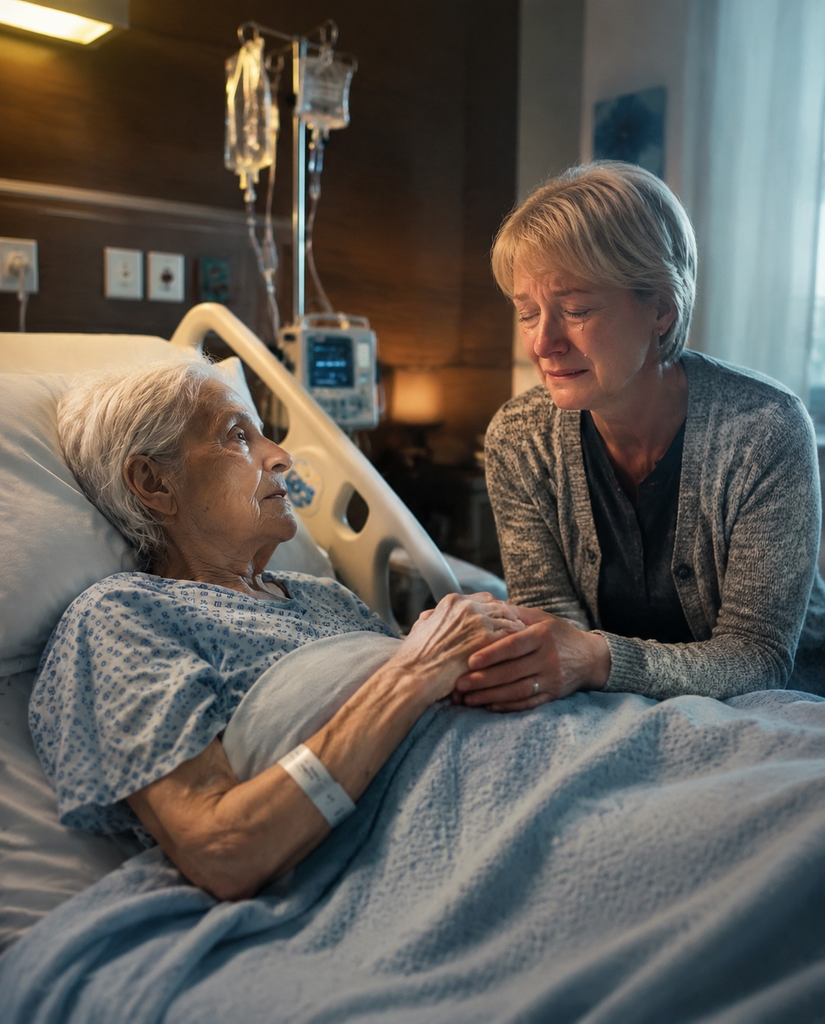
My sister Susan reached down and took hold of my elbow, her fingers digging through the fabric of my black wool trousers.
“Get up off the floor, Clara,” she said.
I did not move. My back was pressed against the lower cabinet where the baking pans were kept, and the wood felt solid behind me.
“The service ended two hours ago,” Susan said, dropping her hand and wiping her palms on her apron. “People will be coming by the house soon with food, and they should not find you sitting on the linoleum.”
“Julian is not back yet,” I said.
She sighed and walked over to the sink, turning the brass tap on and off quickly as if she wanted to wash something but had nothing to clean.
“His flight from Denver was delayed,” she said, her voice dropping to that soft tone people use when they are trying to be patient with a child. “You knew he might miss the burial when he took the trip.”
“He did not answer his phone,” I said. “I called him thirty times while we were standing by the grave.”
Susan turned around, her face pale against the white kitchen cabinets. “He was on a plane, Clara. You cannot get reception at thirty thousand feet.”
I looked at the small black mark on the linoleum near my shoe, wondering how long it had been there.
“There was a strange noise behind him when he answered the last time, before the line cut out,” I said.
“What kind of noise?” Susan asked.
“Like something bubbling,” I said. “A faint, sharp hiss. Like something sliding into a glass.”
Susan did not answer. She crossed her arms, her sweater bunching at her wrists.
“Let me help you up,” she said again.
“I am staying here,” I said.
She stood there for another minute, the silence between us growing heavy. Then she walked out to the hallway to answer the front door, leaving me alone in the kitchen.
I could hear the low murmur of voices from the living room, our neighbors offering their condolences, their voices rising and falling through the plaster walls.
The house grew quiet after the last neighbor left at noon. I stayed on the kitchen floor until the light shifted across the sink, turning the yellow laminate countertops a dull gray.
My hand went into the pocket of my funeral pants, searching for a tissue, and my fingers brushed against a cold piece of metal.
I pulled it out. It was a small silver key, no longer than my thumb, with a tiny circular head.
I had forgotten it was there.
On the floor by the pantry sat the small tin box. It was a green tea canister with a small brass latch on the front, something Evelyn had kept on her bedside table at the nursing home for the last six months.
I had brought it home in a plastic bag with her hairbrush and her lavender soap three days ago, before the room was cleared for the next resident.
I dragged the box closer to me, the tin scraping against the linoleum.
Why had Evelyn insisted I take it before the nurses cleared the room?
The lock on the front was small, barely larger than a button.
I held the key up to the light, looking at the tiny teeth cut into the side.
The house was completely still now, save for the low hum of the refrigerator.
Julian had not called back. I checked my phone on the counter, but the screen remained dark, showing only the time.
I set the key down beside the box and waited, listening to the dry leaves scratching against the back door.
Three weeks before she died, Evelyn had grabbed my hand with a strength that surprised me.
Her fingers were thin, the skin like dry paper, but her grip was tight and desperate, leaving red marks on my wrist.
“Under the handkerchiefs, Clara,” she had whispered, her voice trembling but clear. “The green tin.”
“We can talk about your things later, Evelyn,” I had said, adjusting the blue blanket over her shoulders. “You need to rest.”
“No,” she said, pulling me closer until I could smell the lavender soap on her linens. “He is lying to you.”
“Julian is just busy,” I said, twisting my gold wedding ring around my finger. “His consulting work takes him out of town constantly.”
Evelyn had closed her eyes, a deep line appearing between her brows.
“He is not in Chicago,” she whispered.
“He has a conference there,” I said, wanting her to stop.
“The key is in my blue purse,” she said, her voice fading as she let go of my hand. “Do not let him find it.”
I had found the key in her purse that evening, slipping it into my pocket without thinking much about it.
I had believed she was simply confused, her mind slipping under the weight of her failing health.
Now, sitting on the kitchen floor, I looked at the green tin box again, the brass latch catching the late afternoon light.
The afternoon light was nearly gone when I finally reached for the box.
I picked up the silver key.
If Julian was really delayed by a flight, he would have called the house by now.
The airline would have sent an email, or his assistant would have left a message.
There was nothing.
I held the tin box in my lap, feeling the slight dent on the side where it had fallen once.
“She wanted me to find this, didn’t she?” I whispered to the empty room.
The silver key fit into the small brass lock with a tiny click.
I hesitated, my finger resting on the latch.
Once the box was open, I could not pretend I had not seen what was inside.
I thought of Evelyn’s face in the hospital room, the sorrow in her eyes when I defended her son’s absence.
I turned the key.
The lock gave way, and the lid swung open, revealing a folded piece of white paper.
The small silver key felt cold against my palm as I turned it in the brass lock.
The metal lid of the tin box lifted with a dry scrape against the wood of the kitchen table. Inside lay three sheets of heavy cream stationery, folded in thirds, and a stapled packet of computer paper. The resort logo at the top of the printed sheets was slightly faded, as if the ink on Evelyn’s home printer had been running dry when she pressed print.
I smoothed the first sheet of stationery across the table, recognizing the delicate, slanted loops of Evelyn’s handwriting. She had written in dark blue ink, her letters slightly shaky but perfectly legible.
“My dear Clara,” the letter began. “If you are reading this, I am no longer here to hold your hand, and for that, I am truly sorry. I am even more sorry for what I must tell you.”
My eyes drifted from her words to the stapled packet beneath the stationery. The top page was an invoice from the Whispering Pines Resort in Savannah, Georgia, dated November twelfth of last year. It was made out to Julian Vance, with a room rate of four hundred and eighty dollars a night.
There was a flat charge of thirty-five dollars for a second guest. The second guest was registered under the name Mrs. Julian Vance, but I had spent that entire week in Oakhaven, Ohio, sitting in a vinyl chair at the hospital while Evelyn recovered from her first minor stroke.
My fingers found the gold band on my left hand, twisting it slowly around my knuckle until the skin went white. Julian had called me twice that Thursday night, his voice faint and full of static as he complained about the snow delay at O’Hare airport.
“They have us trapped on the tarmac, Clara,” he had said, his voice dropping into that quiet, patient tone he used when he wanted to calm a client. “The de-icing trucks are backed up for miles. I doubt we will clear the runway before midnight.”
I had told him to get some sleep, to buy a sandwich at the terminal if they let him off, and not to worry about his mother because her vitals were stable. I had sat in the hospital corridor, drinking lukewarm water from a paper cup, feeling guilty that he was working so hard while I was away.
I turned the first page of the printed invoice. The room charges included two entrees of cedar-plank salmon, a side of roasted asparagus, and a bottle of imported sparkling water delivered to the balcony at sunset.
The total bill came to two thousand four hundred and twelve dollars, charged to our joint Visa card, the one we kept for emergency household expenses. I had authorized the automatic payments every month without ever looking at the individual line items, trusting Julian when he said the corporate expenses were always reimbursed within thirty days.
“Clara,” the letter continued on the second page. “I kept silent for months because I wanted to believe he would change. I wanted to believe he was just going through a difficult phase, but when he asked me to help him deceive you while I was lying in a hospital bed, I knew I could not protect him anymore.”
I read the words three times, my thumb tracing the indentations the pen had made on the thick paper. Evelyn had always been a woman of quiet dignity, a retired schoolteacher who valued truth above all else. For her to write these words about her only son must have cost her everything.
I looked at the stapled pages again. Behind the invoice from the resort, there was a copy of an email confirmation. It was a reservation for a double occupancy room with an ocean view. The email was sent to Julian’s personal account, the one he rarely used at home.
The reservation had been made three months in advance, during the hot days of August when we were painting the back porch. I remembered Julian sitting on the porch steps, drinking iced tea and talking about how we should plan a weekend getaway once the autumn leaf-peeping season began.
“We both need a break, Clara,” he had said, smiling as he watched the paint dry on the railing. “Just a few days somewhere quiet, without any phone calls or business emails.”
I had smiled back, touched by his thoughtfulness, but the weekend getaway never happened. Julian said his consulting firm had taken on a new client in Chicago, and he had to work straight through the autumn.
I stood up and walked to the small roll-top desk in the corner of the kitchen, my slippers silent on the linoleum. The third drawer down was where I kept our household records, including the black leather pocket calendars Julian discarded at the end of every December.
I pulled out the calendar from last year, its cover scuffed at the corners, and brought it back to the table. The small desk lamp cast a narrow circle of yellow light over the pages, leaving the rest of the kitchen in deep shadow.
My hands were cold, but my palms felt damp as I flipped the small pages to November.
The block for November twelfth had three words written in Julian’s neat, upright print: Chicago regional conference. Underneath, he had noted a confirmation number for a hotel near the airport and a flight departure time of six thirty in the evening.
The invoice from the Georgia resort showed a check-in time of four fifteen that same afternoon.
I turned the page of Evelyn’s letter, my eyes burning in the dim light as I read her next words.
“He came to see me before he left for that trip,” Evelyn had written. “He asked me to tell you he had stopped by the house to check on the plumbing if you called. I refused, Clara. I told him I would not lie to you anymore.”
I looked at the kitchen clock. It was five past midnight, the silence of the house broken only by the steady, rhythmic hum of the refrigerator.
Julian was supposed to be in Philadelphia on a four-day consulting job, sleeping in a business hotel and calling me between his dinner meetings. I wondered if he was actually in Philadelphia, or if he was somewhere warm, looking out at the water with the woman who had signed in as his wife.
By three in the morning, the cold air from the window had seeped into the kitchen, and I walked down the narrow hallway to the front door. The framed family photographs hung in a straight line along the hallway wall, their glass faces reflecting the faint light from the streetlamp outside.
I stopped in front of the picture we had taken on our fifteenth anniversary in the backyard. Julian was leaning against the wooden railing of the deck, his arm draped loosely over my shoulders, his thick hair slightly windswept. He had that smooth, easy smile that always made people believe whatever he was saying.
I remembered the night he came home from that Chicago trip, carrying a small paper bag with a box of expensive chocolate from the airport gift shop. He had kissed my cheek, his chin rough with stubble, and told me how much he hated the midwestern winters.
“The wind off the lake was brutal, Clara,” he had said, running his hands through his hair as he collapsed onto the living room sofa. “I spent four hours sitting on the tarmac just waiting for the de-icing truck.”
I had made him a bowl of hot soup and rubbed his shoulders while he complained about the corporate budget cuts. I had believed every word, never questioning why his suitcase smelled of lavender soap instead of the usual stale airplane cabin air.
Now, looking at his smiling face in the frame, I felt a strange, hollow sensation in the center of my chest. The man in the photograph was someone I had cooked for, washed clothes for, and lived with for two decades, but he felt like a shadow I had never truly met.
I went back to the hallway, the floorboards cold beneath my slippers. I reached out and touched the frame of our wedding picture. We were so young then, standing on the steps of the Methodist church in the bright June sunshine, surrounded by friends who had since drifted away.
Julian’s father had been gone for years, and Evelyn had been our only remaining link to that early life. She had always been kind to me, treating me like a daughter rather than a daughter-in-law.
I remembered sitting on the edge of her bed at the hospital, holding a cup of cold water for her while she struggled to sit up. She had looked at me with those pale blue eyes, her breath shallow and whistling.“Do not let him make you feel small, Clara,” she had said, her voice a raspy whisper. “You have a good heart. Do not let him use it against you.”
I had thought she was just tired, her mind clouded by the stroke. I had told her to rest, promising that Julian would be there as soon as his meetings were over.
Now, the memory of my own voice defending him made me sick. I had been his shield, his excuse, and his alibi, all while he was spending thousands of dollars on weekend trips to Georgia.
I closed my eyes and saw Evelyn’s face as it had been three weeks ago, propped up against the stiff white pillows at the care facility. The room had smelled of bleach and lavender soap, a clean, sterile scent that could not mask the slow fading of her life.
She had reached out and taken my hand, her fingers surprisingly strong for someone so small. Her grip was tight, almost desperate, as if she were trying to pull herself back into the world through my skin.
“He is not where he says he is, Clara,” she had whispered, her voice trembling but clear.
I had smoothed the hair back from her forehead, thinking her mind was wandering from the medication. “Julian is working, Evelyn. He has a very important project in Boston this week. He will be here on Friday.”
She had looked at me with such deep sorrow that I had to look away. She didn’t press the matter, but she didn’t let go of my hand either.
“He told me your marriage was already over,” she said softly, her blue eyes fixed on mine with a gravity that made me uneasy.
I had laughed it off then, telling her she must have misunderstood a conversation about his long hours. I had defended him, pointing out how hard he worked to pay for her care, while she simply closed her eyes and let out a long, ragged sigh.
“He wanted me to believe that you were the one who wanted to leave,” Evelyn had continued, her voice dropping to a whisper that barely carried across the quiet room. “He said you were tired of the house, tired of Ohio, tired of him.”
I had squeezed her hand, telling her she was getting confused, that Julian loved our home, and that we were fine. I had even told her about the new storm windows we were planning to install in the spring, trying to anchor her mind with ordinary household details.
Evelyn had only shaken her head, her thin lips pressed into a tight line as she turned her face toward the window.
I walked back into the kitchen, the light from the desk lamp casting long, distorted shadows on the wall. I picked up the calendar again, my fingers steadying as I flipped the pages back to September.
On the weekend of September eighteenth, he had written: Detroit merger meeting. On the weekend of October twelfth, he had written: Denver conference.
I looked at the invoices. There were no receipts for Detroit or Denver in the box, but the printed resort confirmation from Savannah was there, clear and undeniable.
I opened my eyes and looked down at the documents spread across the kitchen table. The paper under my hand was real, the printed dates and times cold and unyielding.
I reached for the second page of the resort invoice, searching for the breakdown of the charges. There was a spa treatment, two dinners at the coastal grille, and a bottle of expensive champagne delivered to the room on their first night.
I picked up the black leather calendar again, turning the pages back to the previous summer, then forward to the winter months. Every single business trip he had taken over the past year was noted in his precise handwriting.
The dates on the printed resort confirmation matched the exact weekend he claimed he was stuck in Chicago.
I unfolded the secondary pages. There was a billing statement from a joint account we rarely used, one Julian had suggested we keep for household emergencies. It showed a charge of four hundred and twelve dollars at a boutique hotel on the coast, dated the second Tuesday of October. Underneath it was a printed receipt for a dinner for two, listing oysters and a bottle of Pinot Grigio.
My thumb dragged across the thermal paper, leaving a faint gray smudge. The name on the reservation was Julian’s, but the second guest was listed only as L. Carter. I checked our family calendar on the wall, the one with the pictures of Vermont barns. For those three days, Julian had written Detroit regional conference in his neat, architect-like print.
The hum of the refrigerator seemed louder than usual in the empty house. I reached into the tin box again and pressed my fingers against the bottom to find a sheet of lined paper, written in Evelyn’s fragile, slanted hand.
Clara, the note began, I cannot carry his secrets anymore. He thinks because I am old, I do not see what he has become.
My hands felt cold. I folded the paper back along its original creases, tucking it under the billing statements. Every piece of paper in that box was a tiny, sharp corner of a life I had spent two decades building on empty promises.
There was another receipt from a local jewelry store, dated three weeks before my fifty-fifth birthday. I had received a silver-plated garden trowel that year, wrapped in green tissue. The receipt in the box was for a gold tennis bracelet, purchased on our joint credit card and delivered to an address in Cleveland.
I sat very still, listening to the slow drip of the kitchen faucet. The silence in the house felt heavy, like a physical weight pressing down on my shoulders. I wondered how many times I had stood at this very stove, cooking dinner while he was typing out messages to another woman from a hotel room.
By two in the afternoon, the wind had picked up, carrying the smell of woodsmoke from the houses down the ridge. I carried two heavy green garbage bags down the driveway to the curb, my boots crunching on the dry asphalt.
Dave, our neighbor from across the street, was standing by his mailbox in a thick brown wool jacket. He waved and walked over, his boots making a slow, steady rhythm on the street.
Afternoon, Clara, he said, stopping at the edge of my lawn. I saw the porch light was still on this morning. Julian not back from his trip yet?
I gripped the plastic tie of the garbage bag a little tighter. His flight got delayed. Some weather in the Midwest.
Right, sure, Dave said, rubbing his hands together. They are predicting rain tonight. Let me know if you need help with those gutters before the storm hits. Julian usually gets to them by now.
I think I can manage, I said, keeping my voice level. Thank you, Dave.
He lingered for a second, his eyes shifting to the empty driveway, then back to my face. You look tired, Clara. You getting any sleep since the funeral?
A little, I lied. It just takes time.
He nodded, murmured something neighborly, and began walking back toward his driveway. I watched his retreat, feeling a sudden, heavy distance between myself and everyone else on this street. They lived in a world where husbands went on business trips and came home on Friday nights.
I walked back up the driveway, my chest tight. I wondered if Julian would realize his mother left the tin box behind in her bedroom closet when he finally returned to help clear out her house. He had been so careful to keep her isolated, yet he had left her alone with his secrets.
Back inside, the kitchen was starting to lose the afternoon light. I sat at the table with the tin box under the yellow glow of the stove lamp. Near the bottom of the stack, beneath the receipts, were three pages of printed text messages, dated from the previous winter.
The first exchange was from Julian to his mother.
She is asking where I am, Julian had written. Tell her I called you from the tarmac in Denver. Tell her the reception was bad.
Evelyn’s reply was short. I will not lie to Clara again, Julian. She was here for three hours helping me with my breathing treatment while you were gone.
It is one time, Mom, his next message read. Just tell her we spoke. I need this
I stared at the words until the letters blurred. He had used his dying mother to shield his absences, turning her quiet house into a fortress for his lies. Evelyn had kept these printouts, saving the evidence of her own son’s actions like a collection of unpaid debts.
Why had she kept them? Perhaps she wanted to protect herself, or perhaps she knew that one day, I would be the one sitting at this table, looking for the truth.
The kitchen clock ticked against the wall, a sharp, metallic sound that seemed to mark the seconds of my old life running out. I gathered the papers, stack by stack, and placed them back inside the metal container. The lid closed with a quiet, hollow snap.
The law office of Martha, my family law attorney, sat in a quiet strip mall between a dry cleaner and a vacant storefront with faded blue paint. The sign on the glass door simply read, Martha, Family Law.
The waiting room smelled of old paper and carpet cleaner. A single fluorescent bulb flickered overhead, casting a pale, cold light on the low chairs.
Martha, a woman of fifty-nine with sharp eyes and silver-streaked hair, sat behind a dark wood desk cluttered with tall stacks of manila folders. She didn’t look up immediately when I sat down, instead finishing a line on a yellow legal pad.
We need to be precise, Clara, she said, tapping her gold-rimmed reading glasses against her notepad as she focused on me. Divorce in this state is a matter of numbers and dates, not feelings.
I have these, I said, placing the first four pages of the resort receipts and the copies of Julian’s text messages on the polished wood between us.
She picked them up, her eyes moving quickly down the columns of numbers. She did not look surprised; her face remained entirely neutral, a mask of professional weariness earned from decades of watching marriages dissolve.
This is a joint account, Martha said, pointing to the header on the resort statement. He used household funds for these trips?
Yes, I said. He told me the account was for emergencies.
We can trace every dollar, she said, leaning back in her leather chair. If he was using marital assets to support another relationship, the court will take that into account during the division of the property. But we need the full history.
He is coming back tomorrow night, I said, my voice barely above a whisper. He thinks I am still waiting for him. He has no idea I found the box.
Martha set her glasses on the desk with a quiet click. I need to know what my options are before he walks through that door.
Your options are simple, Martha said, her tone steady and reassuring. We can file quietly, or we can wait until we have a full accounting of the joint travel expenses. But once he knows you have this, he will try to move the money.
I don’t want a scene, I said. I just want to leave.
We will do this quietly, she agreed. But you must act as if nothing has changed until the papers are ready to be served. Can you do that, Clara?
I looked at the documents on her desk, the neat columns of figures that had dismantled my entire life in the space of a single morning.
I folded the copies of his text messages and slid them into my purse, my hands shaking.
The sweep of high beams cut across the kitchen window, casting the shadow of the maple tree against the refrigerator.
The gravel in the driveway crunched under the tires of his sedan.
I stayed on the kitchen chair, my fingers still resting on the leather of my handbag where the folded papers were tucked away.
The engine died, and the headlights flickered off, leaving the room in the gray twilight of a late autumn evening.
Julian took three minutes to open the trunk, retrieve his garment bag, and walk up the back steps.
He pushed the door open, carrying the heavy smell of peppermint soap and the bitter scent of airport coffee into the warm kitchen.
“Clara,” he said, setting his leather bag on the linoleum. “The roads out of O’Hare were a complete parking lot.”
He did not reach for me, but he leaned in close enough for me to see the neat trim of his hair and the small, dark luggage tag hanging from his zipper.
“Your mother was buried at eleven o’clock this morning,” I said.
Julian ran both hands through his thick hair, pushing it back from his forehead before he looked down at his shoes.
“I know,” he said. “I tried to call the funeral home from the gate in Chicago, but the reception was down in that terminal.”
“You did not call the funeral home,” I said.
He reached into his pocket and pulled out his phone, tapping the screen with his thumb before holding it out toward me.
“The battery died just after we boarded,” he said. “I didn’t have the right adapter for the seat outlet.”
I reached into my pocket and took out my own phone, setting it flat on the wooden table between us.
The screen lit up, showing the log of thirty calls I had placed over forty-eight hours while Evelyn lay in her bed at the hospice facility.
“Thirty times,” I said.
Julian glanced at the glowing screen, then looked toward the hallway, his shoulder twitching slightly.
“Clara, you have to understand the pressure I was under with this client,” he said. “The regional VP was in the room the entire afternoon.”
“The hospital called me at three in the morning on Thursday,” I said. “They said her breathing had changed.”
“You should have found a way to reach me,” he said.
The words sat in the space between us, heavy and cold, while the refrigerator hummed in the corner.
He reached for the kettle on the stove, his fingers touching the handle before he realized it was cold.
“I called your office in Chicago,” I said. “They said the project in Rosemont ended on Tuesday.”
Julian did not drop his hand from the kettle, but his thumb remained pressed against the metal band.
“The office doesn’t keep track of the regional site visits,” he said. “We had to move the meetings to a hotel conference room near the airport.”
He turned back to face me, his face smooth, his eyes wide with the steady, practiced sincerity he used when a contract was falling through.
“It was a logistics nightmare, Clara,” he said. “I was running on two hours of sleep.”
“Evelyn kept her eyes on the door until ten o’clock that night,” I said. “She didn’t speak, but she kept looking.”
Julian took a step toward me, his hand reaching out as if to touch my arm, but he stopped when I turned my gold wedding ring around my finger.
“I wanted to be here,” he said. “You know how much I wanted to be here for her.”
“I know exactly where you were,” I said.
He laughed, a short, dry sound that had no humor in it, and leaned his hip against the counter.
“I was in a mid-range hotel off Interstate 90, eating cold sandwiches and trying to save a six-figure account,” he said.
I did not look at him, keeping my eyes on the white ceramic urn resting on the shelf by the pantry.
“The airline said there were no delays on the afternoon flight from O’Hare,” I said.
“They change the flight numbers when they merge the regional carriers,” he said. “It’s a technicality, Clara.”
“There was no delay,” I said.
He crossed his arms, his mouth tightening into a thin line as he looked at the small tin box sitting on the table near my purse.
“What is that?” he asked.
The silver key was still sticking out of the lock, the small metal ring catching the light from the stove bulb.
“Evelyn wanted me to have it,” I said.
Julian stepped closer, his eyes fixed on the green painted metal of the box, his hand dropping to his side.
“That’s my father’s old cash box,” he said. “It was supposed to be in the attic at the family house.”
“It wasn’t in the attic,” I said.
“She was confused at the end, Clara,” he said, taking another step. “She was giving away things that didn’t belong to her.”
He reached his hand out toward the table, his fingers extending toward the small silver key.
I closed the lid of the tin box before his fingers could touch the silver lock.
The silence in the kitchen stretched until Julian pulled his hand back, his knuckles brushing the edge of the kitchen table. He looked at the tin box, then at the pocket of my cardigan where my fingers still held the key.
“You should get some sleep,” he said, his voice dropping into that quiet, rhythmic tone he used when a client was losing their temper. “We can talk about the estate details tomorrow.”
I did not answer him, and I did not move from the chair until I heard his footsteps fade down the carpeted hallway toward the guest room.
By nine the next morning, the wind was blowing the dry oak leaves across the asphalt parking lot of the suburban strip mall. Martha’s office smelled of old paper and carpet cleaner, a sharp contrast to the lavender soap that still clung to my own clothes.
Martha sat behind her desk, tapping her gold-rimmed reading glasses against a yellow notepad. She had a thick manila folder open between us, the edges of the pages slightly curled.
“The house in Oakhaven is the primary asset,” Martha said, her voice dry and perfectly even. “Since the deed is in both your names, the court will look at a standard division, but we need to address Julian’s consulting accounts first.”
“He told me those accounts were locked in a five-year corporate retention plan,” I said.
Martha did not look up from her notes, but her glasses made a sharp click against the wood. “There is no such thing as a locked retention plan that prevents a marital audit, Clara.”
She slid three stapled pages across the desk toward me, the text crowded with columns of figures.
“This is the draft of the petition,” she said. “It requests a full accounting of all travel expenses from his joint account over the last twenty-four months.”
I looked at the bold lettering at the top of the page, my own name typed in capital letters next to his.
“I also called the crematorium this morning,” Martha added, her tone softening just enough for me to notice. “They said the white ceramic urn with Evelyn’s ashes is ready for pickup.”
“I will go get her tomorrow,” I said, my voice barely louder than the hum of the small space heater under her desk.
“Take these draft papers with you,” Martha said, sliding the folder into a large green envelope. “Do not leave them where he can find them, but read every page before you sign the retainer.”
The envelope was heavy in my lap as I drove back to the house, the gray sky hanging low over the state route.
When I walked through the back door, the kitchen smelled of fresh coffee, a scent that had been missing from our mornings for months. Julian was standing by the sink, carefully wiping the counter with a clean dishcloth.
“I bought the dark roast you like,” he said, pointing to the ceramic mug sitting on the counter. “I thought you could use a break from the instant stuff.”
He had already cleared the breakfast dishes, stacking them neatly in the drying rack.
“Thank you,” I said, keeping my purse on my shoulder so he wouldn’t see the outline of the green envelope.
“I can run down to the grocery store on Route Four this afternoon,” he said, turning to face me with a quick, helpful smile. “We need milk, and I noticed we were low on those apples you like.”
He had not offered to do the grocery shopping since the winter we remodeled the upstairs bathroom.
“I have some things to take care of in the bedroom first,” I said, moving past him toward the stairs.
“Clara,” he called out, his voice smooth and steady. “I asked the neighbors if they needed anything while I was out.”
I stopped on the third step, looking down at him as he stood by the refrigerator.
“Which neighbors?” I asked.
“Dave and Sarah,” he said, running both hands through his thick hair. “Just trying to help out around here.”
I went upstairs without replying, my boots heavy on the wooden treads.
In our bedroom, I opened the bottom drawer of my oak dresser, sliding the green envelope beneath a stack of winter sweaters. The wood of the drawer gave a dry creak as I pushed it shut.
By six in the evening, the house had grown cold, the thermostat clicked off to save on the heating bill. Julian had set two plates of chicken and rice on the dining table, though neither of us had touched the food.
“The air is supposed to drop below freezing tonight,” he said, staring at his fork. “We should think about getting away for a few days.”
“A trip?” I asked.
“Just up to the lake, or maybe further south where it is warmer,” he said, leaning forward. “We have twenty years of history to consider, Clara.”
I reached down and twisted my gold wedding ring around my finger, the metal feeling tight against my skin.
“We cannot leave while the probate court is waiting on the estate files,” I said.
“The lawyers can handle the paperwork without us standing over them,” he said, his voice rising slightly in that fast, persuasive cadence. “We need to clear our heads after everything with my mother.”
He reached across the table, his hand resting near my water glass, his fingers completely still.
“Evelyn would have wanted us to move forward,” he said.
“Evelyn wanted many things that did not happen,” I said.
Julian withdrew his hand, his eyes narrowing slightly before he picked up his water glass.
“I am only trying to find a way for us to talk without all this weight in the house,” he said.
I stood up from the table, leaving my plate untouched, and walked down the short hallway to the bedroom.
The room was dark except for the streetlight shining through the bare branches of the maple tree outside. I did not turn on the lamp as I walked over to the dresser.
I pulled the bottom drawer open, the scent of lavender and cedar rising into the cold air of the room. I reached beneath the wool sweaters and pulled out the green envelope.
The drafted petition was cold in my hands as I sat on the edge of the mattress, the paper rustling in the quiet house. I turned to the final page, where a line was marked with a small yellow arrow.
Below the arrow, the black ink of my signature would mean the end of the house, the end of the shared accounts, and the end of the life I had known since I was thirty-six.
From the hallway, I heard the faint sound of Julian opening the hall closet, the wooden hangers clinking against one another.
I took the ballpoint pen from my nightstand and held it over the paper, my thumb pressing against the plastic cap.
The streetlights cast long, thin shadows across the carpet, shifting slightly as the wind shook the windowpane.
I stared at my signature on the retainer agreement, realizing there was no turning back.
The next morning, the smell of hazelnut coffee drifted into the hallway before I had even finished buttoning my cardigan. It was a sweet, heavy aroma that Julian only bought when he felt he had something to make up for, a habit he had started years ago during his first major promotion struggle at the consulting firm.
I found him standing by the kitchen island, already dressed in his blue Oxford shirt and his good trousers, looking as if he were preparing for an important presentation. He had two matching ceramic mugs sitting on the marble counter, steam rising from both of them in thin, straight lines.
“Morning, Clara,” he said, pushing one of the mugs toward my side of the counter. “I got up early and drove down to the bakery on Tenth Street. I thought we could use a quiet start to the day.”
“Thank you,” I said, taking my seat on the high wooden stool.
The mug was hot against my palms, but I did not drink from it immediately. I watched the way the white cream slowly swirled into the dark liquid, forming patterns that quickly dissolved into the brown circle.
“I was looking through some of my mother’s old estate letters last night,” Julian said, leaning back against the sink with his hands in his pockets. “She had so many thoughts about how we should manage the house in Oakhaven. She always wanted us to keep it as a core asset.”
“She didn’t mention that to me during her final weeks,” I said, keeping my voice quiet.
Julian nodded, his voice dropping into that smooth, persuasive register he used for nervous corporate clients. “She was traditional about those things, Clara. She believed a family home is an anchor for our partnership. She loved you, and she always said you were the one who kept our lives consolidated.”
“She was a practical woman,” I said, my thumb slowly tracing the dry rim of my mug.
“Exactly,” he said, taking a slow sip from his coffee. “And she would want us to be practical now. This estate business, the probate court, it is going to be a lot of noise. But if we present a unified front, we can mitigate the risk of any outside interference. I only want what is best for us, Clara.”
I looked at his smooth forehead, his thick hair combed perfectly back without a single strand out of place. He spoke with such easy conviction that for a second, I could almost believe he was the same man I had lived with for twenty years.
“We have to follow the legal steps, Julian,” I said, setting my mug down on the counter without tasting the sweet coffee.
“Of course,” he said, walking over to press his hand briefly against the back of my neck. “But we manage the process. We don’t let the process manage us.”
By three in the afternoon, the winter sky had turned the color of wet asphalt, throwing a grey shadow across the living room carpet. Julian came down the stairs carrying a small wooden box with a brass latch, his leather-soled shoes making a sharp, rhythmic sound on the wooden steps.
He joined me in the living room, where I was folding the clean sheets from the laundry basket on the armchair. He sat on the edge of the sofa and placed the box on the low coffee table between us.
“Look what I found in the bottom drawer of the study,” he said, lifting the latch with his thumb. “I forgot we even kept these in the house.”
He pulled out a silver-bordered photograph and held it out toward me, the glass catching the pale, cold light from the window. I did not take it, so he placed it gently on top of a folded bath towel in my lap.
It was a picture from our tenth anniversary trip to the cabin in Vermont. We were standing by the edge of the lake, the water behind us reflecting the yellow and orange leaves of early October.
“You wore that green jacket every day of that trip,” Julian said, a soft smile appearing at the corners of his mouth as he looked at the photo. “We didn’t have a working heater in the cabin, and we had to keep the fireplace going all night just to keep from freezing.”
“The wood was wet,” I said, looking down at the young woman in the photograph who was laughing so easily. “We spent three hours trying to get it to light.”
“But we did it,” he said, leaning closer so his shoulder brushed mine. “We always figured out how to maximize our resources, Clara. We have twenty years of history to consider, and we never let the small things disrupt our alignment. We shouldn’t start doing that now.”
“A lot has changed since Vermont, Julian,” I said, lifting the photograph by its metal edges and placing it back on the wooden table.
“It doesn’t have to,” he said, his voice quiet and steady. “We can go back there this spring, right after the probate hearing is settled. Just the two of us, with no phones, no work, and just some time to reinvest in our relationship.”
I folded another pillowcase, smoothing the corners with the heel of my hand until they were perfectly square. “I don’t think a trip is what we need right now.”
“Think about it,” he said, his eyes staying on my face as I stood up with the laundry basket. “For my mother’s sake, if not for ours. She would hate to see us wasting what we’ve built.”
I did not answer him as I carried the heavy basket out of the room, the weight of the plastic handles digging into my fingers.
By seven in the evening, the wind had begun to hurl dry twigs against the kitchen windows, making a light tapping sound. Julian had offered to make dinner, and the smell of roasting garlic and rosemary filled the warm air.
He was standing by the stove, using a silver spoon to baste two chicken breasts in a small copper pan. He looked completely relaxed, almost happy, humming a tune under his breath as he worked.
“I called the airline again today about that lost mileage credit from my December trip,” he said, turning the chicken over with a pair of tongs.
“Did they find it?” I asked, sitting at the kitchen table with a stack of unpaid bills.
“They did,” he said, wiping a splash of grease from the stovetop with a paper towel. “It was a mess because of that delay at O’Hare. We were sitting on the runway in Chicago for four hours because of the ice storm before they finally taxied us back to gate B twelve.”
I stopped sorting the envelopes in my hand. “Gate B twelve?”
“Yes,” he said, turning to look at me with a smile. “They wouldn’t even let us off the plane to stretch our legs. I had to sit there in seat twelve C, listening to some guy complain about his luggage. I told you, it was the worst delay I’ve had all year.”
I looked down at the bill for the water district, my thumb tracing the blue emblem on the corner. On the night of his flight delay, I had stayed up until three in the morning, checking the weather radar and the flight trackers on my tablet.
O’Hare airport had been completely shut down by three in the afternoon that day due to a blizzard, and no domestic arrivals had been permitted on the tarmac after four. More importantly, the resort confirmation receipt I had found in Evelyn’s tin box showed that Julian’s return ticket was a direct flight from Savannah to Columbus, with no connection through Chicago at all.
“You must have been exhausted,” I said, my voice barely louder than the sizzle of the pan.
“I was,” he said, turning back to the stove to turn down the flame. “But I’m just glad to be home now. That’s what matters.”
I slid the bills back into their neat stack, my fingers cold against the paper. The lie was so small, so casually delivered, that he didn’t even realize he had crossed his own stories.
He had forgotten that he told me he spent the night in a hotel near the airport, yet now he was claiming he had been stuck on the tarmac for four hours. He was weaving his details out of old business trips, mixing up the gates and the cities because he assumed I would never look closely enough to see the gaps.
“Dinner is almost ready,” he said, setting two plates on the island. “Do you want a glass of white wine?”
“No,” I said, standing up from the table. “I think I’ll just go upstairs and wash my face before we eat.”
“Don’t be long,” he said, his voice warm and inviting. “It’s best when it’s hot.”
I walked up the stairs in the dark, not turning on the hall light. The house felt incredibly quiet, the only sound being the low hum of the refrigerator below.
In our bedroom, I closed the door until I heard the latch click into place. I did not turn on the bedside lamps.
I walked over to the cherrywood dresser and pulled open the middle drawer, reaching beneath my winter sweaters to touch the thick, white envelope containing Martha’s draft of the divorce papers. I pulled it out, the legal bond paper heavy in my hands.
The draft was fifty pages long, detailing the division of the house, the retirement accounts, and the savings Julian thought he had successfully hidden.
Downstairs, I heard the faint clinking of silverware against ceramic as Julian set the table. He was still downstairs, still playing the role of the devoted husband who had returned from a difficult journey to take care of his wife.
I held the envelope against my chest, my eyes adjusting to the shadows in the room. The warmth he had shown me all day was nothing but a performance, a calculated attempt to soften me before the probate court forced him to reveal his mother’s assets.
He didn’t want a divorce because a divorce would mean an audit of our joint accounts, revealing the thousands of dollars spent on resort hotels and dinners for two.
The bedroom door creaked open, and Julian’s silhouette appeared in the warm light from the hallway. He was holding a glass of water, his silver wedding band gleaming in the dim light.
“Clara?” he said, stepping into the room. “The food is getting cold. Are you alright in here?”
“I’m fine,” I said, sliding the envelope back into the drawer and closing it with a soft click. “I just needed a moment.”
He walked closer, setting the glass of water on the nightstand, and reached out to touch my shoulder. His thumb rubbed the fabric of my sweater in a slow, familiar circle, the same gesture he had used for years to quiet my worries.
His hand felt warm on my shoulder, but all I could think of was the resort bill in my purse.
I pulled away from his touch, pretending to reach for the kettle on the stove.
“I need to rinse these cups before we go to sleep,” I said, keeping my voice as level as I could.
Julian let his hand drop to his side. “Of course. Don’t stay up too late, Clara. You look pale.”
He turned and walked out of the kitchen, his steps light and easy on the stairs. I stood by the sink and watched the water run over my fingers, warm and then cold, until the pipes upstairs stopped rattling.
The next morning, the house was empty by half past seven. Julian’s car was already gone, leaving only two dark tracks on the wet gravel of the driveway from the early morning fog.
I sat at the kitchen table with a single piece of dry toast on a blue plate. The hum of the refrigerator was the only sound in the room, steady and relentless.
My phone sat on the place mat next to my plate, its screen dark.
I reached into my cardigan pocket and felt the small silver key, its metal edge pressing into the pad of my thumb. It was the only thing that felt real in the quiet house.
At nine o’clock, the phone vibrated against the wood of the table.
The screen lit up with a number I did not recognize, showing a Florida area code followed by seven unfamiliar digits.
I did not pick it up. I watched the screen fade back to black, but a second later, the phone buzzed again.
A text message appeared on the lock screen.
“Are you Clara?” the message read.
I picked up the phone, my thumb hovering over the screen for several seconds. My hand did not shake, but my fingers felt heavy.
I typed a single word in reply.
“Yes.”
I set the phone back on the table and waited. The clock on the microwave changed from 9:02 to 9:07 before the screen lit up again.
“My name is Laura,” the text said.
I stood up from the table, leaving the plate and the uneaten toast behind. I carried the phone into the living room, where the pale winter light was beginning to touch the edges of the furniture.
The room was perfectly neat, every cushion in its place, smelling faintly of the lavender polish I had used on the sideboards. It felt like a stage set after the play had ended.
I sat on the edge of the sofa, my back straight.
Another message appeared, longer this time, the words scrolling up the screen as I watched.
“I think we need to talk about Julian,” she wrote.
I did not type a reply. I sat in the quiet room and waited for her to continue.
“I found your number in his old leather travel journal,” the next message said. “The one he keeps in his briefcase.”
The gray bubbles at the bottom of the screen bounced, disappeared, and then returned.
“He told me you were separated,” Laura wrote. “He said you had been living as roommates for years.”
I looked at the framed photograph on the side table, taken during our trip to the lake five years ago. We were standing by the water, Julian’s arm wrapped tightly around my waist.
“He told me the marriage was just a legal arrangement,” the text continued. “He said you both agreed to keep up appearances so his mother wouldn’t suffer.”
I touched my wedding ring, turning the gold band slowly around my finger.
“But I found the letters his mother wrote to him,” Laura wrote. “He kept them in his desk drawer at his office. I know the truth now.”
The silence in the living room felt heavy, pressing against my ears.
“What did the letters say?” I typed back.
The reply came after a long pause, as if she were choosing every word with extreme care.
“She knew about us,” Laura wrote. “She found out last summer when he used her address to receive some mail from the resort.”
I remembered the sudden change in Evelyn last August, the way she had stopped asking about Julian’s business trips and how she had looked at him with a quiet, steady anger during our Sunday visits.
“She told him she would not lie for him anymore,” the message read. “She became dangerous to him because she refused to keep his secrets.”
I stared at the screen, the pieces of the past year shifting into a new, cold shape.
“He wanted her to tell you he was staying at her house when he was really with me,” Laura wrote. “She told him she was going to call you herself if he didn’t stop.”
That was why he had stopped visiting her. It was not because he was too busy with his corporate consulting or because her failing health was too difficult for him to witness. He was hiding from her honesty.
I stood up and walked back to the kitchen, the linoleum cold beneath my thin socks.
“There is more,” the next message said.
I stood by the counter, my hand resting on the cool laminate near the sink.
“He told me you always panicked when his mother had a bad day,” Laura wrote.
I did not breathe as I read the next line.
“He said you were unstable,” the text read. “He told me you hysterically called him dozens of times over nothing.”
I remembered the hospital room, the smell of antiseptic, the sound of the heart monitor slowing down, and my own finger pressing the redial button on my phone thirty times while Julian’s phone rang in the distance.
“He said you had panic attacks,” Laura wrote. “He told me he had to turn his phone off during our resort trips just to protect his own peace of mind.”
The thirty unanswered calls while Evelyn was dying had not been missed because of a bad connection or a flight delay. He had turned his phone off because he had convinced another woman that his wife’s desperate calls were merely the actions of an unstable woman.
“He told me you always panicked,” I whispered to the empty room.
The image of Julian sitting by a pool, sliding his phone into his pocket while I begged him to come home to his dying mother, sat before me with terrible clarity.
The phone buzzed one last time.
“I am sorry,” Laura wrote. “I did not know any of this.”
I did not reply. I set the phone on the kitchen counter, next to the glass of water I had poured but never drank.
The clock on the wall read two in the afternoon. Julian would not be home from his meeting until at least seven.
I walked slowly up the stairs to our bedroom.
The room was clean and bright, the white duvet smoothed over the mattress. I pulled two large, dark blue suitcases from the top shelf of the closet and laid them open on the bed.
I did not take the silver picture frames or the decorative glass bowls we had collected over two decades. I did not take the winter coats we had bought together in Chicago.
I packed six of my sweaters, four pairs of trousers, and my sturdiest walking shoes.
I walked down to the kitchen, picked up the small tin box and the silver key, and carried them upstairs. I tucked them carefully between the layers of my folded shirts.
I looked at the matching nightstands, the neat piles of books, the brass lamps. There was no need to write a note. There was nothing left to say that could be understood by a man who had turned his mother’s death into a convenient excuse.
I closed the lids of the suitcases and pulled the heavy brass zippers shut, the sound sharp and final in the quiet room.
The final illusion of my marriage crumbled with a single text message from a woman I had never met.
I carried the heavy blue suitcase down the narrow hallway myself, the wheels catching on the warped edge of the floor. The driver had charged me forty-one dollars for the single taxi ride from the house, and he did not offer to help with the stairs.
The key to unit 3B was brass and had a yellow plastic tab with the number hand-written in black marker. It took three tries to get the deadbolt to turn in the warped wooden frame.
Inside, the air smelled of stale paint and pine-scented cleaner. I set my bags down in the middle of the small room, where a brown corduroy armchair sat under a single window.
My fingers went to my left hand, twisting the gold wedding ring around my finger until the skin turned red. I had not called my sister Susan or told anyone the address of this place.
The landlord had promised the building was quiet, but the sound of someone walking on the floor above made the glass dome of the ceiling light rattle. I sat down on the larger suitcase and did not unzip it.
The walls were painted a dull beige that seemed to absorb the fading evening light. It was only six miles from the old driveway in Oakhaven, but the distance felt absolute.
I stood up and dragged the largest suitcase toward the bedroom. The door to the bedroom was painted white, but the paint had chipped around the brass knob, showing the dark wood beneath.
The closet was empty, save for three wire hangers that clinked together when the draft from the hallway hit them. I left my clothes inside the suitcase, keeping the lid open like a low dresser.
A single streetlamp flickered to life outside, casting long shadows across the bare floorboards. I stood up to explore the small kitchen, which was separated from the main room by a low counter.
The yellowed laminate on the countertop was lifting at the corners, exposing the gray particleboard underneath. In our old kitchen, the granite countertops were dark and cool, and I had spent three months choosing the exact shade of grey for the subway tile.
Here, a single metal sink held a brown water stain around the drain. I turned the cold tap, and the pipes shuddered behind the wall before a thin stream of rusty water sputtered out.
I opened the small refrigerator, and the high-pitched hum of the motor filled the silence. There was nothing inside but an empty ice tray and a yellow baking soda box left by the previous tenant.
My hand hovered over the wire shelf before I closed the door. The magnetic seal was weak, requiring a firm push to make it click shut.
I needed to buy milk, bread, and perhaps some tea, but the thought of walking down the three flights of stairs to the grocery store on the corner felt impossible. My coat remained buttoned to my chin.
I leaned against the counter, looking out the small kitchen window at the alleyway below. A blue plastic recycling bin sat overturned near a pile of wet cardboard boxes.
I had left behind the copper pots we bought in France, the solid oak dining table, and the quiet garden where the hydrangeas were just beginning to dry. Those things belonged to a life I had agreed to live, but they were no longer mine.
The silence here was different, punctuated by the hum of the old refrigerator and the occasional horn from the street. It was a cold silence that did not offer any comfort.
This was the space I had traded for my peace, a rented room where nothing belonged to me. The realization of leaving my beautiful family home and the comfortable life I had built was a cold weight.
I went back to the suitcase, unzipped the front pocket, and pulled out the white ceramic urn. I set it carefully on the small wooden shelf beside the door.
Evelyn would have understood this room, though she would have disliked the draft coming from the window frame. I touched the cold ceramic side of the urn and whispered her name.
The phone in my pocket vibrated, a short double pulse that signaled another voicemail. I did not want to look at the screen, but the blue light persisted in the dimming room.
By nine o’clock, the apartment had grown cold, and I had to search the drawers for the thermostat. It was a round plastic dial on the wall, painted over so many times that the temperature numbers were barely visible.
I clicked it to seventy and waited for the metal radiator in the corner to hiss. When it finally clanked to life, it smelled of hot dust and scorched iron.
I pulled a gray wool blanket from the smaller suitcase and wrapped it around my shoulders. The corduroy chair was stiff, forcing me to sit upright with my knees close together.
My phone lit up again on the kitchen counter, its screen casting a pale square on the yellow laminate. It was the eleventh notification of the night.
I walked over and picked it up, my thumb hovering over the play button on the screen. The voicemail was forty seconds long, recorded just ten minutes prior.
Julian voice came through the speaker, tight and high, stripped of his usual corporate confidence.
“Clara, this is ridiculous,” he said, his breathing heavy as if he were walking while speaking. “You cannot just disappear without a word. The neighbors saw a taxi here.”
I held the phone close to my ear, listening to the background noise. There was no sound of pouring champagne this time, only the dull hum of his car engine idling.
“You are abandoning me when I need you the most,” he said, his voice dropping into a flat accusation. “We have things to settle, and you are acting like a child.”
The message ended with a sharp click as he cut the connection. I stood in the small kitchen, holding the phone until the screen went black.
He did not know about the apartment, and he did not know about the silver key still tucked into my purse. He was likely sitting in the empty house on Oakhaven, looking at the space where my suitcases had been.
I deleted the message, the small trash can icon on the screen flickering for a second before the screen cleared. The log showed ten other missed calls from him since three o’clock.
The silence returned, heavier now that the radiator had stopped clanking. I walked back to the living room area and stared at the cardboard box I had carried under my arm.
Inside was the tin box, its silver lock dull under the single light bulb. I did not want to open it tonight, but its presence on the low coffee table felt like an anchor.
I lay down on the small sofa, keeping my boots on in case I needed to leave. The fabric smelled of dry cleaning fluid and old dust.
Sleep did not come easily, only fitful drifts where I dreamed of the old house and the sound of Julian car in the driveway. Every time a car passed on the street below, I tensed, waiting for the sound of tires on gravel.
But there was no gravel here, only asphalt and the occasional shout of someone walking home from the bar on the corner. This was the city, and I was just another face behind a lighted window.
By five morning, the gray light of dawn was pushing through the thin curtains. I sat up, my back aching from the thin cushions of the rented sofa.
I walked to the window and looked out at the street. A delivery truck was unloading crates of vegetables outside the grocery store, the driver whistling a quiet tune.
At fifty-six, my life was contained within these four walls and three bags. The house on Oakhaven, with its three bedrooms and manicured lawn, belonged to a woman who no longer existed.
I went to the bathroom and splashed cold water on my face. The mirror above the sink was small and spotted with silver rot at the edges, reflecting a tired face with graying hair.
I had no office to go to, no schedule to keep, and no husband to prepare breakfast for. The empty day ahead felt vast and terrifying.
I opened my purse and pulled out the legal folder Martha had given me. The white sheets of paper were crisp and clean, a stark contrast to the worn surfaces of the apartment.
I laid the papers on the small kitchen table, aligning the edges with the laminate border. There was a space at the bottom of the last page for my signature, a line that would change everything.
I took a pen from my purse and set it beside the folder. My fingers were still twisting the gold band on my ring finger, a habit I could not seem to break.
The phone lit up again, this time with a text message from Julian. It read: “Tell me where you are, Clara. This is your last chance.”
I did not reply, setting the phone face down on the counter. The red notification light continued to blink against the laminate, casting a tiny, rhythmic shadow.
I went to the bedroom, where the double bed was covered in a simple brown bedspread. The mattress was thin, the springs squeaking when I pressed my hand against the center.
This was where I would sleep tonight, and the night after that, until the lawyers finished their work. The quiet of the room was different from the silence of the old house; it was a waiting silence.
I reached into my pocket and felt the silver key, its metal cold against my skin. It was the only thing that connected me to the truth Evelyn had left behind.
The road ahead was narrow and unclear, but the alternative was a return to a house built on lies. I stood by the bed, listening to the city wake up around me.
The delivery truck doors slammed shut below, followed by the roar of the diesel engine as it pulled away. I sat on the edge of the unfamiliar bed, listening to the traffic on the street below.
The phone on the laminate nightstand buzzed again, vibrating against the cheap wood until it slid two inches to the left.
Julian’s name appeared across the screen for the fifth time since six o’clock.
The preview of the message showed only the first few words, asking where I had gone and who had helped me move my things.
I did not open it.
Instead, I tapped his name, scrolled past his corporate contact details, and selected the option to block his number.
The screen went black, leaving only my own reflection in the dusty glass.
The small bedroom was silent now, save for the rhythmic, metallic hum of the refrigerator in the kitchen.
I stood up and walked into the short hallway, my socks sliding easily on the worn linoleum floor.
On the kitchen counter, next to a box of saltine crackers, sat the remainder of the cash from the taxi ride, now just three crumpled singles and some loose change.
The small space smelled of fresh paint and the pine cleaner the landlord had used to wash the cupboards before I signed the lease.
Another message had come through just before I blocked him, a short demand about the probate court hearing for his mother’s estate.
He had written that we needed to coordinate our statements before the court date in four weeks, as if we were still a team working toward a shared goal.
I sat at the small laminate table and looked at the yellow envelope Martha had given me.
The paper was thick and heavy, containing three copies of the draft separation agreement.
I did not open the envelope yet.
I merely rested my hand on it, feeling the stiff corners through the paper.
Susan arrived at noon, carrying two cardboard boxes from the local grocery store and a paper bag that smelled of sliced turkey and rye bread.She set the boxes on the table with a dull thud and immediately began organizing the small pantry shelves.
“The landlord said the radiator in the hall gets loud in January,” Susan said, handing me a jar of peach preserves.
“It was humming last night,” I said, placing the jar on the lower shelf.
“We can get a thick rug for the floor,” she said, looking around the small kitchen. “Something to keep the drafts from coming up through the floorboards.”
She did not ask about Julian, nor did she mention the old family home in Oakhaven.
Instead, she took my heavy winter coats from the suitcase and began hanging them in the shallow closet near the entrance.
One of the plastic hangers snapped in her hand with a sharp, clean crack.
“I have three more of these in my car,” she said, holding the broken pieces.
“Don’t worry about it,” I said, setting the loaf of bread next to the preserves.
“Clara,” she said, her voice dropping as she looked at my left hand. “Have you spoken to him at all today?”
“I blocked his number this morning before breakfast,” I said.
She nodded slowly, then reached into her pocket and pulled out a small brass ring with two silver keys on it.
“These are for the deadbolt,” she said, placing them on the table near the bread. “I had the hardware store on Broad Street cut them before I came over.”
“Thank you,” I said.
“He called my house twice last night,” she said, wiping her hands on her apron. “I didn’t answer.”
“Did he leave a message?”
“Just that he was trying to locate you,” she said. “He sounded more annoyed than worried.”
She went back to the boxes, pulling out a carton of eggs and a small tub of butter.
We worked in silence for the next hour, putting away the few dishes I had brought and lining up the canned goods by size.
By eight o’clock that evening, Susan had gone, and the small apartment felt larger than it had in the afternoon.
The wind outside was low, pressing against the single-pane glass of the kitchen window.
I sat at the table and finally pulled the forty-eight pages of the drafted agreement from the yellow envelope.
The legal language was cold, reducing twenty years of shared life into columns of assets, bank account numbers, and the deed to the Oakhaven house.
My name was printed in neat black ink at the bottom of each page, right next to a small pencil mark where I was expected to sign.
The gold band on my left hand felt heavy, thick against my skin in a way I had not noticed during the years of caring for Evelyn.
I turned the gold ring around my finger, twisting it back and forth until the skin turned red, but I did not take it off yet.
A gray sedan slowed down as it passed the front of the building, its brakes squeaking in the quiet street below.
I stood up and walked to the window to watch it go, but the car did not stop; it simply turned the corner and disappeared.
I returned to the table and turned to the page listing the joint savings accounts.
Martha had highlighted three specific withdrawals from the past six months, each one matching the dates of Julian’s business trips.
The numbers were clear, written in black and white, leaving no room for the smooth explanations he had practiced so well.
Martha’s office in the suburban strip mall smelled of damp carpet and old paper when I arrived at nine the next morning.
The cheap wood paneling on the walls was exactly as I remembered it, catching the morning light through the vertical blinds.
She was already at her desk, her gold-rimmed reading glasses resting near the edge of a yellow legal pad.
“He tried to call my sister twice last night,” I said, sitting in the vinyl chair across from her.
Martha tapped her glasses against the pad, her eyes scanning the top sheet of my file.
“Did she speak to him?” she asked.
“No,” I said. “And I blocked his number on my phone yesterday morning.”
“Good,” she said, jotting down a short note in blue ink. “That will keep the transition cleaner.”
“From now on, any message you have for me goes through Martha,” I said, repeating the phrase I had practiced on the drive over.
She looked up, her expression professional but not unkind.
“I will send the formal notice to his corporate office address this afternoon,” she said. “He will have fourteen days to respond once he is served.”
“Will they serve him at his desk?” I asked.
“Yes,” she said. “It is the most reliable way to ensure he receives the paperwork personally.”
She reached for the yellow envelope I had placed on her desk and pulled out the thick document inside.
“We need your signature on the final authorization before I can send the courier,” she said, turning the pages until she reached the last sheet.
The paper was bright white under the fluorescent lights of the office.
I looked down at my left hand, where the gold band sat against my knuckle.
I slid my wedding ring off my finger and set it on the white stack of legal documents.
Martha did not touch the gold band. She tapped her gold-rimmed reading glasses against her yellow notepad, the small plastic click repeating twice in the quiet room.
“He will be here,” Martha said, her voice dry and even. “His attorney confirmed the time twice, and Henderson is not a man who likes to pay for extra hours. He knows we have the leverage.”
I looked at the bare patch of skin on my ring finger. The indentation was still there, a pale circle that had not seen the sun in two decades. It felt strange to have my hand resting on the dark oak of the desk without the weight of the metal. I kept reaching down to twist a ring that was no longer there, my fingers grasping at empty air.
“We have three hours before the court clerk closes for the weekend,” I said. “If he doesn’t show, we have to wait another week. I don’t want to go through another weekend of waiting.”
“Then we wait,” Martha said, her eyes scanning a document in her lap. “But he will show. Julian is a consultant. He knows that when a negotiation is inevitable, delaying only raises the cost of his own representation. He is too smart to let his own lawyer’s bill run up over a pride issue.”
“Are you sure about the exact figures, Clara?” Martha asked, her voice softening slightly. “If we go to court, every single dollar will be scrutinized under oath. There is no room for estimates.”
“I went through the statements twice,” I said. “The forty-one dollars spent on a single taxi ride from the airport in December, the hotel bookings, the restaurant bills. It is all documented. I printed every page from the online portal before he changed the password.”
“Good,” Martha said, tapping her glasses one last time before slipping them onto her nose. “That is what we need. When a man like Julian is confronted with a line-item veto of his own life, he usually signs. It is the only way he can preserve his professional reputation.”
The receptionist tapped on the glass door of the office and opened it a crack. She had a small paper cup in her hand, the smell of peppermint tea drifting into the room.
“They are downstairs in the lobby,” she said. “They are taking the elevator up now.”
My hand reached for my bare finger, then dropped to my lap.
“Let them wait in the main conference room,” Martha told her. “Give us five minutes. Then bring them some water. Not coffee. Just cold water.”
I watched Martha stack her folders, her movements slow and deliberate. She didn’t look nervous. For her, this was a Friday morning routine, a matter of division and subtraction. For me, it was the moment the last twenty years became a set of numbers on a page.
“Are you ready, Clara?” she asked. “Once we walk through that door, the offer is on the table. There is no negotiating down from here.”
“I have the tin box in my car,” I said. “But I don’t think we will need the letters themselves. The bank records should be enough.”
“We won’t,” Martha said. “We have the numbers. Numbers don’t lie, even when the people who wrote them do.”
She picked up her notepad and stood up, her sensible low heels clicking against the thin carpet of the hallway as we walked toward the conference room.
The conference room had cheap wood paneling that smelled of lemon polish and old paper. Julian sat across from me, wearing his charcoal wool suit, the one he always wore for client presentations. His attorney, a man named Henderson with a thick leather briefcase and a red tie, sat to his left. Julian looked exactly as he always did before a big meeting, his hair perfectly combed, his leather folder open, a silver pen balanced between his fingers.
Julian did not look at me. He looked at the white ceramic mug of water the receptionist had set in front of him, turning it slowly by its handle, over and over.
“This is a standard dissolution of assets,” Martha began, laying out three thick blue folders on the long table. “We are asking for an equal division of the home equity, the retirement accounts, and the immediate surrender of the joint checking account.”
Henderson cleared his throat. He had a deep, practiced voice that filled the room. “My client is prepared to discuss a fair split of the property, but the cash accounts have already been heavily utilized for household expenses during the final months of his mother’s care. We have to consider those outlays before we talk about a division.”
Julian leaned forward, his voice smooth and fast. “Clara, you know what those medical bills were like toward the end. The private nurses, the physical therapy, the specialized equipment. It drained more than we anticipated. I was transferring funds constantly just to keep up. I was trying to make sure she had the best care possible.”
He ran both hands through his thick hair, smoothing it back in that familiar way he did whenever a presentation wasn’t going according to his slides.
“The medical invoices were paid directly from Evelyn’s estate account,” I said, keeping my voice low and measured. “I kept every single receipt from the hospice service. They are all organized by date in my files. The joint checking account was never used for her medicine.”
Julian’s eyes flicked to mine, then back to the mug. “There were other costs, Clara. Travel, accommodation, emergency arrangements when I had to fly back from client sites to help you with her care.”
“You did not fly back from Chicago when she was dying,” I said.
“The flights were cancelled,” Julian said, his voice tightening. “I explained the regional delays to you. The weather in the Midwest was terrible that weekend. I spent twelve hours sitting in O’Hare trying to get a standby seat.”
“The weather in Chicago was clear,” I said. “I checked the flight logs. There were no cancellations on that route.”
Henderson put a hand on Julian’s arm, a quiet gesture to slow him down. “My client was managing a very stressful situation, Mrs. Vance. We have the bank statements showing the withdrawals. They are consistent with business travel and family maintenance.”
Martha smiled, though her eyes remained sharp behind her glasses. “We have our own copies of those statements, Mr. Henderson. And they don’t look like family maintenance.”
She reached into her briefcase and pulled out a manila envelope.
“We are looking at the period between October and January,” Martha said, sliding a stack of green-highlighted pages across the table. “Specifically, the four thousand two hundred dollars spent on a single weekend at the Sandpiper Resort.”
Julian did not move. His hands stayed flat on the table, his fingers still.
“These records show exactly where the household funds were spent,” Martha said, her finger resting on a highlighted line.
“That was a client development trip,” Julian said, his voice rising slightly. “It was fully authorized as a business expense. My company will reimburse a portion of it once the final quarter reports are processed.”
“A client development trip registered under two names,” Martha said. “With two spa packages, a massage therapist named Marcus, and a room service bill for three hundred dollars of imported champagne.”
Henderson leaned over to look at the document. He squinted at the names printed on the resort folio, then looked at Julian.
“Who is the second guest, Julian?” Henderson asked, his tone shifting from professional defense to quiet suspicion.
“The second guest was Laura,” I said, before Julian could answer.
Julian’s face went very pale. The color drained from his cheeks, leaving him looking older than fifty-four. He did not look at his attorney. He looked at the printed page, his fingers twitching against the edge of the table.
“Clara,” he whispered. “That was a mistake. It had nothing to do with us. It was a professional association that went too far, but it’s over now.”
“It had to do with my mother-in-law,” I said. “And it had to do with the thirty phone calls you ignored while she was taking her last breaths.”
“I was working,” he said, though his voice lacked its usual speed. “I was trying to secure our future. If I lost that account, we wouldn’t have had the resources we needed.”
“The resort folio shows the final checkout was at noon on Sunday,” Martha said. “The exact hour of the funeral service in Oakhaven. It seems the champagne was billed to the room just three hours before the service began.”
Henderson pulled the papers closer to his face. He leaned toward Julian and spoke in a whisper that carried across the room.
“You told me these were corporate travel vouchers,” Henderson said. “You said the joint account was untouched.”
Julian did not answer him. He ran his hand through his hair again, leaving a few strands standing up near the crown.
“We have the credit card receipts as well,” Martha said, sliding another sheet forward. “Paid from the joint savings account. The one we agreed was reserved for your mother’s long-term care.”
“It was an advance,” Julian said. “I was going to replace it once the winter bonuses were distributed.”
“With what?” I asked. “The money you spent on the second trip in December? The one to Miami where you spent nine hundred dollars on dinners?”
The room went completely quiet, except for the distant hum of the traffic on the road outside.
By five o’clock, the light outside the conference room window had turned a dusty gray. Henderson had spent twenty minutes in the hallway with Julian, their voices muffled by the heavy oak door. I could hear the low murmur of their argument through the drywall, a steady rise and fall of tone that ended in a long silence.
When they returned, Henderson did not open his briefcase. He sat down and looked straight at Martha.
“My client is prepared to sign the separation agreement as drafted,” Henderson said. “On the condition that the financial records remain sealed as part of the private dissolution. We do not want these documents entering the public record.”
Martha looked at me. I nodded once.
“We will agree to the seal,” Martha said, sliding the three-page document across the table. “The house will be listed for sale within thirty days. The joint account balances will be transferred to Clara’s individual account by noon tomorrow.”
Julian looked at the paper. He picked up his silver pen, then set it down again.
“You really want this, Clara?” he asked, his voice cracking slightly. “After everything we built? Two decades of our lives, just gone?”
“We did not build this,” I said. “You built a wall of lies, and I finally climbed over it.”
“I was trying to keep things together,” he said. “For both of us.”
“You were keeping yourself comfortable,” I said.
He looked at his attorney, but Henderson was busy arranging his own folders, his face empty of any expression. He was done defending a client who had lied to him.
“The court clerk closes in forty minutes,” Martha said. “We need the signatures now if we want to file before the weekend.”
Julian stared at the signature line on the settlement before slowly pressing his pen to the paper.
The blue ink from his pen was still wet on the page when he slid the document back across the laminate table. He did not look at me as he stood up, buttoning his gray suit jacket with his left hand.
Martha picked up the papers and checked each page, her fingers turning the sheets with a dry, rustling sound. She nodded once, a sharp gesture that meant the work was done.
“We will file these with the clerk before noon,” Martha said, her voice dropping into its standard professional register. “The court will process the final decree within thirty days.”
Julian did not answer her. He reached for his leather briefcase on the empty chair beside him, his movements slow and unusually heavy.
He walked out of the conference room without saying another word, his leather shoes clicking against the tile hallway until the heavy glass door at the front of the suite clicked shut.
Martha tapped her gold-rimmed reading glasses against her notepad, her eyes following the empty doorway before she turned back to me.
“Are you going back to the house to finish packing?” she asked.
“I have everything I need,” I said. “The rest of the furniture can go to the auction house.”
“Do you have a ride to the new place?” she asked.
“I called a taxi,” I said.
The ride to my new apartment cost forty-one dollars. It was a long, silent drive through the slushy streets of Oakhaven, the driver keeping his eyes on the road while the heater in the back seat blew a thin stream of lukewarm air that smelled of old upholstery.
By the time we arrived at the small brick building on the north side of town, the afternoon sun was beginning to slip behind the gray apartment blocks. I carried my last three boxes up the narrow stairwell, my breath coming in short puffs in the cold air.
The next morning, the small kitchen in my new apartment was perfectly still. The only sound was the steady, low hum of the refrigerator, a comforting, rhythmic noise that filled the unfamiliar space.
I stood by the counter, waiting for the water in my small electric kettle to boil. The kitchen was modest, with laminate countertops that had faded to a dull cream color and a single window that looked out over a gravel parking lot.
On the third shelf of the wooden bookcase in the living room sat Evelyn’s white ceramic urn. I had placed it there the night before, right next to a small brass candlestick she had given me for our first anniversary.
My phone vibrated on the kitchen counter, the sudden movement making a sharp rattling sound against the laminate.
The screen showed an unfamiliar ten-digit number with an area code from the southern part of the state. I did not recognize it, but I knew Julian had several corporate accounts he used for his consulting work.
I did not answer the call. I watched the screen light up three more times before it finally went dark, leaving only the small icon for a new voicemail.
I poured the hot water over my tea bag, watching the dark amber color spread through the mug. Then I picked up the phone and pressed the screen to play the message.
Julian’s voice came through the small speaker, sounding thin and dry, as if he were standing outside in a strong wind.
“Clara, please do not delete this,” he said. “I know you blocked my office line, but I needed to reach you.”
He paused, and I heard the faint, dry rustle of dead grass or dry leaves on the recording.
“I am standing here at the cemetery,” he continued, his voice dropping into that quiet, measured tone he always used when he wanted to sound sincere. “The wind is cold today. I came to see Mom’s plot.”
I held the phone closer to my ear, my hand steady against my cheek.
“I brought some yellow roses, the ones she used to keep on the porch,” he said. “I look at her name on the stone, and I just feel so much regret. I wish somebody had made me understand sooner.”
The message ended with a soft, static click as the line went dead.
I set the phone back on the counter and looked toward the living room, where the white ceramic urn sat under the soft morning light.
Evelyn had asked to be cremated three years before she died, a detail we had discussed at her kitchen table while Julian was away on a business trip in Denver. There was no headstone in Oakhaven, and there were no roses on a grave that did not exist.
He did not know where his mother’s remains were because he had never asked, and he had not attended the private service at the crematory.
I carried my tea to the small table by the window. The false warmth in his voice on the recording was the same tone he had used during our last phone call from the Chicago airport, when he claimed his flight was delayed by ice on the runway.
During that call, while Evelyn was taking her final breaths in the hospital room, I had heard a faint, high-pitched clink in the background.
At the time, I assumed it was the sound of a metal spoon hitting a saucer in a crowded terminal, or the bell of an airport shuttle.
Now, sitting in the absolute quiet of my own kitchen, the memory of that sound became sharp and clear. It was the distinct, rising hiss of carbonation, the sound of champagne being poured into a crystal glass at the resort bar while Laura waited for him at the table.
He had been toast-ing a weekend by the water while I sat by his mother’s bed, holding her dry hand as her breathing slowed.
My sister Susan called twenty minutes later, her voice loud and practical through the speaker.
“Have you finished unpacking the kitchen?” she asked.
“Most of it,” I said. “I am just having some tea.”
“Did Julian try to call you today?” Susan asked. “Martha said his lawyer was trying to get an address for the final tax forms.”
“He left a voicemail,” I said. “He told me he was standing at his mother’s grave with yellow roses.”
Susan was quiet for a moment, the only sound on the line being the rustle of her coat as she walked into her own house.
“The cemetery in Oakhaven?” she asked.
“Yes,” I said.
“He really does not know, does he?” she said, her voice dropping. “He has no idea where she is.”
“No,” I said. “He never asked.”
“Are you going to call him back to tell him?”
“There is nothing left to tell him,” I said.
I hung up the phone and set it face down on the table.
The sun had moved past the window, leaving the small kitchen in a cool, gray shadow. I walked into the bedroom and opened the small wooden dresser where I kept my clothes.
In the top drawer, resting on a pile of clean cotton handkerchiefs, was my keyring. The small silver key to Evelyn’s tin box was still attached to the metal loop, its bright surface catching the dim light from the hallway.
I picked up the keys, my thumb running over the smooth, cold edge of the silver teeth.
I had spent twenty years believing that if I only held on tight enough, the hollow spaces in my marriage would eventually fill with something real.
