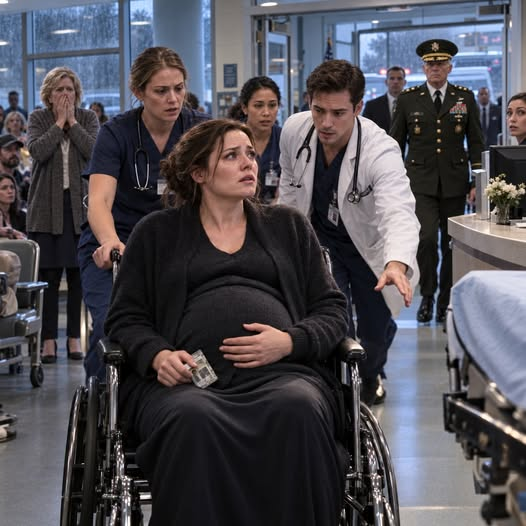
I was thirty-two weeks pregnant when everything changed.
Until that day, my pregnancy had been completely normal. I had experienced the usual discomfort, sleepless nights, swollen feet, and endless advice from people who seemed to think they knew my body better than I did. But I had accepted all of it because I was counting the days until I could finally hold my daughter.
That afternoon, I was standing in the kitchen when a sudden pain hit me.
It wasn’t the kind of discomfort I had experienced before. It was sharp, deep, and frightening. I grabbed the counter and waited for it to pass.
It didn’t.
Another wave of pain came, stronger than the first.
I immediately knew something wasn’t right.
My husband, Daniel, was away on a work assignment several hours from home. I called him, but his phone went straight to voicemail.
I called his mother instead.
She arrived about twenty minutes later.
The moment she walked through the door, I told her that I was scared.
“I think something is wrong with the baby,” I said.
She looked at me and sighed.
“You’re probably just having one of those pregnancy scares again.”
“I’ve never felt anything like this.”
“You’re thirty-two weeks pregnant. You’re going to feel uncomfortable.”
I tried to explain that this was different, but she was already grabbing her purse.
“Come on. I’ll take you to the hospital.”
I was relieved.
At least someone was taking me.
But I didn’t realize that getting me to the hospital wouldn’t necessarily mean that anyone would listen to me.
When we arrived, my mother-in-law spoke to the receptionist before I could explain what was happening.
“She has been very anxious throughout this pregnancy,” she said. “I think she’s having another panic episode.”
I looked at her.
“I’m not having a panic attack. I’m in pain.”
She gave me a look that said I was embarrassing her.
“Just sit down.”
I sat.
The pain continued.
Five minutes passed.
Then ten.
I felt pressure building inside my abdomen.
I stood and walked toward the desk.
“Excuse me,” I said. “I’m thirty-two weeks pregnant and I’m having severe abdominal pain.”
The receptionist asked me to wait.
I returned to my chair.
My mother-in-law leaned toward me.
“You need to stop making everything into an emergency.”
I stared at her.
“I know my body.”
She shook her head.
“You’re being dramatic.”
Those words would stay with me for a long time.
Dramatic.
That’s what she called me while I was terrified that something was happening to my unborn child.
Then, suddenly, I felt something warm between my legs.
I looked down.
There was blood.
A lot of it.
For a second, I couldn’t breathe.
“My baby…”
I stood up.
My mother-in-law looked down and finally realized what was happening.
A nurse saw the blood and immediately rushed toward me.
“Get a wheelchair!”
Everything changed within seconds.
People who had barely looked at me before were suddenly moving quickly.
A doctor came running.
“How far along are you?”
“Thirty-two weeks.”
“Any contractions?”
“Yes.”
“How long?”
“I don’t know. Maybe an hour.”
He looked at the blood and immediately called for the obstetric team.
“Possible placental abruption. We need fetal monitoring now.”
I was rushed down the hallway.
My mother-in-law tried to follow.
The doors closed behind me.
For the first time since the pain began, I felt that someone understood how serious it was.
The monitor was placed on my stomach.
My daughter’s heartbeat appeared on the screen.
Fast.
Then slower.
Then fast again.
The doctor watched the monitor carefully.
“Her heart rate is unstable.”
My eyes filled with tears.
“Is she going to be okay?”
“We’re going to do everything possible.”
A nurse asked me if I had any medical history.
As I answered, she noticed the identification card in my belongings.
“You’re military?”
I nodded.
“Yes.”
“What rank?”
“Lieutenant Colonel.”
She looked surprised.
But my rank didn’t matter to me.
I wasn’t thinking about my career.
I wasn’t thinking about my responsibilities.
I was thinking about the tiny child inside me.
“Please save my daughter,” I whispered.
The doctor told me that the placenta appeared to be separating from the uterine wall.
The baby was losing oxygen.
An emergency C-section was necessary.
I signed the paperwork with trembling hands.
Then I remembered my husband.
He still didn’t know.
I asked the nurse to call him.
Before the nurse could reach him, I made another call.
I called General Samuel Hayes.
He had been my commanding officer and mentor for years.
When he heard my voice, he immediately knew something was wrong.
“Hannah, what’s happening?”
“I’m at the hospital.”
“Are you safe?”
“My baby is in distress. They’re taking me into emergency surgery.”
There was silence.
Then his voice became firm.
“Which hospital?”
I gave him the name.
“I’ll be there.”
“You don’t have to come.”
“Yes, I do.”
The call ended.
I was taken into surgery.
The last thing I remember before the anesthesia took effect was the sound of the monitor and the words of the doctor.
“We’re going to get your baby out.”
When I woke up, the first thing I asked was:
“My baby?”
My husband was sitting beside me.
His face was covered in tears.
“She made it.”
I started crying.
“She’s alive?”
“She’s alive.”
He held my hand.
“She was born at thirty-two weeks. She’s very small, but she’s fighting.”
I couldn’t see her immediately.
She had been taken to the neonatal intensive care unit.
When I finally saw her, my heart broke.
She was tiny.
Her body looked impossibly small beneath the blankets.
There were wires attached to her.
A breathing tube helped her breathe.
Machines surrounded her.
I placed my hand against the incubator.
“Hi, baby.”
My voice broke.
“Mommy’s here.”
Her tiny fingers moved.
I cried harder.
Behind me, I heard footsteps.
General Hayes had arrived.
He was still wearing his uniform.
He walked into the hospital and immediately asked where I was.
When he saw me through the NICU window, he stopped.
Then he noticed my husband.
After speaking with the doctors, he learned what had happened in the emergency room.
He also learned that I had repeatedly asked for help before anyone realized how serious my condition was.
Then he saw my mother-in-law.
She was sitting in the waiting area.
General Hayes walked toward her.
“Are you Hannah’s mother?”
“No. I’m her mother-in-law.”
He nodded.
“Were you with her when she arrived?”
“Yes.”
“Did she tell you she was in severe pain?”
“She was anxious.”
“That wasn’t my question.”
She looked uncomfortable.
“Yes.”
“Did she tell you she was bleeding?”
“She didn’t start bleeding until later.”
“Did she ask you to tell the medical staff that she was in pain?”
“Yes.”
“And what did you tell them?”
My mother-in-law looked down.
“I told them she was anxious.”
General Hayes stared at her.
“She was thirty-two weeks pregnant and experiencing severe pain. You decided that her fear was more important to report than her symptoms?”
“She exaggerates.”
His expression hardened.
“You’re not a doctor.”
She didn’t answer.
“You don’t get to decide whether a pregnant woman is being dramatic when she says something is wrong.”
The waiting room became silent.
Then he said something that everyone there remembered.
“Her rank didn’t make her worth listening to. Her life did.”
My mother-in-law looked away.
Meanwhile, I spent the next several days recovering from surgery while my daughter remained in intensive care.
Every morning I asked about her breathing.
Every afternoon I asked whether she had gained weight.
Every night I stood beside her incubator and prayed.
Some days were good.
Some days were terrifying.
One night, an alarm suddenly sounded.
Doctors rushed into the room.
My daughter’s oxygen level had dropped.
I stood frozen.
A nurse told me to step back.
I couldn’t stop crying.
“Please,” I whispered. “Please don’t take her from me.”
The doctors worked for several minutes before her numbers finally improved.
When the room became quiet again, I placed my hand against the incubator.
“You’re a fighter,” I whispered.
“Mommy is right here.”
My husband stood beside me.
He hadn’t left the hospital.
But something between us had changed.
He finally understood what had happened.
“I should have been there,” he said.
“You were working.”
“No. I mean I should have believed you more often.”
I looked at him.
“What do you mean?”
He sighed.
“My mother has been calling you dramatic for years. I kept telling you to ignore her because I didn’t want to deal with the conflict.”
I didn’t answer.
He continued.
“But this time you could have died.”
He began crying.
“I should have protected you.”
I took his hand.
“I don’t need you to fight everyone for me.”
“What do you need?”
“I need you to believe me when I tell you something is wrong.”
He nodded.
“I will.”
Several days later, my mother-in-law came to the hospital.
She asked to see the baby.
I told her no.
She became angry.
“She is my granddaughter.”
“And I’m her mother.”
“I have a right to see her.”
“You had a right to support me when I was frightened. Instead, you called me dramatic.”
She became quiet.
“I was wrong.”
It was the first time I had ever heard her say those words.
But I wasn’t ready to forgive her.
“My daughter is fighting for her life,” I said. “This isn’t about your feelings.”
She looked at me.
“I didn’t understand how serious it was.”
“You didn’t have to understand medicine. You only had to listen.”
She started crying.
Then she walked away.
My daughter stayed in the NICU for several weeks.
Every day she became a little stronger.
One morning, the nurse told me that she was breathing without assistance.
I couldn’t believe it.
“She did it?”
The nurse smiled.
“She did.”
I touched my daughter’s tiny hand.
“You’re coming home.”
Weeks later, the day finally arrived.
I carried my daughter out of the hospital.
She was still tiny.
Still fragile.
But she was alive.
As we reached the entrance, General Hayes was waiting.
He smiled.
Then, in front of everyone, he stood straight and saluted me.
I was shocked.
I looked at him.
“General, what are you doing?”
He lowered his hand.
“Saluting a soldier who fought the hardest battle of her life.”
People around us became quiet.
I smiled through my tears.
“I wasn’t alone.”
“No,” he said. “You weren’t.”
My mother-in-law eventually apologized properly.
Not because she wanted forgiveness.
But because she finally understood what she had done.
She admitted that she had mistaken my confidence for arrogance and my silence for weakness.
She admitted that she had often tried to make me feel small because she felt threatened by my career.
I accepted her apology.
But I also made a boundary.
“Forgiving you doesn’t mean I will forget what happened.”
She nodded.
“I understand.”
Years later, my daughter grew into a happy, healthy little girl.
One afternoon, she came running into the house after falling off her bicycle.
She had a small cut on her knee.
Her grandmother immediately wanted to tell her it was nothing.
But my daughter looked at me.
“Mommy, it hurts.”
I knelt beside her.
“Where?”
She pointed to her knee.
I cleaned the wound and hugged her.
Then she said something that made me smile.
“I told you because you always listen.”
I hugged her tightly.
Those words meant more to me than any medal, promotion, or military recognition ever could.
Because that was the promise I had made to her in the NICU.
She would never grow up believing that her pain was an inconvenience.
She would never be told that speaking up made her dramatic.
She would never be taught to stay silent just to make other people comfortable.
And I learned something too.
Sometimes people only believe you after something terrible happens.
But you should never have to collapse, bleed, or almost lose your life before someone decides your pain is real.
My uniform didn’t save my daughter.
My rank didn’t make my voice important.
Being a lieutenant colonel didn’t make the doctors listen.
I was simply a frightened mother who knew something was wrong.
And sometimes, the strongest thing a woman can do is trust herself when everyone around her tells her that she’s wrong.
That day, I learned that being called dramatic was not the worst thing that could happen to me.
The worst thing would have been believing them.
