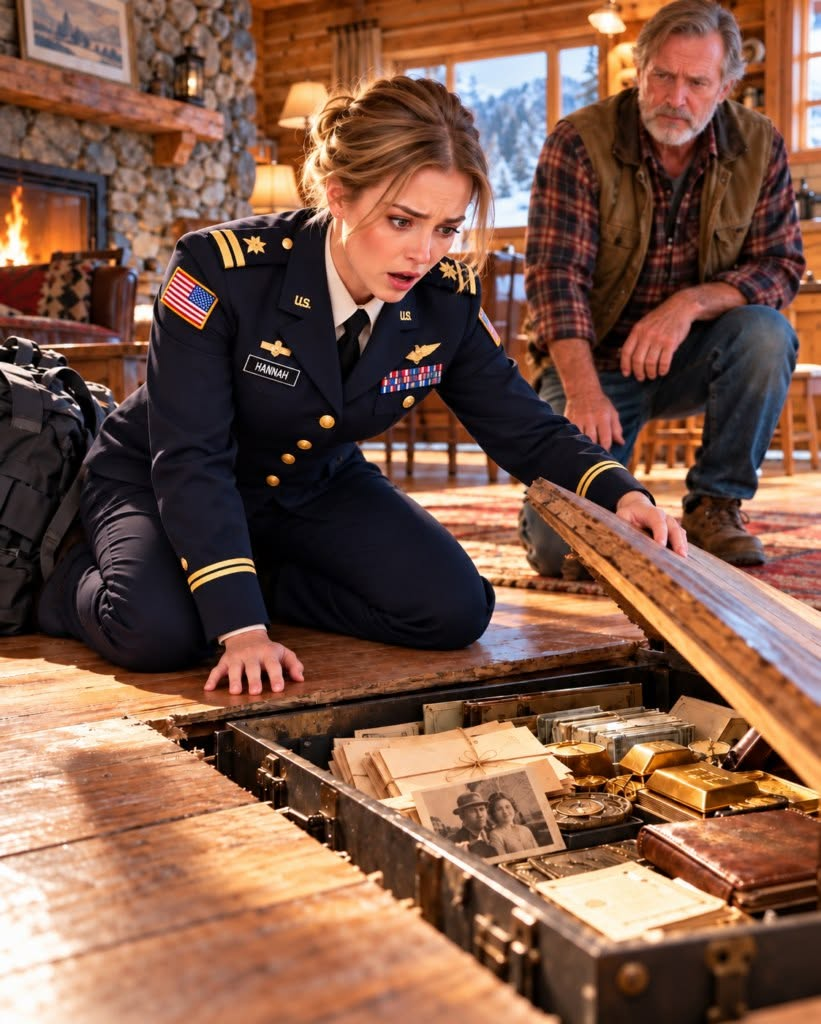
By the time Dad’s funeral ended, grief had hollowed me out. I was still wearing my Army uniform after flying straight from Fort Bragg when attorney Robert Carter arrived at Mom’s house to read the will.
My younger sister, Megan, sat across the dining table almost glowing with anticipation. When Robert announced Dad had left her a luxury apartment overlooking Biscayne Bay in Miami, plus a minority stake in Whitmore Construction, her smile said everything.
Then Robert read my name.
Dad had left me the old family cabin and two hundred acres surrounding it in the Adirondacks.
For a second, nobody spoke. Compared with Megan’s multimillion-dollar apartment, an aging cabin in the mountains sounded almost like Dad had played some final cruel joke on me.
Megan leaned back and smirked. “A cabin fits you perfectly, you stinking woman.”
She laughed, making sure everyone heard her. “Come on, Hannah. You live out of a duffel bag most of the year anyway. That shack is perfect for you. No one will even notice if you disappear up there.”
Her insults burned, but Mom’s silence hurt worse. She sat there staring at the table, refusing to defend me, just like she had through years of fights between Megan and me.
I walked into the hallway before anger took control, but Megan followed. She accused me of abandoning the family to “play soldier” while she supposedly stayed behind and handled everything.
“Dad built everything you’re enjoying,” I snapped. “You mostly showed up when there was something to take.”
Megan smiled coldly. “And now I get the reward. Enjoy your shack.”
The next morning, Mom appeared at my apartment near base with an unbelievable suggestion. Since the Army kept me busy, she thought I should let Megan control my cabin and land too.
“So Dad leaves me one thing, and within twenty-four hours you want me to hand it to Megan?”
Mom called it practical. Megan had real-estate contacts, she said, but I knew what this was really about.
Keeping Megan happy had always mattered more than treating me fairly.
After a week of pressure, Mom finally suggested I visit the cabin before deciding anything. I agreed for one reason.
Dad.
Hours later, darkness swallowed the Adirondack mountains as I pulled onto the property. The cabin looked terrible from outside, with an aging roof and shuttered windows that made Megan’s insults suddenly feel painfully accurate.
Then I unlocked the door.
The floors were polished. The furniture had been carefully maintained, and neatly stacked firewood waited beside the stone fireplace as if someone had been expecting me.
On the mantel sat an old photograph of Dad as a young man beside a woman I didn’t recognize. Written on the back in his handwriting were the words: “With Grandma Rose, 1962. The place where everything began.”
Dad had never told me about Grandma Rose.
A knock suddenly broke the silence.
Outside stood Jack Reynolds, a retired Marine carrying beef stew. He told me Dad had visited shortly before his death, spending days organizing the cabin and leaving Jack one specific instruction.
“Your father said you might come here feeling like the whole world had turned against you,” Jack told me quietly. “He wanted you to remember that sometimes the most valuable things are hidden where nobody thinks to look.”
My skin prickled.
Before leaving, Jack stopped at the door. “There’s one more thing your father told me.”
I waited.
“When you’re ready, check beneath the kitchen floorboard.”
After the door closed, I stood alone, staring toward the dark kitchen.
For the first time, a terrifying thought crossed my mind: maybe Dad had given Megan the inheritance everyone could see…
and left me the one nobody knew existed.
For several minutes after Jack left, I didn’t move.
The cabin settled around me with the quiet creaks of old wood and cooling stone.
Outside, wind moved through the pines in long, whispering breaths.
Somewhere beyond the dark windows, a branch scraped against the roof.
Beneath the kitchen floorboard.
I repeated the words silently, trying to decide whether they sounded like a promise or a warning.
My first instinct was to call Mom.
My second was to call Megan.
I did neither.
Instead, I turned on every light in the cabin and walked into the kitchen.
The room was smaller than I remembered from childhood visits, though I had only been there a handful of times.
Advertisement
A narrow table sat beneath the window, its surface worn smooth by years of use.
Along the far wall stood a cast-iron stove, a sink with brass fixtures, and a row of cabinets painted a muted green.
The floor was made of wide pine planks.
Most were honey-colored with age, but one near the center of the room looked darker than the others.
I crouched beside it.
There were no obvious hinges, handles, or gaps.
I ran my fingertips along the seam and found a shallow notch near the baseboard.
A small metal nail rested in the notch.
I pulled it free.
The floorboard lifted more easily than it should have, as though someone had loosened it recently.
Beneath it was a square opening lined with rough stone. Cold air rose from the darkness below.
I found a flashlight in the drawer beside the sink and shone it through the opening.
There was a narrow cavity beneath the floor, perhaps three feet deep.
Inside sat a weathered wooden box wrapped in oilcloth.
My heart began beating faster.
I reached down and lifted it out.
The box was heavier than it looked. A brass latch held the lid closed, but it wasn’t locked.
When I opened it, the smell of dust, cedar, and old paper drifted into the kitchen.
Inside were several bundles tied with faded blue ribbon.
At the top lay an envelope addressed in my father’s handwriting.
Hannah.
Not to my daughter.
Not to Lieutenant Whitmore.
Just Hannah.
I sat on the floor with my back against the cabinet and held the envelope in both hands.
For years, Dad had written me practical notes. Remember to renew your insurance. Call your sister. Don’t forget Mom’s birthday.
He had never left me anything that required courage to open.
I slid one finger beneath the seal.
The letter inside was only two pages long.
My dearest Hannah,
If you are reading this, then you have finally stood in the room where our family story began.
I wish I could have brought you here myself. I intended to.
Too many times, I told myself there would be another summer, another Christmas, another chance.
There wasn’t.
I paused and looked toward the window.
The last sentence felt painfully familiar. Dad had always been a man who assumed there would be more time.
I continued.
You may believe I left you less because I trusted you less. The opposite is true.
Megan has always understood the value of what can be seen.
You have always understood the value of what must be protected.
The words tightened something in my chest.
I read on.
The cabin is not the whole inheritance.
It is the beginning of an obligation, and perhaps, if you choose it, the beginning of a better relationship with your sister.
That sentence made me stop.
A better relationship with Megan seemed less like a possibility than an old door swollen shut by years of rain.
Beneath the letter were a set of handwritten notes, a folded map, and a thick envelope bearing the name Whitmore Construction.
I unfolded the map first.
It showed the two hundred acres surrounding the cabin. A blue line marked a creek along the eastern boundary.
Several areas were shaded in green, with handwritten notes beside them.
Old growth.
Wetland buffer.
Survey pending.
Near the northern edge of the property, Dad had drawn a circle around a steep hillside.
Beside it he had written: Rose’s ridge.
I had no idea what any of it meant.
The envelope from Whitmore Construction contained copies of legal documents.
I recognized Dad’s signature on some, but the language was dense and formal. Easement agreements. Conservation restrictions. Timber management.
Mineral rights.
I read the same paragraph three times before the meaning began to take shape.
The land was not simply a wooded parcel surrounding an old cabin.
Much of it had been placed under a conservation agreement years earlier, with restrictions on development and logging.
Another document referenced a private research partnership involving the Adirondack Land Trust and a university forestry program.
There was also a letter from a law firm in Albany.
Dear Mr. Whitmore,
Following our recent discussion, the proposed transfer may proceed only with clear direction regarding the stewardship of the property and the continuation of the access agreement supporting the Rose Ridge watershed project.
Rose Ridge watershed project.
I read the words again.
A folded note slipped from the bottom of the folder. Dad’s handwriting covered both sides.
Hannah,
The land may become valuable in ways that no appraisal will show. Developers have approached me more than once.
I refused because the value is not only financial. The western forest protects the creek.
The creek feeds three private wells and joins the watershed used by the nearby community.
If the land is divided carelessly, people will lose more than trees.
But I also know you may not want this responsibility.
You have spent your life serving where you were needed, and I have no right to assume you will continue serving here.
If you decide to sell, sell with your eyes open.
If you decide to keep it, don’t try to do it alone.
I folded the note slowly.
Dad had never spoken to me about conservation, land agreements, or community wells.
During our occasional phone calls, he had asked about my deployments, my work, whether I was eating properly.
He had complained about his knee and the price of heating oil.
He had never once said, I’m trying to protect a watershed.
A floorboard creaked behind me.
I turned sharply.
No one was there.
The cabin was silent again, but my body stayed tense. I reached for the flashlight and rose to my feet.
The front door was still locked from the inside. The windows were latched. Nothing appeared disturbed.
I told myself the sound had come from the old beams.
Still, I gathered the papers and carried them into the living room.
I spent the next two hours reading everything in the box.
There were tax records, maps, old photographs, and letters dating back decades.
Some had been written by my grandmother, Rose Whitmore, whose face I had seen for the first time that evening.
She had been younger than I expected in the photograph, perhaps in her late twenties.
Her dark hair was braided over one shoulder, and she stood beside my father near the cabin’s stone chimney.
On the back, Dad had written: With Grandma Rose, 1962. The place where everything began.
Another photograph showed Rose sitting at the kitchen table with two men I didn’t recognize.
A handwritten note identified them as Thomas Alvarez and Edwin Marsh.
Beneath their names, Dad had written: First agreement. Shared water. Shared responsibility.
The oldest document in the box was a faded deed from 1958.
It transferred a portion of the land to Rose Whitmore, along with “rights of passage, access to water, and shared stewardship of the northern watershed.”
I understood little of the legal language, but a pattern was emerging.
Rose had not simply owned the cabin. She had helped establish some kind of cooperative agreement with neighboring families.
The land was connected to other people’s lives.
At the bottom of the box, I found a small leather notebook.
The first pages were filled with Rose’s handwriting. Her entries were brief, practical, and sometimes surprisingly tender.
June 4, 1961: The creek rose after last night’s storm. Thomas says the lower crossing will need stone before autumn.
August 19, 1962: Daniel wants to build a second room onto the cabin.
He says someday his children will need a place to come home to.
October 2, 1964: The boys from town came to ask about cutting the ridge. We said no.
Forests take a lifetime to grow and a morning to lose.
I turned the pages more quickly.
Rose wrote about weather, planting, repairs, and neighbors. She recorded births, weddings, and illnesses.
She wrote about my father as a boy and mentioned a young Megan’s mother visiting the cabin during a family summer.
Then, near the back, her handwriting changed.
May 1971: The offer came again. More money than this land has ever seen. Daniel says we should consider it.
I told him the creek cannot sign a contract.
July 1971: We agreed to preserve the western ridge. The children may not understand now. Perhaps one day they will.
A pressed fern rested between two pages.
Under it, Rose had written: What is protected belongs to more than the person who owns it.
I closed the notebook.
For the first time since Dad’s funeral, my anger began to loosen.
Not disappear. Not transform into forgiveness.
But loosen.
Perhaps the cabin had not been an insult. Perhaps Dad had given me something he believed I could understand.
That realization made me both grateful and resentful.
Why hadn’t he trusted me enough to tell me while he was alive?
The next morning, I drove into the nearest town.
The cabin was nearly forty minutes from Lake Placid, farther than I had expected.
The roads wound through forests and over low hills, with occasional clearings where modest houses stood behind snow fences.
Even in late autumn, the mountains held traces of green beneath the copper and brown.
I stopped at a diner called The Copper Kettle.
The woman behind the counter looked to be in her sixties, with silver hair pulled into a loose bun.
She glanced at the papers under my arm.
“You’re Daniel Whitmore’s daughter,” she said.
It wasn’t a question.
I hesitated. “Yes.”
“I’m Ellen Marsh.”
The name caught my attention. “Edwin Marsh?”
“My father.” She poured coffee into a thick white mug. “He knew your father since they were teenagers.”
I sat at the counter.
Ellen placed a plate of eggs and toast in front of me without asking.
“Your father told me you might come through here.”
“When?”
“Last spring. He said he was organizing things.”
“Did he tell you what things?”
She smiled faintly. “Daniel was never very good at telling people more than he thought they needed to know.”
“That sounds like him.”
“And you?”
“I’m not sure. I usually tell people exactly what I think.”
“That sounds like a soldier.”
I looked down at my coffee.
Ellen leaned against the counter. “He was proud of you.”
“He didn’t say that often.”
“Some men think showing up at the airport with a packed lunch counts as a speech.”
Despite myself, I smiled.
Dad had done that when I returned from officer training.
He had arrived at the airport at six in the morning with coffee, a ham sandwich, and a newspaper.
When I asked why he had come so early, he said, “Traffic gets unpredictable.”
Ellen watched my expression soften.
“He talked about you,” she said. “More than you probably realize.”
“What did he say?”
“That you were the only one in the family who could look at a problem without immediately asking what it was worth.”
I stared at her.
She reached beneath the counter and brought out a manila folder.
“Your father left this with me two weeks ago.
He told me to give it to you if you came asking about Rose Ridge.”
I took the folder but didn’t open it.
“Why didn’t he give it to me himself?”
Ellen’s face grew thoughtful.
“Maybe he wanted you to come here because you chose to, not because he dragged you into it.”
“That sounds convenient.”
“It may be. Grief makes every unanswered question feel like an accusation.”
The words landed more gently than they should have.
I opened the folder.
Inside was a printed email from a man named Samuel Ortiz, director of the Adirondack Land Trust.
The subject line read: Rose Ridge Stewardship Proposal.
The message explained that a regional energy company had been exploring the possibility of purchasing land near the cabin for a small hydroelectric project.
The proposal was still preliminary, but access roads and construction staging would likely affect the western ridge and the creek.
The Land Trust wanted to discuss purchasing a conservation easement or helping the new owner establish a long-term stewardship plan.
At the bottom, Dad had written in pen:
They will approach Megan first because she owns the visible assets.
If they approach you, remember that money is not the only form of pressure.
I felt a cold heaviness settle in my stomach.
“Megan knows about this?” I asked.
Ellen’s expression tightened. “I don’t know what she knows.”
“Dad left her the apartment and the construction stake. If there’s money involved, she’ll find out.”
“Maybe.”
“That doesn’t sound reassuring.”
“Your sister has been coming here with your mother.”
I looked up. “To the cabin?”
“Not recently. To the town. They met with a realtor at least once. I saw them at the municipal office.”
“When?”
“Three days before the funeral.”
I thought of Mom arriving at my apartment the next morning, already urging me to let Megan control the cabin.
Practical, she had called it.
Megan had real-estate contacts.
The idea formed before I could stop it.
“Did they know about the hydroelectric proposal?”
Ellen shook her head. “I don’t know. But I saw a folder with a blue mountain logo.
Could have been a development company. Could have been something else.”
I closed the folder.
“Can I speak with Samuel Ortiz?”
“I’ll call him.”
She reached for the phone, but I stopped her.
“Not yet.”
I needed to understand what I had inherited before anyone else tried to explain it to me.
On the drive back to the cabin, I called Robert Carter.
He answered on the fourth ring.
“Hannah. I was wondering when you’d call.”
“You knew about the land agreements.”
There was a pause.
“I knew some of them.”
“Did you know about Rose Ridge?”
“Yes.”
“Why didn’t you tell me?”
“Because your father’s will was clear. The property transferred to you with all associated rights and obligations.
I assumed you would review the documents before making a decision.”
“You assumed I would understand them?”
“I assumed you would ask for help if you didn’t.”
I tightened my grip on the steering wheel.
“Did Dad tell you why he left the land to me?”
“He said you were the person most likely to preserve his intentions.”
“That sounds flattering, but it also sounds like he assigned me a job without asking whether I wanted it.”
Robert sighed softly. “Your father believed you were capable of making your own choice.
He specifically instructed me not to pressure you.”
“Did he say anything about Megan?”
“Your father loved both of you.”
“That isn’t what I asked.”
“No. He didn’t ask me to protect you from your sister.
He did ask me to make sure you had independent counsel if you chose to sell or enter into any agreement.”
“Why?”
“Because there are potential financial interests attached to the property.
You should not rely solely on advice from family or anyone connected to Whitmore Construction.”
The words sharpened my attention.
“Connected in what way?”
“I can’t give you details over the phone. Come to my office, and I’ll show you the documents.”
“Did Megan or Mom know about the conservation agreements?”
“I don’t know what they knew.”
“Robert.”
“Hannah, I’m telling you the truth. Your father kept his affairs unusually compartmentalized.
He wanted to avoid conflict while he was alive.”
“Instead, he left it for after he died.”
“I’m afraid that may be true.”
I ended the call and drove the rest of the way in silence.
By afternoon, dark clouds had gathered over the mountains.
I parked beside the cabin and found Mom’s car near the front steps.
She was standing on the porch with a wool coat wrapped tightly around her.
For one moment, I thought about driving away.
Then she saw me.
“Hannah.”
“What are you doing here?”
“I wanted to talk.”
“You could have called.”
“You wouldn’t have answered.”
“That’s possible.”
She looked older than she had at the will reading.
The grief had settled into her face, but there was something else too—worry, perhaps, or exhaustion.
“I’ve been trying to reach you.”
“I’ve been here.”
“I know.”
The answer made me pause.
“You know?”
“Megan told me.”
Of course she had.
I unlocked the cabin door and stepped inside.
Mom followed, looking around as if she had entered a place she had tried to forget.
Her eyes landed on the photograph of Rose.
“You found it,” she said.
“You knew it was here?”
“Your father told me.”
“What else did he tell you?”
She removed her gloves slowly. “Not enough.”
“That seems to be the family tradition.”
“Hannah, I know you’re angry.”
“I’m not only angry.”
“What are you?”
I looked at the old photograph.
“I’m trying to understand why everyone acted like I inherited a worthless cabin when Dad knew the land had legal and environmental obligations.”
Mom’s expression changed.
“You found the documents.”
“I did.”
“Where?”
“Under the kitchen floor.”
She closed her eyes briefly.
“Jack told you.”
“Yes.”
Mom sat at the table.
For a moment, neither of us spoke.
Finally, she said, “Your father wanted to tell you. I asked him not to.”
The admission was so unexpected that I remained standing.
“Why?”
“Because you were preparing for another deployment. You were exhausted, and he believed the land would become a burden.”
“He left it to me anyway.”
“He thought you should have the choice.”
“You mean he wanted me to carry the responsibility while Megan got the easy inheritance.”
Mom flinched.
“Your father didn’t see it that way.”
“How did he see it?”
“He believed Megan needed security.”
“And I didn’t?”
“You had your career. Your pension. Your own life.”
“So because I worked for what I had, I deserved the complicated part?”
“That isn’t what I said.”
“It’s what everyone keeps saying without using the words.”
Mom lowered her gaze.
I walked to the window. The sky had darkened, and fine rain began tapping against the glass.
“Did you know Megan was meeting with a realtor?”
Mom’s silence answered before she did.
“She was trying to understand the property.”
“By trying to control it?”
“She was concerned you would make a decision impulsively.”
“She has known me for thirty-five years. When have I ever made an impulsive financial decision?”
Mom looked toward the hallway. “She thinks you are angry enough to reject everything simply because it came from Dad.”
That accusation struck deeper than I expected.
“Am I supposed to pretend I’m not angry?”
“No.”
“Then what does she want?”
“She wants to help.”
“She called me a stinking woman.”
Mom’s mouth tightened. “Megan was cruel.”
“You sat there and said nothing.”
“I know.”
The room seemed to grow smaller.
Mom folded her gloves in her lap.
“I have spent years believing that if I kept the peace, eventually you and Megan would find your way back to each other.”
“That wasn’t peace. That was silence.”
“I know that now.”
I looked at her.
She had never said those words before.
“I thought Megan needed more from me,” she continued. “She was always louder about her problems.
You were independent, capable, and determined to prove you didn’t need anyone.”
“I was a child.”
“Yes.” Her voice trembled slightly. “And I treated your strength as permission to give you less.”
I looked away before she could see how much that hurt.
For years, I had told myself Mom’s favoritism was a fact I could survive.
I had built my life around not needing her approval.
But hearing her admit it did not make the wound disappear. It only gave the wound a name.
“What exactly did Dad leave Megan?” I asked.
“The apartment. Her shares in the company.”
“And what did he leave you?”
“Your father said the cabin and land were worth more than the apartment.”
“Financially?”
“Not necessarily.”
I turned back.
“Then why?”
Mom hesitated.
“He said you were the only one who understood that ownership was not the same as entitlement.”
I almost laughed, but the sound never formed.
“Did he say that before or after deciding to keep me in the dark?”
“He was afraid you would refuse.”
“Maybe I would have.”
“That was his fear.”
“Then he should have let me make that choice while he was alive.”
Mom nodded.
“Yes.”
The simple agreement unsettled me more than an argument would have.
She reached into her handbag and removed a small envelope.
“Your father asked me to give you this if you came to the cabin.”
I stared at it.
“Why didn’t you give it to me when Robert read the will?”
“I was afraid.”
“Of what?”
“That you would open it and decide he had loved you more.”
I looked at the envelope but didn’t take it.
“Did he?”
Mom’s eyes filled with tears.
“He loved you differently. I don’t know if that’s better.”
The envelope was thin. My name was written across it in Dad’s handwriting.
I took it.
Inside was a single key and a note.
The key was old, darkened with age, and marked with a brass tag bearing the number 17.
The note read:
The records you need are not all in the cabin. Ask for Box 17 at the Lake Placid Historical Society.
Tell them Rose left it in trust.
Nothing else.
I read it twice.
Mom watched me carefully.
“What’s Box 17?”
“I don’t know.”
“Did Dad tell you anything else?”
“He said if you found it, you would understand why the land could not be treated as an ordinary inheritance.”
“Why didn’t you go yourself?”
“I didn’t know where to start.”
“Yet Megan did?”
Mom looked down.
“Megan found out about a potential offer.”
“What offer?”
“She wouldn’t tell me everything.
She said there was interest in the land and that, if you signed a power of attorney, she could negotiate on your behalf.”
“Of course.”
“She said the money could settle the estate taxes and give you enough to leave the Army if you wanted.”
For a moment, I said nothing.
It was a persuasive argument. More money than I had ever possessed. Freedom from deployments.
A life chosen instead of assigned.
And yet, Dad’s note echoed in my mind.
Money is not the only form of pressure.
“Did she know the land was protected?”
“I don’t think she understood what that meant.”
“Did you?”
Mom’s eyes moved to the photograph of Rose.
“I knew your father cared about it. I didn’t know why.”
I slipped the key into my pocket.
“Where is Megan now?”
“At home.”
“Did she send you here?”
“No.”
“Would she know about Box 17?”
Mom shook her head.
“Then please don’t tell her yet.”
She looked hurt.
“I’m still your mother.”
“And she’s still my sister. That doesn’t mean either of you gets to make decisions for me.”
Mom accepted the words quietly.
Before she left, she stood beside the door and turned back.
“I’m sorry,” she said.
I believed she meant it.
That did not erase the past, but it changed the shape of the present.
“Thank you,” I replied.
She nodded and stepped into the rain.
I waited until her car disappeared down the road before calling the Lake Placid Historical Society.
A man named Peter answered.
When I mentioned Rose Whitmore and Box 17, his voice became cautious.
“That collection is restricted.”
“By whom?”
“Your father.”
“Is he the only person who can authorize access?”
“He left written instructions.
The box may be opened by the current owner of the Whitmore Adirondack property, but only in the presence of a trustee.”
“I’m the current owner.”
“I know who you are.”
The words carried no accusation, but I felt exposed.
“Can I come tomorrow?”
Peter hesitated. “Tomorrow morning. Nine o’clock.”
I arrived early and waited in my truck while the town woke around me.
The historical society occupied a restored brick building near the lake.
Inside, the air smelled of old wood, paper, and floor polish.
Peter was a narrow man with round glasses and an expression of habitual patience.
He led me downstairs to a climate-controlled archive.
“The box has not been opened in twenty-two years,” he said.
“Who placed it here?”
“Your grandmother.”
“Why?”
“That is what you are here to find out.”
He removed a key from a ring and unlocked a metal cabinet.
Inside sat several archival containers, each labeled with a number.
Box 17 was smaller than I expected.
Peter carried it to a table and placed it between us.
The lid was sealed with dark red wax.
Pressed into the wax was a symbol I recognized from the old deed: a circle divided by three lines, representing the creek and its tributaries.
I touched the seal.
“What does the symbol mean?”
“Rose designed it,” Peter said. “She called it the three promises.”
“What promises?”
“Water, forest, and neighbor.”
He handed me cotton gloves.
I put them on, then broke the seal.
Inside were ledgers, photographs, a bundle of letters, and a cassette tape labeled 1978.
Peter lifted the tape.
“We still have a player.”
“Can we listen to it?”
“Your father’s instructions say the box should be reviewed in full before any copies are made.”
“Did he listen to it?”
“Yes.”
“Recently?”
“Three months ago.”
I looked at the tape.
“What was he like when he came here?”
Peter considered.
“Older.”
“That’s not what I mean.”
“He seemed relieved.”
The answer stayed with me as we began examining the contents.
The first ledger documented the formation of the Rose Ridge Cooperative, established by six families in 1968.
They had pooled access rights to the creek and agreed to maintain the forested slopes above it.
The agreement was voluntary, but it had been renewed over the years and eventually incorporated into formal conservation restrictions.
A later document listed a fund established by Rose to support local landowners who could not afford repairs after floods or storms.
The fund still existed.
So did the cooperative.
And I was now listed as its newest member.
I looked up.
“Why didn’t anyone tell me?”
Peter gave a small, sad smile.
“Your father attended the annual meeting every year.
He said you were serving overseas and should not be burdened with local politics.”
“Local politics?”
“Most of it was people arguing about culverts and invasive plants.”
I laughed softly.
Then I found a letter addressed to my father from a development company dated eight months earlier.
Mr. Whitmore,
We remain interested in acquiring the western parcel, subject to the cooperation of the current stakeholders.
We believe the proposed renewable-energy facility would bring significant economic benefit to the region.
At the bottom, Dad had written:
They keep calling it progress because “profit” sounds less neighborly.
Another letter, from Samuel Ortiz, explained that the project might be legal if enough landowners agreed to modify the access restrictions.
Because of the conservation agreement, however, no single owner could simply sell the land for development.
No single owner.
That meant the two hundred acres might be valuable, but not in the straightforward way Megan or a developer would expect.
The cassette player sat at the end of the table.
Peter inserted the tape.
Static filled the room. Then my father’s voice emerged, older and rougher than I remembered.
“If this recording is being played, Hannah has opened the box.”
I closed my eyes.
Dad continued.
“I don’t know whether she will be angry. She has earned the right to be.
I should have told her sooner.
I told myself secrecy would protect her from pressure, but secrecy has a way of becoming its own kind of pressure.”
Peter glanced at me but said nothing.
Dad’s voice crackled through the speaker.
“Rose believed property should be held in trust, even when the law called it ownership.
She taught me that a person could inherit land without truly possessing it.
You inherit the decisions made before you, and the consequences of the decisions you make after.”
There was a pause, followed by the soft scrape of paper.
“The family has changed. Megan sees the cabin as an asset because that is how she was taught to survive.
I cannot blame her entirely. She has spent her life afraid there would not be enough.”
My throat tightened.
“Megan is not greedy because she lacks love. She is frightened because she measures love by security.
That does not excuse the way she treats Hannah.
But Hannah should understand that anger will not teach Megan what fear has hidden from her.”
I opened my eyes.
Peter remained motionless.
Dad continued.
“I have left Megan the apartment and my shares because they are assets she can use without asking anyone else’s permission.
I have left Hannah the land because it requires a decision only she can make.”
A soft click sounded on the tape.
“Not whether to keep it. Whether to accept the responsibility of choosing freely.”
The recording paused again.
Then his voice became quieter.
“There is one matter I have not told either of my daughters.
Rose’s original agreement contains a provision that may change the future of the property.
I have placed that document in the box, but I have not marked it. Hannah must find it herself.”
The tape clicked off.
For several seconds, the archive room was silent.
Peter removed the cassette.
“What provision?” I asked.
“I don’t know.”
“Did my father tell you?”
“No.”
We returned to the box.
The ledgers contained pages of meeting notes, names, and financial records.
The photographs showed Rose with neighbors, lawyers, surveyors, and schoolchildren planting saplings along the creek.
At the bottom lay a thin envelope made of blue paper.
It had no name on it.
Inside was a single document written in Rose’s hand.
The first half described the original stewardship agreement. The final paragraph had been added in 1974.
If the Whitmore property is ever transferred outside the family, the cooperative shall have the right to review the transfer and approve any change in use.
If the property remains within the family, the new owner shall serve as steward for a minimum of ten years before seeking release from these obligations.
I read the sentence slowly.
Ten years.
The land could not be sold freely for a decade unless the cooperative approved.
But beneath the paragraph was another line, written in darker ink.
In the event that the family’s inheritance is divided between siblings, neither sibling may alter, sell, or encumber the protected property without the written consent of the other.
I stared at the words.
Neither sibling.
Megan’s inheritance suddenly looked less separate from mine.
The apartment and construction stake might be hers outright, but the protected land required cooperation between us if either of us hoped to change anything connected to the estate.
The developer’s offer, if there was one, could not proceed without my consent.
Neither could Megan simply take control of the land.
Peter read over my shoulder.
“Your father knew this clause existed?”
“He said he did.”
“Then why leave the land to you instead of explaining it to both of you?”
I thought about the recording.
He believed anger would not teach Megan what fear had hidden from her.
Maybe he had hoped responsibility would.
Maybe he had been wrong.
My phone buzzed.
Megan.
I let it ring once, twice, then answered.
“Where are you?” she asked.
“Out.”
“You didn’t come home last night.”
“I stayed at the cabin.”
“Mom said you found some old papers.”
“She talks to you.”
“She’s worried.”
“Are you?”
“That depends. Are you planning to sell?”
The directness of the question made my shoulders stiffen.
“I haven’t decided.”
“You don’t have to decide alone. I spoke with someone who can help.”
“A realtor?”
“A development consultant.”
“Who?”
“Richard Vale. He represents a group interested in the land.”
I looked at the document on the table.
“Interested in the western parcel?”
“I don’t know the exact terminology.”
“Did you know the property is under conservation restrictions?”
There was silence.
“Megan?”
“I knew there were restrictions.”
“How much did you know?”
“Not enough to make a decision.”
“But enough to ask me for power of attorney?”
“I was trying to protect you.”
“By negotiating a sale before telling me what I owned?”
“That’s unfair.”
“Is it?”
Her voice hardened.
“You think everyone is against you because Dad left you a piece of land instead of a check.”
“I think everyone decided what I should do before asking me what I wanted.”
“I’m trying to make this easier.”
“Easier for whom?”
Another silence.
When she spoke again, her tone was quieter.
“You have no idea what it costs to maintain a place like that.”
“Maybe not.”
“You don’t know the taxes, the insurance, the repairs.
You don’t know what happens when the roof fails or the access road washes out. I do.”
“Then give me the numbers. Not a power of attorney.”
“I can’t believe you’re turning this into a fight.”
“I’m not. I’m asking for information.”
“You always do this. You take a simple problem and turn it into a test of loyalty.”
The accusation hurt because it sounded like something Dad might have said.
“Maybe loyalty shouldn’t require signing documents I haven’t read.”
She breathed out sharply.
“Richard says the offer could be worth several million dollars.”
The number hung between us.
Several million dollars.
Enough to pay taxes, repair the cabin, and change my life.
Enough to make Dad’s hidden inheritance look less like a burden and more like an opportunity.
But I remembered Rose’s sentence.
The creek cannot sign a contract.
“What exactly would they build?”
“A small facility. Access roads. Maybe a visitor center. They say it would create jobs.”
“And what happens to the western ridge?”
“I don’t know.”
“Then find out.”
“You’re impossible.”
“No. I’m uninformed.”
“You could be throwing away the best offer we’ll ever get.”
“We?”
She went quiet again.
“What does that mean?” she asked.
“Are you negotiating for yourself or for me?”
“For the family.”
“Which family?”
She ended the call.
I sat there with the phone in my hand.
Peter began gathering the documents.
“You don’t have to decide today,” he said.
“I know.”
“Your father wanted you to have time.”
“He also left me a puzzle.”
“Rose was fond of puzzles.”
“Did she leave anything else?”
Peter nodded toward the box.
“There is one item we haven’t examined.”
At the very bottom was a small envelope sealed with the same red wax.
This one bore two names.
Hannah Whitmore and Megan Whitmore.
My breath caught.
I broke the seal.
Inside was a letter addressed to both of us.
My daughters,
If you are reading this together, then perhaps you have already discovered that the land cannot be divided as neatly as the rest of my estate.
That is intentional.
You have spent much of your lives believing you were given different things because one of you mattered more.
I helped create that belief by avoiding difficult conversations.
The truth is simpler and harder.
Megan, you have always wanted certainty. Hannah, you have always wanted freedom. Neither of you has found enough of either.
The land will not give you what you want unless you learn to listen to what the other needs.
I am not asking you to become close overnight.
I am not asking you to forgive old wounds before you are ready.
I am asking you to make one decision together.
At the end of the letter, he had written a date.
November 18.
I checked the calendar on my phone.
Three days away.
Beneath the date were the words:
Meet at the cabin. Bring the original deed. Do not bring anyone else.
I read the final line.
There is something beneath Rose Ridge that belongs to both of you.
I looked at Peter.
“What does that mean?”
He had gone pale.
“I don’t know.”
“But you know something.”
He removed his glasses and polished them with a cloth.
“Your grandmother once told me the ridge contained the first spring used by the cooperative.
She believed the source was deeper than the surveyors had found.”
“That’s not what Dad meant.”
“No,” Peter said quietly. “It probably isn’t.”
I folded the letter and placed it back in the envelope.
For years, I had thought my father’s final gift was a decaying cabin at the end of a lonely road.
Now I understood that the cabin was only a doorway—to Rose’s past, to my father’s regrets, and to a future that might require Megan and me to stand on the same side of something for the first time in our lives.
Three days later, we were supposed to meet beneath the dark pines of Rose Ridge.
And somewhere beneath that land, Dad had left one more secret waiting for both of us.
