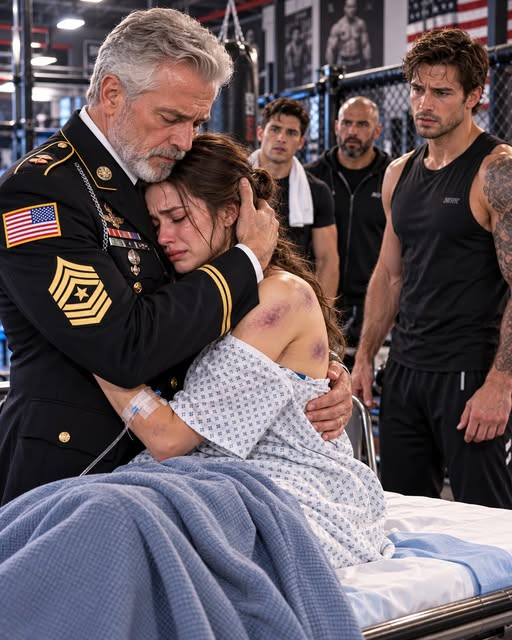
His coach laughed at my gray beard and warned, “Leave now, Grandpa, unless you want to leave in a body bag.”
Four heavyweight fighters stepped between me and the door while Dustin stood inside the cage smiling.
What they didn’t know was that I had spent fifteen years training elite Marine combat units—and I hadn’t walked into that gym without a plan.
When I slowly rolled up my sleeves, Dustin laughed… until I told him what had already been recorded.
PART 1
My name is Robert Hale.
For fifteen years, I trained Marines in close-combat techniques.
I had one rule.
What I taught belonged in combat and controlled training.
Never in anger.
Never against civilians.
Then my wife called from the hospital.
“Robert, it’s Marcy.”
Something in her voice made me stand immediately.
“What happened?”
“She’s in the ER.”
My wife had been an emergency-room nurse for twenty-three years.
She did not panic easily.
“She has two broken ribs, a concussion, and bruising across her arms.”
My stomach went cold.
“What did she say?”
“That she fell down the stairs.”
We both knew that wasn’t true.
For months, Marcy had been changing.
Long sleeves in warm weather.
Canceled family dinners.
Jumping whenever her phone rang.
And bruises she always explained away.
Her boyfriend, Dustin Cole, was an up-and-coming MMA fighter.
Talented.
Popular.
And, according to Marcy, connected to an uncle people in town were afraid to cross.
The first time I confronted her, she broke down.
“Dad, please don’t do anything.”
“Did Dustin hurt you?”
She cried harder.
“If I leave him, his uncle will come after you and Mom.”
That told me enough.
But fear had kept her trapped.
Now she was in the hospital.
I should have gone directly to her.
Instead, I drove to Dustin’s gym.
Not because I wanted revenge.
Because I knew Dustin would still think he was in control.
And people like that often talk too much when they believe nobody can challenge them.
The gym was nearly empty.
Dustin stood inside the cage with his coach.
Four large fighters were nearby.
The moment he saw me, he smiled.
“Well, look who finally showed up.”
I walked toward the cage.
“You put your hands on my daughter.”
He shrugged.
“She needed to learn some respect.”
His coach laughed.
“Careful, Grandpa.”
I looked at him.
He stepped closer.
“You should go see your daughter and stay out of things you don’t understand.”
The four fighters slowly moved around me.
One blocked the main exit.
Another cracked his knuckles.
Dustin leaned against the cage.
“What are you going to do?”
I took off my jacket.
The coach laughed louder.
“Oh, this is going to be good.”
I slowly rolled up my sleeves.
Then I said:
“For fifteen years, I trained more than three thousand Marines.”
The laughter faded slightly.
Dustin still smiled.
“So what?”
“So I know exactly what happens when angry men make bad decisions.”
One fighter stepped closer.
I didn’t move.
Then I looked directly at Dustin.
“But I didn’t come here to fight you.”
His smile changed.
I reached into my shirt pocket.
And placed a small device on the bench.
A recorder.
The room became silent.
Dustin stared at it.
I said:
“You just admitted what you did to Marcy.”
His coach stopped smiling.
Then I added:
“And that wasn’t the only reason I came here.”
Because before entering the gym, I had already spoken to someone who had been investigating Dustin’s uncle for months.
For several seconds, nobody in the gym said anything.
The recorder sat on the bench between us.
It was no bigger than a pack of gum.
Yet every man in that room seemed to be staring at it as though it had suddenly become the largest object in the building.
Dustin’s smile disappeared first.
His coach, Marty Vance, looked from the recorder to me.
Then toward the front windows.
The four fighters who had positioned themselves around me no longer looked eager to prove anything. One of them, a thick-necked young man with a shaved head, quietly stepped away from the door.
That was the first sensible decision anyone had made since I walked in.
Dustin folded his arms.
“You can’t record people without permission.”
His voice was confident, but not as confident as it had been thirty seconds earlier.
“I didn’t say this was the only recording.”
That was true.
Before walking into the gym, I had called Detective Elena Ruiz.
I had known Elena’s father years earlier. He had been a county deputy before retirement, and Elena had since joined a joint financial-crimes task force that was quietly investigating a network of local businesses connected to Dustin’s uncle, Ray Cole.
Three weeks earlier, Elena had called me for an entirely unrelated reason.
At least, I had thought it was unrelated.
She wanted to ask about a former Marine I had trained who now worked as a private security consultant. His name had appeared as a reference on a company application tied to one of Ray Cole’s businesses.
I told her what little I knew.
The conversation should have ended there.
But near the end, she asked something strange.
“Robert, does your daughter still date Dustin Cole?”
Every part of me sharpened.
“Why?”
There was a pause.
“I can’t discuss an active investigation.”
“That isn’t an answer.”
“No,” she said. “It isn’t.”
I had not told Marcy about that conversation.
At the time, I had convinced myself there was no reason to.
Now, standing in Dustin’s gym, I wondered whether keeping it from her had been my first mistake.
Dustin took one step toward the cage door.
“What exactly did you tell the police?”
“Enough.”
It was an answer designed to keep him talking.
Elena had been precise about that.
Do not accuse.
Do not threaten.
Do not provoke.
Listen.
Let silence do the work.
That last instruction amused me when she gave it.
For fifteen years, I had taught young Marines that silence could be useful under pressure. Most inexperienced people rushed to fill it.
Dustin was no different.
“You don’t even know what happened,” he said.
I looked at him.
He continued.
“Marcy gets dramatic. She gets upset. She says things she doesn’t mean.”
Marty shifted beside the cage.
“Dustin.”
But Dustin ignored him.
“She probably told you some story because she knows you’ll believe anything.”
There it was.
Not another admission.
Something more revealing.
A pattern.
I kept my voice level.
“She hasn’t told me anything yet.”
That stopped him.
For the first time since I entered the gym, he looked uncertain.
I picked up my jacket.
Then the recorder.
“I’m going to the hospital.”
Nobody stopped me.
At the door, Marty spoke.
“Mr. Hale.”
I turned.
His face had changed.
He no longer looked amused.
He looked tired.
Older than I had noticed before.
“I didn’t know she was in the hospital.”
Dustin stared at him.
“Marty.”
The coach kept his eyes on me.
“I mean it.”
I studied him for a moment.
Then nodded.
“I hope you mean it.”
Outside, the evening air felt colder than it had twenty minutes earlier.
I got into my truck.
My hands did not shake until I closed the door.
That surprised me.
I had been calm inside.
Controlled.
Focused.
Now my fingers trembled against the steering wheel.
I sat there and let them.
People misunderstand control.
They think it means you do not feel fear.
Or rage.
Or grief.
It means you feel all of it and decide what happens next anyway.
My phone buzzed.
Elena.
I answered.
“How much did you hear?”
“Enough.”
“That doesn’t sound very official.”
“It isn’t meant to.”
I could hear traffic behind her.
Then she said, “Robert, you need to leave.”
“I’m already outside.”
“Good.”
“What happens now?”
“Go to your daughter.”
I closed my eyes.
“You’re going to keep saying that until I listen, aren’t you?”
“Yes.”
A small pause.
Then her voice softened.
“She needs her father more than I need another witness tonight.”
That landed harder than anything Dustin had said.
I started the truck.
“I’m going.”
“Robert.”
“Yes?”
“Don’t call Ray Cole. Don’t speak to Dustin again. Don’t contact anyone else connected to them.”
“I wasn’t planning to.”
“That sentence sounded exactly like something a man planning to do all three would say.”
Despite myself, I almost smiled.
“I’m going to the hospital.”
“Good.”
I ended the call.
The hospital was twelve minutes away.
It felt longer.
Every red light gave me time to think.
That was not necessarily a gift.
I thought about Marcy at eight years old, running beside me while I tried to teach her to ride a bicycle.
She had fallen twice.
The second time, she sat on the sidewalk with tears running down her cheeks and announced she would never ride again.
I sat beside her.
“All right.”
She looked offended.
“All right?”
“If you don’t want to ride, don’t ride.”
“You’re supposed to tell me not to quit.”
“No. I’m supposed to remind you that the bike belongs to you.”
She stared at me.
I pointed toward it.
“You decide when you’re ready.”
Ten minutes later, she was back on the seat.
By sunset, I was running behind her, pretending to hold on long after I had let go.
For years, that memory had made me proud.
Tonight it made me ashamed.
Somewhere along the way, I had forgotten the lesson.
Her life belonged to her.
Not to Dustin.
Not to fear.
And not to me.
When I reached the hospital, my wife, Ellen, was standing outside Marcy’s room.
She still wore the navy cardigan she kept in her car because hospitals were always cold.
She crossed her arms when she saw me.
“Where were you?”
There are moments in marriage when a man knows lying would be useless.
This was one.
“I went to the gym.”
Ellen closed her eyes.
“Robert.”
“I didn’t touch anyone.”
“That is not the standard by which I evaluate my husband.”
“I know.”
“Do you?”
Her voice remained quiet.
That was worse than anger.
I stepped closer.
“I thought I could get him to talk.”
“And did you?”
“Yes.”
She stared at me.
Then understood.
“You recorded him.”
“Yes.”
“Was that your idea?”
“Partly.”
Her expression sharpened.
“Partly?”
I told her about Elena.
The earlier investigation.
The phone call three weeks before.
The question about Marcy and Dustin.
By the time I finished, Ellen was no longer angry.
She was hurt.
“You knew there might be something dangerous around him.”
“I didn’t know that.”
“You knew enough to worry.”
“Yes.”
“And you didn’t tell me?”
“I didn’t want to frighten you.”
She looked through the small glass panel in Marcy’s door.
Then back at me.
“Robert, I worked in emergency rooms for twenty-three years. Fear is not something you protect me from by keeping me uninformed.”
I had no defense.
So I did something that had taken me most of my life to learn.
I admitted it.
“You’re right.”
She blinked.
Perhaps she had expected an argument.
“I should have told you.”
“Yes.”
“I should have told Marcy too.”
Ellen sighed.
“That part is more complicated.”
“No. It isn’t.”
She studied me.
“She already thinks everyone around her makes decisions for her.”
I looked toward the room.
“Does she know I’m here?”
“Yes.”
“Does she want to see me?”
Ellen hesitated.
That hesitation hurt.
“She asked where you were.”
I nodded.
“What did you tell her?”
“That I didn’t know.”
I pushed my hands into my pockets.
For the first time all night, I felt uncertain about entering a room.
Ellen touched my arm.
“Robert.”
I looked at her.
“Don’t go in there as the man who solves things.”
I swallowed.
“Who should I go in as?”
“Her father.”
Marcy was sitting slightly upright when I entered.
The lights were dim.
A paper cup of water rested on the tray beside her.
There was a faint bruise near her temple.
I made myself look at her face, not the medical chart, not the monitors, not the places where I imagined injuries.
Her face.
My daughter.
She gave me a tired smile.
“Hi, Dad.”
“Hi, kiddo.”
She had hated that nickname since college.
Tonight she did not correct me.
I took the chair beside the bed.
For a while, neither of us spoke.
Finally she asked, “Did Mom yell at you?”
“A little.”
“She doesn’t yell.”
“Exactly.”
That earned a small laugh.
Then her eyes became serious.
“You went to see Dustin.”
It was not a question.
I nodded.
“Mom figured it out.”
“I’m sorry.”
“For going?”
“For making another decision that involved your life without talking to you.”
She looked down at the blanket.
“You always do that when you’re scared.”
The accuracy of it startled me.
“When did you figure that out?”
“When I was about twelve.”
I leaned back.
“That long?”
“You reorganized our entire family vacation because I said I was nervous about flying.”
“I thought you were afraid.”
“I was nervous.”
“There’s a difference.”
“Yes.”
She looked at me.
“That’s kind of the point.”
I had spent years teaching people to read danger.
My daughter had spent years learning to read me.
“What happened, Marcy?”
She became still.
I immediately regretted the question.
Not because it did not matter.
Because I had asked too soon.
“You don’t have to tell me tonight.”
Her eyes filled.
“I’m embarrassed.”
I felt something crack quietly inside me.
“Of what?”
“That I stayed.”
I leaned forward.
“No.”
She closed her eyes.
“I knew something was wrong months ago. I knew it. Every time he apologized, every time he said things would be different, I wanted to believe him.”
I did not interrupt.
“He didn’t start out like this.”
I waited.
“He was funny. He listened. He remembered little things. The first time I met him, I mentioned I liked that old bakery near the river. Two weeks later he drove forty minutes to bring me their cinnamon bread.”
She smiled faintly at the memory.
Then the smile faded.
“People think bad relationships look bad from the beginning.”
“People think a lot of things when they’re standing outside someone else’s life.”
She looked at me.
I hoped that was the right thing to say.
After a moment, she continued.
“He started checking where I was. Then he’d say it was because he worried. Then he didn’t like certain friends. Then he said my job took advantage of me. Then he said you never respected him.”
That surprised me.
“Me?”
“You made him nervous.”
“I barely spoke to him.”
“Exactly.”
I almost laughed, but stopped myself.
Marcy rubbed her thumb against the edge of the blanket.
“He said you judged him.”
“I did.”
“Dad.”
“I’m not saying I handled it well.”
That brought another faint smile.
Then silence settled again.
Finally, she whispered, “He kept telling me his uncle could ruin people.”
“Did Ray Cole ever threaten you?”
“No.”
I frowned.
“Did you ever meet him?”
“Twice.”
“What happened?”
“Nothing.”
She looked confused.
“He was actually polite.”
That was interesting.
“Did Dustin ever say specifically what his uncle would do?”
Marcy thought.
“No.”
“Did anyone else?”
“No.”
I sat back.
A possibility began forming.
Not a comforting one.
But an important one.
Maybe Dustin had been using his uncle’s reputation without his uncle’s knowledge.
Or maybe the truth was somewhere in between.
My phone vibrated.
A message from Elena.
CALL ME WHEN YOU’RE ALONE.
I put the phone facedown.
Marcy noticed.
“Police?”
I did not answer quickly enough.
Her face changed.
“What did you do?”
“Nothing that puts you at risk.”
“That’s not what I asked.”
“I spoke to a detective.”
“About me?”
“About Dustin.”
“That means about me.”
She pushed herself more upright, winced, and stopped.
I stood instinctively.
She held up one hand.
“Please don’t.”
I froze.
The words were not loud.
But I heard everything behind them.
Do not take control.
Do not move before I ask.
Do not decide what I need.
I sat down again.
“You’re right.”
She looked surprised.
“I should have talked to you.”
“Why didn’t you?”
“Because I thought I could fix something before you had to be afraid of it.”
“I was already afraid.”
“I know.”
“No, Dad.”
Her voice shook now.
“I don’t think you do.”
I said nothing.
“For months, I thought if I told you, you’d go after him.”
“I wouldn’t.”
“You went to his gym before coming here.”
There was no answer to that.
She wiped one tear away.
“That’s why I didn’t tell you everything.”
The room seemed to narrow.
“What else is there?”
Marcy stared at the window.
Not at me.
“When Dustin started talking about his uncle, I got scared. So I started writing things down.”
“What things?”
“Dates. Arguments. Things he said. Names.”
My breathing slowed.
“Where?”
“On my laptop.”
“Does Dustin know?”
“No.”
“Are you sure?”
“I thought I was.”
Thought.
Past tense.
“What changed?”
She finally looked at me.
“Last week he asked why I was taking notes.”
The small hairs on my arms lifted.
“What did you say?”
“That they were for work.”
“Did he believe you?”
“I don’t know.”
Before I could ask anything else, Ellen entered.
She looked between us and immediately understood that something had shifted.
“What happened?”
Marcy told her.
Not everything.
Enough.
Ellen sat on the other side of the bed and took our daughter’s hand.
“Where is the laptop?”
“My apartment.”
I looked at Ellen.
She looked at me.
We were both thinking the same thing.
I reached for my phone.
Marcy watched me.
“Who are you calling?”
“Detective Ruiz.”
This time I waited.
“Is that okay?”
Marcy looked surprised again.
Then she nodded.
“Yes.”
I stepped into the hallway.
Elena answered on the first ring.
“What happened?”
I told her.
There was a pause.
Then she said, “Nobody goes to the apartment.”
“I wasn’t planning—”
“Robert.”
“Fine.”
“We’ll secure it properly.”
“You said you needed to talk to me.”
“I do.”
“What is it?”
Another pause.
“Your recording from the gym confirmed something.”
“What?”
“Dustin thinks Ray Cole is protecting him.”
“Marcy thinks that too.”
“That’s the problem.”
I leaned against the wall.
“I’m listening.”
“We’ve been monitoring financial activity linked to Ray for months.”
“And?”
“And Dustin’s name appears nowhere.”
I frowned.
“Maybe Ray keeps him separate.”
“Possible.”
“But you don’t think so.”
“We interviewed one of Ray’s former employees this afternoon.”
My grip tightened around the phone.
“He said Dustin has been telling people for years that his uncle handles problems for him.”
“That doesn’t prove anything.”
“No.”
Elena’s voice lowered.
“But the employee also said Ray stopped speaking to Dustin almost two years ago.”
I looked through the glass toward Marcy.
“Why?”
“We don’t know yet.”
“What are you saying?”
“I’m saying the threat your daughter believed may have been built on a lie.”
I closed my eyes.
All those months.
All that fear.
A story repeated often enough until it became a cage.
Then Elena added, “There’s something else.”
Of course there was.
“What?”
“When I mentioned Marcy’s name to the former employee, he recognized it.”
My eyes opened.
“How?”
“He said Ray has asked about her.”
My pulse quickened.
“When?”
“Several times over the last six months.”
“Why?”
“That’s what we don’t know.”
I looked back into the room.
Marcy was speaking quietly to her mother.
For the first time that night, she looked less frightened.
Not safe.
Not yet.
But less alone.
“Elena.”
“Yes?”
“Find out.”
“We are.”
I ended the call.
When I went back inside, I told Marcy and Ellen everything.
No editing.
No protecting.
No deciding for them what they were ready to hear.
Marcy listened without speaking.
When I finished, she stared at the blanket for a long time.
Then she whispered, “If Dustin lied about his uncle…”
Ellen squeezed her hand.
Marcy looked at me.
“…then what else did he lie about?”
That question followed us through the night.
The next morning, the police recovered Marcy’s laptop.
Nothing had been taken from the apartment.
Nothing appeared disturbed.
But something unexpected was waiting inside the laptop.
Marcy had saved her notes in a folder labeled “Taxes.”
Apparently even Dustin had limits to his curiosity.
Elena came to the hospital shortly before noon.
She wore plain clothes and carried a legal pad.
She did not sit until Marcy invited her.
I noticed that.
So did Marcy.
They spoke for nearly an hour.
I waited outside with Ellen.
At one point, I found myself pacing.
Ellen watched me.
“You’re wearing a trail into the floor.”
“I’m thinking.”
“You pace when you can’t control something.”
“Apparently everyone has been studying me.”
“We’ve had decades.”
I stopped.
Then sat beside her.
After a moment, I said, “I should have seen it.”
“What?”
“What was happening.”
Ellen shook her head.
“We saw pieces.”
“I should have known.”
“You trained Marines, Robert. You did not become all-knowing.”
“I saw the bruises.”
“So did I.”
“I accepted explanations.”
“So did I.”
Her voice softened.
“Because she asked us to.”
I looked down.
“That doesn’t make me feel better.”
“It isn’t supposed to.”
I glanced at her.
“What is it supposed to do?”
“Keep you from making her recovery about your guilt.”
That hurt.
Which usually meant Ellen was right.
The interview ended.
Elena stepped into the hall.
“She did well.”
I stood.
“What happens now?”
“She decides what happens next.”
I appreciated the phrasing.
“She wants to make a formal statement.”
I exhaled.
“Okay.”
“But there’s something you both need to see.”
We went inside.
Marcy had her laptop open.
A list of documents filled the screen.
Most were notes.
Dates.
Descriptions of conversations.
Times Dustin had borrowed money.
Names he mentioned.
Stories he told.
But one file had nothing to do with him.
At least not directly.
Marcy clicked it.
A scanned letter appeared.
I recognized the handwriting immediately.
My older brother’s.
Thomas Hale.
Dead eleven years.
I stared at Marcy.
“Where did you get this?”
“Dustin gave it to me.”
The room went still.
“When?”
“Six months ago.”
“Why would Dustin have a letter from Thomas?”
“That’s what I asked.”
Her eyes moved to Elena.
“He said his uncle had it.”
My throat tightened.
Thomas and I had not been close near the end of his life.
That was the polite version.
The real version was simpler.
We had loved each other.
And disappointed each other.
Thomas had struggled after leaving the service.
Not with drinking or drugs, as people often assumed.
With purpose.
He went from a structured military life to a civilian world that seemed to him shapeless and indifferent.
He started a construction business.
It failed.
Started another.
That failed too.
Then he borrowed money from people I did not trust.
One of those people, according to family rumor, had been Ray Cole.
I had never known whether that was true.
I looked at the letter on Marcy’s screen.
The date was fourteen years ago.
Three years before Thomas died.
It was addressed to Ray.
The first paragraph was ordinary.
Business.
Repayment schedules.
A dispute over equipment.
The second paragraph was not.
Thomas wrote that he had discovered Ray’s company was being used by someone else to move money through false invoices.
He said he had copied the records.
He said he would return them if Ray agreed to forgive part of the debt and walk away.
I felt sick.
Elena leaned closer to the screen.
“Did Dustin say why he gave this to you?”
Marcy shook her head.
“He said it proved our families had history.”
“Did he say anything else?”
“He said Dad had hidden things from me.”
I looked at her.
Marcy continued.
“He said maybe Uncle Thomas didn’t die owing money. Maybe someone owed him.”
“That doesn’t make sense,” I said.
“I know.”
But my voice sounded less certain than I wanted.
Elena read the letter again.
Then she looked at me.
“Robert, did you know about these records?”
“No.”
“Did Thomas ever mention false invoices?”
“No.”
“Did he leave papers behind?”
“Boxes.”
“Where?”
“My garage.”
Ellen turned toward me.
“You still have them?”
“I never threw away his service papers.”
“You said boxes.”
“There are other things mixed in.”
Elena closed Marcy’s laptop.
“We need to look at them.”
I nodded slowly.
A memory had begun surfacing.
Thomas standing in my driveway a year before his death.
Angry.
Exhausted.
Holding a cardboard box.
He had asked me to keep it.
I refused.
I told him I was tired of being pulled into his financial mistakes.
He put the box back in his truck.
At least, I thought he had.
Two weeks later, I found three boxes in my garage.
I never opened them.
I assumed they contained old photographs and military records.
For eleven years, they had sat behind camping equipment and Christmas decorations.
I suddenly remembered something else.
A phrase Thomas had shouted at me that day.
At the time, I thought it was bitterness.
Now I was not so sure.
“You think you know who the dangerous people are, Bobby.”
Nobody had called me Bobby since childhood.
Thomas only used it when he wanted me to listen.
I had not listened.
That afternoon, Elena obtained permission to examine the boxes.
I went with her.
So did Ellen.
Marcy remained at the hospital.
Not because we excluded her.
Because she chose not to go.
That mattered.
The garage smelled like dust, old paint, and cedar.
The boxes sat exactly where I remembered.
Three of them.
Elena photographed everything before touching anything.
We opened the first.
Old uniforms.
Letters.
A cracked coffee mug.
Photographs.
The second held receipts and business files.
The third was mostly empty.
Mostly.
At the bottom sat a sealed envelope.
My name was written across the front.
ROBERT.
I stared at it.
Ellen stood beside me.
“You never saw that?”
“No.”
My voice barely worked.
Elena did not touch it.
“It’s addressed to you.”
I picked it up.
The seal had yellowed with age.
For a moment, I could not open it.
Then Ellen placed her hand against my back.
I tore the envelope carefully.
Inside were four pages.
Thomas’s handwriting.
The first line stopped me.
Bobby,
If you’re reading this, then either I finally found the courage to tell you the truth, or I ran out of time.
I sat down on an overturned bucket.
Ellen crouched beside me.
The letter was not a confession.
Not exactly.
Thomas explained that Ray Cole had lent him money during a desperate period in his business.
But Ray was not the one who trapped him.
Another man had.
A business partner named Carl Mercer.
Mercer had used Ray’s company name on invoices without permission.
Thomas discovered it.
Ray discovered it soon after.
The two men had briefly cooperated to expose Mercer.
Then Thomas panicked.
He had debts.
A family to support.
A failing business.
He tried to leverage the documents for financial relief.
Ray refused.
Their relationship broke apart.
Thomas wrote that he regretted trying to turn evidence into a bargaining chip.
Then came the line that changed everything.
Ray isn’t a good man, Bobby, but he isn’t the man everyone thinks he is either. That reputation suits him, so he lets people believe it. I think one day that will cost somebody who mistakes fear for permission.
I read the sentence twice.
Then again.
At the bottom of the final page, Thomas wrote:
I kept copies of the Mercer invoices. Not because they’re worth money. Because truth should belong somewhere outside the hands of frightened men.
Under that was a storage-unit number.
Elena stared at it.
“That facility still exists.”
I looked at her.
“You know it?”
“It’s one of the businesses we’ve been examining.”
My skin prickled.
“Ray’s?”
“No.”
She paused.
“Carl Mercer’s.”
Ellen inhaled quietly.
I thought of Dustin giving Marcy the first letter.
I thought of him telling her Ray could ruin people.
I thought of fear passed from one person to another like inherited debt.
Then I understood something that chilled me in an entirely different way.
“Dustin knew about the letter.”
Elena nodded.
“Yes.”
“Which means he knew enough about Thomas to search for it.”
“Yes.”
“But why?”
Nobody answered.
We did not have to wait long.
At 6:14 that evening, Elena received a call from an investigator already assigned to Mercer’s businesses.
The storage unit listed in Thomas’s letter still existed.
The rent had been paid automatically for fourteen years.
Not by Thomas.
Not by Ray.
By an account Elena’s team had spent months trying to identify.
A small holding company.
The same holding company that, two months earlier, had quietly paid several thousand dollars toward Dustin Cole’s training expenses.
Elena lowered the phone.
For the first time since I had known her, she looked genuinely unsettled.
“Robert.”
“What?”
“The money wasn’t coming from Ray.”
A long silence followed.
Then she said the name.
“Carl Mercer has been paying Dustin.”
And suddenly the question was no longer why Dustin had lied about his uncle.
It was why someone connected to a secret my brother had buried fourteen years ago had taken such an interest in my daughter.
I did not sleep that night.
Not properly.
I lay beside Ellen listening to the old house settle around us.
The furnace clicked.
A truck passed on the road.
Somewhere outside, a dog barked twice and then went quiet.
Normal sounds.
That was the strange thing about frightening discoveries.
The world rarely changes its behavior to match them.
Morning still comes.
Coffee still needs making.
Bills still sit unopened on the counter.
And a man can discover that something he believed for fourteen years was wrong while the refrigerator hums exactly as it did the day before.
At 5:30, I gave up pretending to sleep.
Ellen appeared in the kitchen ten minutes later wearing slippers and the robe Marcy had given her for Christmas.
“You’re making enough coffee for a platoon.”
“Habit.”
“No platoon is coming.”
“You never know.”
She leaned against the counter.
For a moment, neither of us mentioned Thomas.
Then she said, “You’re angry with him.”
It was not a question.
“Yes.”
“For keeping secrets?”
“Yes.”
“Anything else?”
I poured coffee.
“For making me wonder whether I failed him.”
Ellen took the mug from my hand.
“Thomas made choices.”
“So did I.”
“Yes.”
I looked toward the dark window over the sink.
“The last real conversation we had ended with me telling him I was done rescuing him.”
“Were you?”
“I thought so.”
“Robert.”
I faced her.
“You spent eight years helping him.”
“He was my brother.”
“And he lied to you about money. Borrowed from you without repaying it. Put your name down as a reference for loans without asking.”
I frowned.
“You remember everything.”
“I was there.”
She stepped closer.
“You are allowed to wish you had done things differently without rewriting the past into a story where everything was yours to fix.”
I smiled faintly.
“You and Marcy comparing notes?”
“Constantly.”
That helped.
Not much.
But enough.
At seven, Elena called.
The storage unit had been secured under a warrant.
She wanted me there later that morning, not because she needed me for the search but because several items recovered during the first inventory included family photographs and papers bearing my name.
“Marcy?” I asked.
“She can come if she wants.”
The answer mattered.
I called our daughter.
She had been discharged from the hospital and was staying with us.
Her bedroom was only twenty feet away, but calling felt respectful somehow.
She answered after three rings.
“Dad?”
“Elena found the storage unit.”
Silence.
“Can I go?”
“Yes.”
Another pause.
“Do you want me to?”
There it was again.
The question underneath the question.
Do you trust me to decide?
“Yes,” I said. “If you want to be there, I want you there.”
“Okay.”
At nine-thirty, we drove across town.
Marcy sat in the back seat with a pillow against her side.
Ellen had insisted.
Marcy complained.
Ellen ignored her.
Some family dynamics survive every crisis.
The storage facility stood beside an old industrial park near the river.
Rows of metal doors stretched beneath a gray sky.
Elena met us at the gate.
She looked at Marcy.
“You sure?”
Marcy nodded.
“If I change my mind, I’ll leave.”
“Good answer.”
Elena led us toward Unit 114.
The door was already open.
Two investigators were photographing boxes.
Nothing about the unit looked important.
There were shelves.
Plastic bins.
A filing cabinet.
Three framed photographs.
An old desk lamp.
A folded camp chair.
The first photograph showed Thomas and me as boys.
I stopped walking.
We were standing beside our father’s station wagon.
I must have been ten.
Thomas twelve.
We were both sunburned and grinning.
Ellen touched my arm.
“How did this get here?”
“I don’t know.”
Marcy looked at the photograph.
“I’ve never seen that.”
“Your grandmother took it.”
Another photograph showed Thomas in uniform.
The third showed a group of men outside a construction site.
Thomas.
Ray Cole.
Carl Mercer.
And someone I recognized immediately.
Marty Vance.
Dustin’s coach.
Marcy saw my reaction.
“What?”
I pointed.
“Marty.”
Her face tightened.
Elena stepped closer.
“You’re sure?”
“Yes.”
Marcy nodded.
“That’s him.”
Elena photographed the frame.
“Interesting.”
“That word is doing a lot of work,” I said.
She almost smiled.
The boxes contained records.
Not dramatic records.
That was what made them persuasive.
Invoices.
Bank statements.
Equipment leases.
Meeting notes.
Copies of checks.
Thomas had organized everything by date.
A man I remembered as perpetually disorganized had built an archive.
Watching Elena’s team work through it gave me a strange sensation.
I had spent years thinking Thomas drifted through his final decade.
But this version of him had been careful.
Patient.
Maybe even afraid.
Marcy stood beside one shelf.
“Dad.”
I walked over.
She held a photograph.
Thomas was sitting at a diner table with Ray Cole.
On the back, Thomas had written:
Ray — knows more than he says. Maybe afraid of Mercer too.
I read it twice.
“Ray afraid of someone?”
Marcy asked.
“That doesn’t fit what Dustin told you.”
“No.”
She looked toward Elena.
“Can we talk to Ray?”
“Not yet.”
“Why?”
“Because if Mercer is still financially connected to people around Dustin, I don’t know who talks to whom.”
Marcy gave her a tired look.
“I hate this.”
“The waiting?”
“Not knowing which parts are true.”
Elena nodded.
“That’s usually the hardest part.”
One of the investigators approached.
“Elena.”
He held a small notebook in a clear evidence sleeve.
“Found this behind the filing cabinet.”
Elena took it.
The first few pages were ordinary expense notes.
Then names appeared.
Initials.
Dates.
Payments.
I watched Elena’s expression change.
“What is it?”
She did not answer immediately.
She turned several pages.
Then looked at me.
“Your brother kept track of who was receiving money from Mercer.”
“And?”
She pointed to an entry from thirteen years ago.
M.V.
Monthly payment.
I thought of Marty in the photograph.
Then she flipped forward.
Several years.
Same initials.
Same pattern.
M.V.
M.V.
M.V.
Until two years ago.
The notation changed.
D.C.
Marcy inhaled sharply.
“Dustin Cole.”
Elena did not confirm it.
She did not need to.
I stared at the notebook.
“Marty worked for Mercer.”
“Possibly.”
“And then Dustin did.”
“Possibly.”
“Why?”
“That’s the part we still need.”
Marcy moved toward the camp chair and sat.
She looked pale.
Ellen sat beside her.
I stayed where I was.
Every instinct in me wanted to demand answers.
From Marty.
From Dustin.
From Ray.
From my dead brother, if such a thing had been possible.
Instead, I did the harder thing.
Nothing.
We left an hour later.
On the drive home, Marcy spoke quietly.
“I need to tell you something.”
Ellen turned slightly in her seat.
“What?”
Marcy watched the road through the window.
“Dustin used to ask about Uncle Thomas.”
I looked at her in the mirror.
“How often?”
“Not a lot at first.”
“What did he ask?”
“How he died. Whether you talked about him. Whether Grandma kept his things.”
“Did that seem strange?”
“Not then.”
She closed her eyes.
“He made it sound like he was interested in our family.”
I waited.
“There was something else.”
My hands tightened on the steering wheel.
“Take your time.”
“One night, maybe four months ago, he asked whether Uncle Thomas ever used a storage unit.”
Ellen looked at me.
I kept my eyes on the road.
“What did you tell him?”
“That I didn’t know.”
“Anything else?”
“He asked if you were sentimental.”
Despite everything, I frowned.
“What does that mean?”
“He wanted to know if you kept old papers.”
The truth settled heavily in the car.
Marcy’s voice became smaller.
“He wasn’t asking because he cared about me.”
“No.”
She looked out the window again.
For several minutes, nobody spoke.
Then she said, “I feel stupid.”
Ellen turned fully toward her.
“You were deceived.”
“I should have noticed.”
“People who deceive others depend on that sentence,” Ellen said.
Marcy looked at her.
“What sentence?”
“I should have noticed.”
Her mother’s voice was gentle.
“It moves responsibility away from the person who chose deception and gives it to the person who trusted.”
Marcy was quiet.
Then she nodded.
I remembered Ellen saying I should not make Marcy’s recovery about my guilt.
Now I understood another part of it.
Marcy had enough weight without carrying ours.
That afternoon, Elena called Marty Vance.
He asked for an attorney.
That surprised nobody.
What surprised us was what happened next.
He called back twenty minutes later and agreed to speak voluntarily.
At the station.
With counsel present.
Elena did not tell me much afterward.
Only that Marty confirmed he had known Thomas.
And Ray.
And Mercer.
“He worked for Mercer?” I asked.
“Not exactly.”
“What does that mean?”
“It means he accepted money from Mercer.”
“For what?”
Elena sighed.
“Information.”
“About Thomas?”
“At first.”
My chest tightened.
“What kind of information?”
“Where Thomas went. Who he spoke to. Whether he was planning legal action.”
“Why would Marty know?”
“He and Thomas trained at the same gym.”
I remembered.
Vaguely.
Thomas had boxed recreationally after leaving the service.
I had gone to see him once.
Maybe twice.
I could almost see the old building.
Peeling red paint.
A heavy bag repaired with silver tape.
Young Marty must have been there.
“What happened after Thomas died?”
“Marty kept taking money.”
“For what?”
“That’s still unclear.”
“Dustin?”
“Yes.”
“What about him?”
Elena hesitated.
“We believe Mercer began paying part of Dustin’s training costs after Dustin learned about Thomas’s files.”
My stomach turned.
“So Dustin found out what Marty had done.”
“Maybe.”
“And used it?”
“Maybe.”
“You keep saying maybe.”
“Because I prefer facts.”
I exhaled.
“What facts do we have?”
“One important one.”
I waited.
“Marty says Ray Cole tried to warn Thomas.”
That brought me upright.
“Warn him about Mercer?”
“Yes.”
“And Thomas didn’t listen?”
“He may have listened more than anyone realized.”
I thought about the storage unit.
The archive.
The letter.
“What does Ray say?”
“We haven’t spoken to him yet.”
“Why not?”
“Because he contacted us first.”
I stared at the phone.
“What?”
“He wants to meet.”
“When?”
“Tomorrow.”
“With who?”
“Me.”
A pause.
“And you.”
I laughed once.
There was no humor in it.
“No.”
“Robert.”
“I’m not part of your investigation.”
“No. But he specifically asked for Thomas Hale’s brother.”
“Why?”
“I don’t know.”
I thought of my brother’s note.
Ray — knows more than he says.
Maybe afraid of Mercer too.
“Elena.”
“Yes?”
“Is that a good idea?”
“I wouldn’t have mentioned it if I thought it was reckless.”
Ellen, sitting across the kitchen table, watched my face.
I said, “Fine.”
The next morning, we met Ray Cole in a conference room at the district attorney’s office.
Not a warehouse.
Not a back room.
Not some secret location.
A plain room with beige walls, cheap chairs, and a coffee machine that sounded like it was negotiating its own retirement.
Reality has very little respect for dramatic expectations.
Ray arrived with an attorney.
He was in his late sixties.
Silver hair.
Dark coat.
No visible jewelry.
No entourage.
He looked less like the man whose name people whispered around town and more like someone who might complain politely about property taxes.
He studied me.
“You look like Thomas.”
I did not sit.
“So they say.”
Ray took a chair.
“I’m sorry about your daughter.”
My jaw tightened.
“You knew who she was.”
“Yes.”
“Why?”
He looked toward Elena.
She nodded once.
Ray folded his hands.
“Because I knew Dustin was seeing her.”
“That doesn’t answer the question.”
“No.”
His gaze returned to me.
“I knew because I keep track of Dustin.”
“Why?”
“Because he uses my name.”
There was no anger in his voice.
Only weariness.
“For years, he’s told people I protect him. That I solve his problems.”
“Do you?”
“No.”
I stared at him.
He sighed.
“I’m not asking you to think well of me, Mr. Hale. I spent thirty years building businesses through methods I’m not proud of. I let people assume things because fear made negotiations easier.”
“You benefited from your reputation.”
“Yes.”
“And now you want distance from it.”
“I want accuracy.”
I almost laughed.
“That’s convenient.”
“It is.”
At least he admitted it.
Ray glanced at Elena.
“Two years ago, I discovered Dustin was telling people I had authorized him to collect debts.”
“Had you?”
“No.”
“I confronted him.”
“And?”
“He laughed.”
For the first time, Ray’s expression hardened.
“He told me reputation is only useful if someone uses it.”
I understood immediately.
Dustin had mistaken inherited fear for permission.
Exactly as Thomas had predicted.
“I cut him off.”
Ray continued.
“No money. No introductions. No access to my businesses.”
“But somebody kept funding him.”
“Yes.”
“Mercer.”
Ray’s eyes flickered.
“So you know.”
“We know enough.”
Ray leaned back.
“Then you also know Marty Vance took money from Mercer.”
“Yes.”
He nodded.
“That began with Thomas.”
“What happened?”
For several seconds, Ray said nothing.
Then he looked at me directly.
“Your brother came to me convinced I was stealing from him.”
“Were you?”
“No.”
“But you lent him money.”
“Yes.”
“At terrible terms?”
Ray did not flinch.
“Terms I would not offer today.”
That was as close to regret as I expected.
“He found false invoices.”
“Yes.”
“He thought they were yours.”
“At first.”
“And then?”
“We compared records.”
Ray looked older suddenly.
“We discovered Carl Mercer had been using both our companies.”
“For what?”
“To hide losses. Move funds. Cover obligations.”
Elena said, “Financial fraud.”
Ray nodded.
“Thomas wanted to expose him.”
“What changed?”
“Fear.”
“Whose?”
“All of ours.”
He looked down.
“Mercer knew Thomas was unstable financially. Knew I had businesses that would not survive serious scrutiny. Knew exactly which weaknesses to press.”
“So you backed off.”
“Yes.”
“And Thomas?”
“He pretended to.”
I thought of the archive.
“While collecting copies.”
Ray gave a faint nod.
“He was more stubborn than I was.”
“That sounds like him.”
A sad smile touched Ray’s mouth.
“Yes.”
The room became quiet.
Then I asked the question I had avoided.
“Did Mercer have anything to do with Thomas’s death?”
Elena shifted slightly.
Ray looked at me.
“No.”
The answer came without hesitation.
“Thomas died because his heart failed while he was driving home.”
I knew that.
We had the medical report.
But grief is irrational.
Give it a mystery and it begins rewriting old facts.
Ray continued.
“Mercer did not kill your brother.”
I exhaled slowly.
“Then why keep paying Marty?”
“Because information is habit-forming.”
“What does that mean?”
“Marty had debts. Mercer learned he could buy access to people around him. Fighters. Business owners. Clients.”
“And Dustin?”
Ray’s expression changed.
“I think Dustin discovered the arrangement.”
“When?”
“About two years ago.”
“The same time you cut him off?”
“Yes.”
“And he started working with Mercer?”
“Not exactly.”
“What exactly?”
Ray looked toward his attorney.
The attorney said nothing.
Then Ray turned back to me.
“Dustin began blackmailing Marty.”
The word sat heavily in the room.
“With what?”
“Proof Marty had accepted money to monitor Thomas.”
I stared.
“So Marty paid Dustin?”
“No.”
“Mercer did.”
“Why?”
“Because Dustin threatened to reveal the old files.”
The pieces shifted.
Not perfectly.
But enough.
Dustin had found a way to turn an old secret into money.
A secret connected to my brother.
And then he met my daughter.
“Did Dustin start dating Marcy because of Thomas?”
Ray did not answer.
That silence told me he had wondered the same thing.
My hands curled.
Then relaxed.
I thought about Marcy.
Her voice in the hospital.
He wasn’t asking because he cared about me.
I stood.
“I need air.”
Outside, the sky was bright and cold.
Elena joined me a minute later.
“You okay?”
“No.”
“Reasonable.”
I looked at her.
“Did he use my daughter to get to Thomas’s files?”
“We don’t know.”
“That’s what this looks like.”
“It looks possible.”
“Same thing.”
“No.”
She folded her arms.
“Possibility is where angry people make bad decisions.”
I almost smiled.
“You quoting me now?”
“You trained half the people my father worked with. Your sayings got around.”
I looked toward the parking lot.
“I want to tell her.”
“You should.”
“Everything?”
“Yes.”
I nodded.
That afternoon, I sat with Marcy at our kitchen table.
Ellen stayed nearby.
Not because Marcy needed supervision.
Because none of us wanted to be alone.
I told her everything Ray said.
When I finished, she did not cry.
She stared at her hands.
Then she asked one question.
“Do you think Dustin ever loved me?”
I had prepared for anger.
For fear.
For disbelief.
Not that.
“I don’t know.”
She nodded.
I hated the answer.
But it was hers to hear.
“I think sometimes he did.”
Ellen sat beside her.
Marcy continued.
“I know that sounds stupid.”
“It doesn’t,” Ellen said.
Marcy looked at me.
“People aren’t one thing, right?”
“No.”
“He could have cared about me and still used me.”
“Yes.”
“He could have meant some apologies and still kept making selfish choices.”
“Yes.”
Her eyes filled.
“That’s harder.”
“What is?”
“If he never cared, then I can hate all of it.”
I understood.
“But if some of it was real…”
“Then you have to grieve the good parts too.”
She nodded.
Ellen reached for her hand.
No one tried to solve it.
That evening, Marcy asked for privacy.
We gave it to her.
Around eight, she came downstairs holding her phone.
“I remembered something.”
She showed us a photograph taken almost a year earlier.
Dustin was in her apartment, smiling toward the camera while holding a takeout box.
In the background was Marcy’s bookshelf.
Nothing unusual.
Until she enlarged the image.
On the second shelf sat an old framed photograph.
Thomas.
Behind him, barely visible, was the sign for the storage facility.
I stared.
“Did Dustin ever comment on that picture?”
“Yes.”
“When?”
“The night this photo was taken.”
My chest tightened.
“What did he say?”
“He asked where it was taken.”
“And?”
“I said I didn’t know.”
She swallowed.
“Dad, I think that’s how he found the storage company.”
The following morning, Elena confirmed something else.
Facility access records showed repeated inquiries about Unit 114 over the previous year.
Not attempts to enter.
Questions about ownership.
Payment status.
Whether abandoned units were auctioned.
One inquiry came from an email account linked to Dustin.
Another came from Marty’s gym office.
But the latest inquiry was different.
It had been made only six days earlier.
From an account registered to Carl Mercer.
That afternoon, Elena called us to the station.
Her expression was serious.
“We searched Mercer’s office.”
Marcy sat straighter.
“What did you find?”
“A draft purchase agreement.”
“For what?”
“The storage facility.”
I frowned.
“He wanted to buy the whole place?”
“Yes.”
“Why?”
“We think he was trying to gain lawful control over abandoned or disputed units.”
“Including Thomas’s.”
“Yes.”
“But the rent wasn’t abandoned.”
“No.”
Marcy looked confused.
“Then why would buying the facility help him?”
Elena opened a folder.
“Because someone recently tried to cancel the automatic payment.”
My skin prickled.
“Who?”
“That’s what we checked.”
She slid a document across the table.
The cancellation request included my name.
Robert Hale.
My address.
A copy of my driver’s license.
And a signature that looked almost exactly like mine.
Almost.
Marcy stared at it.
“Dad?”
“I didn’t sign this.”
“I know,” Elena said.
“How?”
“Because the request came from an IP address associated with the gym.”
Silence.
I looked at the copied license.
Then remembered.
Three months earlier, Marcy had asked me to help co-sign paperwork for a car insurance change.
She had taken a photo of my license.
On her phone.
A phone Dustin sometimes had access to.
Marcy went pale.
“I gave him that.”
“No,” I said immediately.
She looked at me.
“You gave me the photo,” I continued. “He chose what to do with it.”
Her eyes filled.
For once, she let the distinction stand.
Elena turned another page.
“There’s one more thing.”
A security still appeared.
The image was grainy.
Timestamped three nights earlier.
A man stood outside the storage office after closing.
Baseball cap.
Jacket.
Head lowered.
Dustin.
But he was not alone.
Another man stood several feet behind him.
Older.
Broad shoulders.
Partially turned toward the camera.
Marty Vance.
Marcy looked at Elena.
“So they were working together.”
Elena’s expression remained cautious.
“Maybe.”
I studied the image.
Marty’s posture bothered me.
Something about it.
He was not standing beside Dustin.
He was behind him.
Watching.
Then Elena placed one last item on the table.
A printed email.
Sent from Marty to the storage manager the morning after the photograph.
The message was short.
Do not process any cancellation request for Unit 114. The signature may be fraudulent. Please contact law enforcement.
I read it again.
Marcy whispered, “He was trying to stop Dustin.”
Elena nodded.
“That’s what it appears.”
The room became very quiet.
All this time, we had assumed Marty was still helping hide the truth.
Instead, sometime between laughing at me in that gym and speaking to police, he had made a choice.
Maybe too late.
Maybe for complicated reasons.
But a choice.
Then Elena showed us the final line from Marty’s interview transcript.
It was the answer to a question she had asked him about Dustin.
Why had he continued protecting a young man who was lying, exploiting old secrets, and using people’s fear?
Marty’s answer was only nine words.
Because I thought protecting him might keep him from becoming worse.
I stared at the sentence.
There was something painfully familiar in it.
The belief that protection meant solving things for someone.
The belief that control could substitute for trust.
The belief that if you stood between a person and every consequence, you were helping them.
I thought of myself.
Of Marcy.
Of Thomas.
Of all the frightened men in this story who had tried to manage the truth instead of facing it.
Elena closed the file.
“Marty wants to meet with Marcy.”
I looked at my daughter.
My first instinct was immediate.
No.
Then I stopped.
Marcy saw it happen.
A small, sad smile crossed her face.
“You were about to answer for me.”
“Yes.”
“At least you caught yourself.”
“I’m improving.”
“Slowly.”
Ellen laughed softly.
Marcy looked at Elena.
“Why does he want to see me?”
“He says there’s something he needs to explain.”
“About Dustin?”
“Yes.”
“About why he stayed quiet?”
“Yes.”
Marcy thought for a long time.
Then she said, “I’ll meet him.”
My heart sank.
She turned toward me.
“In the station.”
I exhaled.
“With you and Mom nearby.”
Another breath.
“And Elena in the room.”
I nodded.
She was not being reckless.
She was setting boundaries.
Her boundaries.
“Okay.”
The meeting took place the next morning.
Marty entered looking nothing like the man from the gym.
No swagger.
No smile.
He sat across from Marcy.
Elena took the chair between them, slightly off to the side.
Ellen and I watched through the observation window.
Marty rubbed his hands together.
“I owe you an apology.”
Marcy’s expression did not change.
“You owe me the truth.”
He nodded.
“Yes.”
For the next forty minutes, he gave it.
He had known Thomas.
He had taken money from Mercer.
At first, he told himself it was harmless.
Schedules.
Meetings.
Names.
He was young, broke, and convinced everyone involved was playing the same game.
By the time he realized how much Thomas feared losing control of the evidence, Marty was already implicated.
After Thomas died, Mercer kept him close.
Years later, Dustin discovered old payment records.
He used them to pressure Marty.
Then Mercer.
Then, indirectly, Ray.
Marty tried to control Dustin instead of exposing him.
He gave him more opportunities at the gym.
Covered training expenses.
Warned people not to cross him.
Every compromise made the next one easier.
Marcy listened.
Then asked quietly, “Did Dustin date me because of my uncle?”
Marty’s face tightened.
“I don’t know how it started.”
“That’s not an answer.”
“No.”
He swallowed.
“But I know when he first told me your name, he asked whether your father still had Thomas’s belongings.”
Marcy looked down.
I closed my eyes.
Marty continued.
“I told him to leave it alone.”
“Did he?”
“No.”
“Did you?”
Marty looked at her.
“No.”
The honesty of it mattered.
Not enough to erase anything.
But enough to distinguish confession from excuse.
Then Marcy asked the question that changed the room.
“Why did you warn the storage manager?”
Marty took a long time.
“Because your father came into my gym.”
I stiffened.
“He didn’t threaten anybody,” Marty said. “He didn’t do what I expected.”
Marcy looked toward the observation window.
Toward me, though she could not see clearly through the glass.
Marty continued.
“He put a recorder down and told Dustin he didn’t come there to fight.”
A faint, humorless smile touched his face.
“And I realized I had spent years telling myself violence was what dangerous men did.”
He looked at his hands.
“But the most dangerous thing in my life was cowardice.”
Nobody spoke.
Marty looked back at Marcy.
“I went home and told my wife everything.”
His voice cracked slightly.
“She asked me one question.”
“What?”
“Who are you protecting?”
Marty blinked hard.
“I didn’t have an answer.”
Marcy sat quietly.
Then she said, “Thank you for telling the truth.”
Marty lowered his head.
“I’m sorry it took so long.”
Afterward, in the parking lot, Marcy leaned against our car.
The wind moved her hair across her face.
I stood beside her.
“You okay?”
“No.”
“Want to go home?”
“In a minute.”
We watched cars pass.
Then she said, “Dad?”
“Yeah?”
“I don’t want my life to become this.”
I turned.
“This investigation. Dustin. Uncle Thomas. All these secrets.”
“It doesn’t have to.”
“I spent months organizing my whole life around what Dustin might think.”
She looked at me.
“I don’t want to spend the next year organizing it around what he did either.”
I nodded.
“What do you want?”
She considered the question.
“I want to go back to work.”
“When you’re medically cleared.”
She gave me a look.
I raised both hands.
“Sorry.”
“I want to see Jenna again.”
Her college friend.
Dustin had disliked her.
“I want to move apartments.”
“Okay.”
“And I want counseling.”
I smiled.
“What?”
“Nothing.”
“You’re smiling.”
“I’m proud of you.”
Her eyes filled unexpectedly.
“Don’t.”
“Why?”
“Because then I’ll cry in the parking lot.”
“Terrible place for it.”
She laughed.
And then cried anyway.
I did not fix it.
I did not tell her to stop.
I stood beside her until she was ready to go.
Three days later, Carl Mercer was charged with financial offenses related to several businesses.
The investigation continued.
Dustin faced charges connected to fraud, coercion, and what happened to Marcy.
Marty agreed to cooperate.
Ray Cole submitted records from his companies and entered negotiations concerning his own past conduct.
None of it happened cleanly.
None of it ended quickly.
Real consequences seldom arrive with satisfying music in the background.
They arrive as paperwork.
Interviews.
Court dates.
Phone calls.
Waiting.
Marcy changed her number.
She began counseling.
She reconnected with Jenna.
One evening, I passed the living room and heard them laughing over an old television show.
I stopped in the hallway.
Ellen appeared behind me.
“What are you doing?”
“Listening.”
“That’s called eavesdropping.”
“I prefer appreciating.”
She slipped her hand into mine.
For the first time in weeks, our house sounded normal.
Then the doorbell rang.
I opened it.
A courier handed me a small padded envelope.
No return name.
Inside was an old key.
A storage key.
Not Unit 114.
The tag read 309.
There was also a folded note.
Thomas’s handwriting.
Only one sentence.
Bobby, if the first box ever gets opened, the second one matters more.
I stared at the note.
Ellen read over my shoulder.
“What second box?”
I turned the key over in my hand.
Stamped into the metal was the name of another storage company.
One I recognized.
Not from the investigation.
From childhood.
It stood in the town where Thomas and I grew up.
Marcy came into the hallway.
“What is it?”
I looked at her.
For weeks, every secret had pointed backward.
Toward Dustin.
Toward Mercer.
Toward old fear.
This one felt different.
Personal.
Thomas had left something specifically for me.
And for the first time, I wondered whether the greatest secret he had kept had nothing to do with crime at all.
The key sat on our kitchen table for two days.
Nobody touched it.
That was my decision.
More accurately, it was the first decision I had made in weeks that was deliberately not immediate.
Old Robert Hale would have driven to that storage facility the same night.
He would have called Elena from the highway.
He would have opened Unit 309 before breakfast and convinced himself urgency was the same thing as necessity.
I was beginning to understand the difference.
Marcy noticed too.
On the second morning, she poured coffee and looked at the key.
“You haven’t gone.”
“No.”
“Are you sick?”
“Possibly.”
She smiled.
Ellen sat at the table reading the news.
“He’s practicing restraint.”
“Should we call somebody?”
“I’m sitting right here.”
“That has never stopped us before,” Ellen said.
I looked at my daughter.
“Do you want to come?”
Marcy leaned against the counter.
“To the storage unit?”
“Yes.”
“You’re asking me?”
“I’ve been told it’s fashionable.”
She smiled again.
Then became thoughtful.
“I do.”
“Okay.”
“But not because of Dustin.”
“I know.”
“And not because of the investigation.”
“I know.”
“I want to know Uncle Thomas.”
I nodded.
“So do I.”
That surprised her.
Maybe it surprised me too.
For eleven years, I had believed I knew exactly who my brother had been.
Difficult.
Funny.
Generous when he had money.
Embarrassed when he did not.
Proud.
Restless.
Sometimes careless.
Sometimes impossible.
But the storage unit had revealed another Thomas.
Methodical.
Watchful.
Trying, however imperfectly, to preserve truth.
I had spent years reducing him to the parts that hurt me.
It had taken his secrets to remind me that people remain larger than our disappointments in them.
We left Saturday morning.
The old town was ninety minutes west.
Ellen drove.
Her choice.
Apparently I was no longer trusted to drive toward mysterious family storage units without exceeding the speed limit.
Marcy sat in the passenger seat.
I took the back.
“Feels wrong back here,” I said.
“Growth is uncomfortable,” Marcy replied.
Ellen laughed.
The highway moved through open fields.
Autumn had begun touching the trees.
Not dramatically.
A few red leaves.
Patches of yellow.
Small changes visible only when you were paying attention.
Marcy had made small changes too.
She had gone back to her apartment once with Jenna and Ellen to collect clothes.
Not permanently.
She was not ready for that.
But she wanted to choose what came with her.
Photographs.
Books.
A lamp.
Her grandmother’s quilt.
She left several things behind.
Gifts from Dustin.
A jacket.
A framed photograph.
A coffee mug from a weekend trip.
She did not smash them.
Did not burn them.
Did not perform grief for anyone.
She simply placed them in a box.
“What will you do with it?” I asked.
“I don’t know yet.”
“Fair.”
“That answer would have bothered you a month ago.”
“It bothers me now.”
She smiled.
“But?”
“But apparently not knowing is survivable.”
That was becoming our family motto.
We reached the storage facility shortly before noon.
It was smaller than Unit 114’s complex.
Older.
Brick office.
Green metal doors.
A woman named Denise worked behind the counter.
She had gray curls and reading glasses hanging from a beaded chain.
When I showed her the key, she studied it.
“Unit 309.”
“Yes.”
She typed into an old desktop computer.
Then looked at me.
“Robert Hale?”
“Yes.”
Her eyebrows rose.
“Well.”
“What?”
“I wondered whether you’d ever come.”
My stomach tightened.
“You knew my brother?”
“No.”
She opened a drawer.
“But my father did.”
Her father had owned the facility before her.
Thomas rented Unit 309 sixteen years earlier.
He prepaid five years.
Then arranged for payments through a trust account managed by an attorney.
After his death, the attorney renewed the contract.
Two years ago, instructions changed.
If anyone named Robert Hale came with the original key, he was to receive access.
“Why two years ago?” I asked.
Denise shrugged.
“That’s when the attorney sent the update.”
“What attorney?”
She read the name.
Samuel Avery.
I knew it.
Thomas’s old lawyer.
He was retired now.
Living in Florida, according to my mother’s Christmas-card network.
“Why send the key now?”
Denise shook her head.
“We didn’t.”
I frowned.
“The courier envelope—”
“Didn’t come from here.”
Marcy looked at me.
Ellen asked, “Then who sent it?”
Denise turned the screen slightly.
“The account instructions list one secondary contact.”
She read the name.
Raymond Cole.
Ray.
Of course.
Not a threat.
Not a warning.
A final obligation.
I laughed.
Quietly.
Marcy looked at me.
“What?”
“I have spent weeks wondering what Ray wants from us.”
“And?”
“Maybe he wanted to return something.”
Denise handed me a clipboard.
“Unit’s down the third row.”
We walked outside.
The key turned easily.
For a few seconds, I stood with my hand on the metal handle.
Then I looked at Marcy.
“You ready?”
She nodded.
“You?”
“No.”
“Good enough.”
I lifted the door.
Inside were no financial records.
No secret ledgers.
No evidence.
There were boxes.
Maybe twenty.
A workbench.
An old fishing rod.
Two folding chairs.
A bicycle wheel.
And my father’s wooden toolbox.
I stared at it.
“Oh my goodness,” Ellen whispered.
Marcy looked from the toolbox to me.
“What?”
“That belonged to Grandpa.”
“My grandpa?”
“Yes.”
He had died when Marcy was three.
She had only photographs.
I walked inside.
The air smelled like cardboard and old wood.
On top of the toolbox sat an envelope.
BOBBY.
I opened it.
This letter was shorter.
If you found this, then Ray kept at least one promise.
That made me smile.
Thomas continued.
This unit isn’t important to anyone but us.
That sentence made my throat tighten.
I read on.
I spent too much of my life acting as if every problem needed leverage, every mistake needed hiding, and every fear needed a plan. Maybe that runs in the family.
Marcy read over my shoulder.
She looked at me.
I ignored her smile.
Thomas wrote that when our mother sold the family house, he had taken boxes neither of us wanted to sort through.
At the time, he planned to divide them later.
Then life became complicated.
Later kept moving.
He stored everything.
Photographs.
Letters from our father.
Our mother’s recipe cards.
School certificates.
Home movies.
My father’s tools.
Thomas’s first guitar.
My childhood baseball glove.
Ordinary things.
That was the surprise.
After weeks of secrets and investigations, the thing my brother had protected most carefully was ordinary family history.
At the end of the letter, Thomas wrote:
If Marcy is grown by the time you read this, show her the blue box. There’s something in there proving you were once fun.
I laughed aloud.
“What?” Marcy demanded.
“Nothing.”
She grabbed the letter.
“Dad.”
Ellen pointed toward the stack.
“Find the blue box.”
We spent three hours inside Unit 309.
The first hour was mostly laughter.
The second was quieter.
The third hurt in the way good memories sometimes do.
We found photographs of Thomas and me camping with our father.
A cassette recording of our mother singing badly while washing dishes.
A stack of letters Ellen had written me during my first year away from home.
She immediately confiscated those.
“That seems suspicious,” Marcy said.
“Those are private.”
“I’m your daughter.”
“Exactly.”
The blue box contained photographs from my twentieth birthday.
Thomas and I had apparently decided matching cowboy hats were a reasonable fashion decision.
Marcy nearly cried laughing.
“You cannot destroy these.”
“I absolutely can.”
“You taught Marines while this existed?”
“Give me that.”
She held the photograph away from me.
Ellen took a picture with her phone.
Betrayal came from everywhere.
Then, beneath the photographs, we found an old VHS tape labeled:
ROBERT — TALENT SHOW.
“No,” I said.
Marcy held it up like treasure.
“Yes.”
“No.”
“Yes.”
“I will cut you out of the will.”
“What am I getting, cowboy hats?”
For ten minutes, Thomas was alive again.
Not literally.
Not magically.
But in the shape of our laughter.
In the joke he had prepared fifteen years earlier for a niece he might never see grow up.
That mattered.
Near the bottom of the final box, I found another letter.
This one was addressed to Marcy.
My hands stopped.
She saw it.
“What is that?”
“Yours.”
Her expression changed.
She took it carefully.
The envelope said:
FOR MARCY — WHEN YOU’RE OLD ENOUGH TO KNOW YOUR FATHER IS HUMAN.
“I already know that,” she said.
“Apparently Thomas anticipated recent developments.”
She opened the letter.
Thomas had written it when Marcy was eleven.
He told her about the day she was born.
I remembered it.
He arrived at the hospital carrying a stuffed bear nearly as large as he was.
Ellen had laughed.
I had told him he was ridiculous.
He had replied, “That’s what uncles are for.”
In the letter, he wrote about watching me hold Marcy for the first time.
Your dad looked terrified, Thomas wrote. Not of you. For you.
Marcy paused.
I looked away.
She continued reading silently.
Then she handed me the page.
The next paragraph said:
Robert has always believed loving someone means standing between them and danger. He learned that from Dad. Dad learned it from his father. It’s a decent instinct until you forget the person behind you still needs room to become themselves.
I swallowed.
Thomas knew me.
Perhaps better than I had known him.
The final lines were for Marcy.
If your father ever gets overprotective, remind him that when you learned to ride a bicycle, he let go.
Marcy stared at me.
“You told him that story?”
“I must have.”
“I thought that was our story.”
“It still is.”
She folded the letter carefully.
“I think he understood you.”
“I think he did.”
“Did you understand him?”
The honest answer hurt.
“Not enough.”
Marcy nodded.
Neither of us said anything for a while.
Some truths do not need solutions.
They need room.
Before we left, we loaded several boxes into the car.
The rest would come later.
Again, later no longer felt like failure.
It simply meant we did not have to carry everything at once.
On the drive home, Marcy fell asleep.
Her head rested against the window.
Ellen reached back and took my hand.
“You okay?”
“Yes.”
“You sure?”
“No.”
She smiled.
“Better answer.”
I watched the countryside pass.
“I spent eleven years angry at Thomas.”
“You had reasons.”
“I also missed him.”
“Both can be true.”
That sentence stayed with me.
Both can be true.
Thomas had loved me and lied to me.
Ray had done questionable things and still kept a promise.
Marty had failed people and eventually told the truth.
Dustin may have cared for Marcy in some ways while still treating her in ways she could not accept.
Marcy could miss parts of her relationship without wanting it back.
I could want to protect my daughter while learning not to control her life.
People were difficult because truth rarely arrived alone.
It brought contradictions.
Months passed.
The investigation moved into legal channels.
I learned not to ask Elena for updates every forty-eight hours.
She learned not to answer when I did.
Dustin eventually accepted responsibility for several charges through a plea agreement.
The details mattered less to Marcy than I expected.
She did not attend every proceeding.
She chose one hearing.
Then decided she had heard enough.
“I thought I’d need to see everything,” she told us afterward.
“And?”
“I don’t.”
She stood outside the courthouse holding a cup of coffee.
“I know what happened to me. I know what I’m doing next.”
“What is next?” Ellen asked.
Marcy smiled.
“I signed a lease.”
I blinked.
“What?”
She handed us a folded paper.
An apartment.
Across town.
Near her work.
Third floor.
Good lighting.
Secure entrance.
Too expensive, in my opinion.
I mentioned none of those things.
Mostly.
“Parking?”
Marcy stared at me.
“What?”
“You lasted six seconds,” Ellen said.
“That was a practical question.”
“It was.”
“See?”
Marcy laughed.
“Yes, Dad. It has parking.”
“Good.”
She moved in two weeks later.
We helped.
I carried boxes.
Ellen organized the kitchen despite repeated instructions not to.
Jenna brought plants.
Too many plants.
At sunset, we ate pizza on the living-room floor.
Marcy looked around.
The apartment was not fancy.
But it was hers.
Her books.
Her pictures.
Her choices.
She had framed Thomas’s letter.
Not the whole thing.
Just one line.
The person behind you still needs room to become themselves.
She placed it near the front door.
I pretended not to notice.
Later that evening, while Ellen and Jenna argued about where a lamp should go, Marcy joined me on the balcony.
Traffic moved below.
“You hate that I’m on the third floor.”
“No.”
“You checked the railing twice.”
“Engineering curiosity.”
She laughed.
Then leaned beside me.
“I used to think being safe meant knowing what everyone around me was going to do.”
I looked at her.
“That sounds exhausting.”
“It was.”
She watched the street.
“Counseling is helping.”
“I’m glad.”
“I still get nervous.”
“I know.”
“I still replay things.”
I waited.
“But I don’t feel like I have to solve everything before I can keep living.”
I smiled.
“Someone should teach your father that.”
“I’ve been trying.”
“Poorly.”
“Slow student.”
We stood quietly.
Then she asked, “Do you forgive Dustin?”
The question surprised me.
“No.”
She nodded.
“Do you think you ever will?”
“I don’t know.”
Another nod.
“What about Marty?”
“I don’t know.”
“Ray?”
“I don’t know.”
She smiled faintly.
“You’ve gotten good at that answer.”
“I’m considering embroidery.”
She became serious again.
“I think I spent a long time believing forgiveness was something I owed so I could prove I was okay.”
I listened.
“My counselor says I don’t have to decide what forgiveness means right now.”
“That sounds wise.”
“I can let go of wanting answers from Dustin without pretending none of it mattered.”
“Yes.”
“I can hope he becomes better without being part of his life.”
“Yes.”
She looked at me.
“And I can stop being angry at myself.”
My throat tightened.
“That one sounds important.”
“It is.”
I looked toward the living room where Ellen was now moving the lamp for the fourth time.
“You know, your mother and I spent weeks wondering what we missed.”
“I know.”
“We’re working on stopping too.”
Marcy leaned her head briefly against my shoulder.
“We all believed things because we wanted to.”
“That doesn’t make them our fault.”
“No.”
She looked up.
“Look at you learning.”
“Don’t get used to it.”
Spring arrived.
The boxes from Unit 309 eventually came home.
We sorted them slowly.
Sunday afternoons.
One box at a time.
Sometimes Marcy joined us.
Sometimes she did not.
That was okay.
We digitized old photographs.
Ellen labeled people nobody remembered.
I repaired my father’s toolbox.
Marcy found a VHS conversion company and, despite my objections, had the talent-show tape transferred to digital.
The footage was unforgivable.
I was twenty-one.
I wore a denim vest.
There was singing.
We will not discuss it.
Marcy played it during my birthday dinner.
Even Elena came.
By then she had become less “Detective Ruiz” and more “Elena,” though she still threatened to arrest me whenever I asked unauthorized questions about active cases.
Marty left the gym.
He cooperated fully with investigators and later wrote Marcy a letter.
She did not open it for six weeks.
When she finally did, she read it once.
Then stored it with Thomas’s papers.
“What did it say?” I asked.
She raised an eyebrow.
“None of your business.”
I nodded.
“Fair.”
Ray Cole sold several of his businesses.
Some matters involving his financial history continued through attorneys.
He never came to our house.
Never asked for gratitude.
But one December afternoon, a package arrived.
Inside was Thomas’s old guitar.
A note from Ray said only:
He left this in my office after our last argument. I should have returned it years ago.
I repaired the strings.
On Christmas Eve, Marcy sat with the guitar in her lap.
“Did Uncle Thomas play?”
“Badly.”
“Did you?”
“Worse.”
“Show me.”
“No.”
“Coward.”
Ellen looked over from the kitchen.
“She’s right.”
I taught Marcy three chords.
She learned two.
The third remained under negotiation.
After dinner, she asked something none of us expected.
“What was he really like?”
“Thomas?”
“Yeah.”
Not the version from the investigation.
Not the version from old family arguments.
The person.
So we told her.
Thomas hated tomatoes but loved ketchup.
He could fix a washing machine and somehow break a toaster while doing it.
He once drove four hours to pick me up when my car died, complaining the entire way home.
He never remembered birthdays but always remembered stories.
He lied when embarrassed.
Joked when afraid.
Loved loudly.
Apologized badly.
Tried again more often than I gave him credit for.
Marcy listened.
Then she said, “I wish I knew him.”
“So do I.”
The words came easily this time.
Not as guilt.
As grief.
There is a difference.
Later, after Marcy drove home, Ellen and I sat beside the tree.
The house was quiet.
She rested her feet on my lap.
“You’re different,” she said.
“That sounds ominous.”
“It’s a compliment.”
“More ominous.”
She smiled.
“You listen longer.”
“That’s because everyone talks more.”
“You ask before helping.”
“Sometimes.”
“You haven’t inspected Marcy’s apartment in two months.”
“I drive by.”
Ellen stared at me.
“I’m kidding.”
She kept staring.
“Mostly.”
“Robert.”
“I’m improving.”
She laughed.
Then became thoughtful.
“Do you regret going to the gym?”
I considered the question.
“Yes.”
That surprised her.
“I thought you’d say no.”
“I regret going before seeing Marcy.”
She nodded.
“I regret thinking I had to be the one to force the truth into the open.”
“What would you do now?”
“Go to the hospital.”
“And then?”
“Listen.”
She smiled.
“That’s it?”
“No.”
I looked toward Thomas’s repaired toolbox beside the fireplace.
“Then I’d ask what she wanted to do.”
Outside, snow had begun falling.
Small flakes.
Nothing dramatic.
The kind that disappeared when they touched the road.
“I spent years teaching people that preparation saves lives,” I said.
“It does.”
“Yes.”
“But?”
“But I confused preparation with control.”
Ellen squeezed my hand.
“Most of us do, sometimes.”
The following summer, Marcy invited us to dinner.
She had been promoted at work.
Nothing glamorous.
A new position managing a small design team.
She had also started volunteering once a month with a community organization that helped adults rebuild routines after difficult relationships.
She did not tell people what choices to make.
That was important to her.
She helped with resumes.
Apartment searches.
Budget spreadsheets.
Practical things.
“She gets that from you,” Ellen told me.
“Bossiness?”
“Making lists.”
“Much better.”
At dinner, Marcy announced she was taking a trip.
Alone.
My fork stopped halfway to my mouth.
“Where?”
“Oregon.”
“Alone?”
“Yes.”
“For how long?”
“Five days.”
“Driving?”
“Flying.”
“Hotel?”
“Dad.”
“I’m asking normal questions.”
She smiled.
“I already sent Mom the itinerary.”
I looked at Ellen.
“Traitor.”
“She asked.”
Marcy laughed.
Then I realized what this meant.
A year earlier, she had been afraid to attend family dinner without checking her phone.
Now she was planning a trip because she wanted to see the coast.
The bike belonged to her.
I remembered saying those words decades earlier.
You decide when you’re ready.
I put down my fork.
“Have a good trip.”
Marcy blinked.
“That’s it?”
“That’s it.”
“Are you feeling okay?”
“I changed my mind. Send daily coordinates.”
“Too late.”
We laughed.
A week later, she sent us a photograph.
Marcy standing on a cliff above the Pacific.
Wind in her hair.
Ocean behind her.
Smiling.
No explanation.
No reassurance.
Just a photograph.
I printed it.
It sits on my desk now beside the old picture of Thomas and me at the station wagon.
Two different moments.
Two different generations.
Both reminders.
For years, I believed strength meant knowing exactly what to do when danger entered a room.
I had taught stance.
Distance.
Awareness.
Restraint.
All useful things.
But nobody had taught me the hardest form of restraint.
Standing beside someone you love without taking over their choices.
Listening when you want to speak.
Waiting when you want to act.
Admitting when fear has disguised itself as certainty.
Our family did not return to what it had been before.
I am glad.
Before is overrated.
Before, Marcy hid what frightened her.
Before, I thought silence meant protection.
Before, Ellen carried worry quietly so the rest of us could feel strong.
Now we ask harder questions.
We answer more honestly.
We leave room for “I don’t know.”
Especially me.
Thomas once wrote that truth should belong somewhere outside the hands of frightened men.
For a long time, I thought he meant documents.
Evidence.
Files.
I think I understand differently now.
Truth also needs to exist outside our private shame.
Outside the stories we tell ourselves to survive.
Outside the old family roles we inherit without examining them.
Marcy was not the daughter who needed rescuing.
She was a woman rebuilding trust in herself.
Ellen was not the calm wife waiting for everyone else to make choices.
She was the center of our family long before any of us admitted it.
Thomas was not simply the brother who disappointed me.
He was a complicated man who made mistakes, preserved what mattered, and understood me well enough to leave one last lesson behind.
And I was not the man who walked into a gym and frightened everyone with an old résumé.
That version makes a better story at barbecues.
The truth is quieter.
I was a scared father who almost mistook action for love.
The thing I am proudest of came afterward.
I learned to sit beside my daughter.
And listen.
One Sunday afternoon, nearly two years after the hospital call, Marcy came over carrying something under one arm.
A framed photograph.
The picture from Oregon.
She set it on my desk.
“You already have one.”
“I know.”
“Then why another?”
She turned it around.
On the back, she had written something.
For Dad.
Thanks for learning when to hold on.
And when to let go.
I read it twice.
Then looked at her.
“You trying to make your old man emotional?”
“No.”
“Good.”
“Mom said you cry at insurance commercials now.”
“That woman cannot be trusted.”
Marcy hugged me.
Carefully at first.
Then tightly.
I closed my eyes.
For years, I thought my job was to stand between my family and every possible threat.
I know better now.
My job is simpler.
Show up.
Tell the truth.
Listen.
Help when asked.
Speak when silence becomes harmful.
And remember that love is not proved by how tightly we hold the people who matter.
Sometimes love is proved by making sure they know they can walk through the door freely—and still have somewhere warm to come home to.
