Part 1: The Night My Daughter Turned on the Light
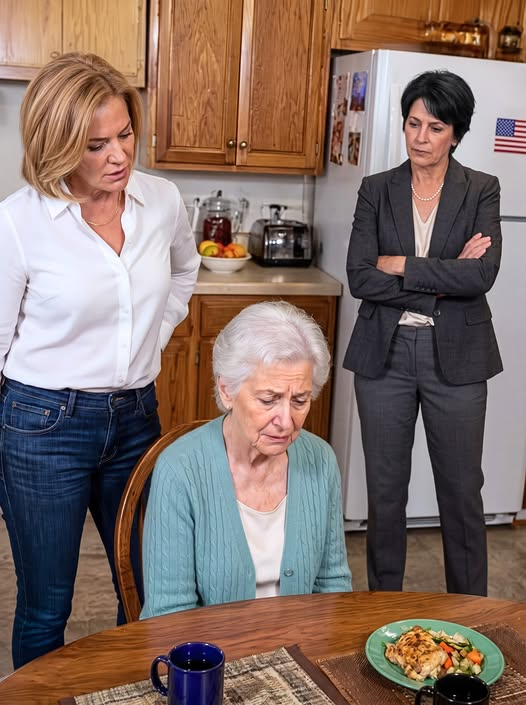
My daughter found me sitting alone in a dark house with almost nothing left to eat. When Emma switched on the living-room light and opened my refrigerator, she found only a bottle of water and half a lemon, even though ten thousand dollars from my pension entered my bank account every month.
“Mom, why is there nothing to eat in the kitchen? You get ten thousand dollars a month. Where is all that money going?”
Before I could answer, my daughter-in-law Rachel stepped into the room with the same calm expression she always wore when explaining my life for me.
“I control every dollar she receives.”
Emma stared at her for several seconds, then slowly removed the small gold earrings I had given her for college graduation and placed them on the table. Her voice remained perfectly steady.
“Then from today on, that control ends.”
My name is Margaret Thompson, and I was seventy-two years old. I had spent thirty-five years working as a nurse, saved carefully, invested responsibly, and built a pension large enough to let me live comfortably, yet somehow I had ended up afraid to buy groceries with my own money.
Two years earlier, after a minor fall in my garden, my son Daniel convinced me that managing my finances alone was becoming risky. He said Rachel worked in accounting and could protect me from fraud, missed bills, and the financial mistakes older people sometimes made.
At first, their concern felt loving. Rachel created online accounts, Daniel placed reassuring papers in front of me, and I signed wherever they marked because my son told me this was what family did for one another.
Slowly, the statements stopped arriving. Whenever I needed cash, Rachel gave me a small envelope containing fifty or one hundred dollars and acted as though I were asking permission to spend money that had always been mine.
I stopped replacing worn clothes, stopped joining friends for Sunday lunches, and canceled a trip to visit Emma because Rachel said traveling was not in the budget. When the heater began failing, she told me repairing it was unnecessary, and eventually I started wondering whether my memory had become unreliable.
That was the part that frightened me most. They had not only taken control of my finances, they had made me doubt myself enough to accept it.
Emma crouched beside me and took my hands.
“Mom, how much money do you receive every month?”
“Ten thousand dollars.”
Rachel laughed softly and explained that the actual amount was lower after taxes and “investment allocations.” Emma immediately stood and asked what investments she meant.
“Private ventures. Daniel and I are building something for the family.”
Then Emma opened the pantry and freezer. Both were empty.
“You’re investing for her future while she has no food?”
Rachel insisted I had agreed to everything and had signed the necessary documents. Emma turned toward me and asked the question nobody had bothered to ask in two years.
“Mom, did you understand what you were signing?”
I looked at Rachel, then back at my daughter.
“No. I told them I didn’t understand.”
Rachel’s face went pale.
Emma did not shout. She simply closed her hand around the earrings she had removed earlier and looked directly at Rachel.
“If she didn’t understand what she was signing, then this wasn’t protection. This was exploitation.”
At that exact moment, Emma’s phone rang. It was Daniel. And when she answered, my son did not sound worried about me. He sounded afraid of what we were about to discover.
Part 2: The Money That Was Almost Gone
Emma answered Daniel’s call on speaker, and his voice immediately filled the room with anger. Rachel accused Emma of creating unnecessary drama, but Emma refused to argue about anything except the missing pension money.
“There’s no drama. Tomorrow morning, Mom and I are going to the bank to find out exactly where her ten thousand dollars a month has been going.”
Daniel went silent for several seconds before answering in a slow, threatening tone.
“You are not going anywhere. The account is locked, and if you interfere, there will be consequences.”
When the call ended, I felt colder than I had when the heater was off. Until that moment, part of me had still wanted to believe this was nothing more than poor financial judgment, but Daniel’s threat made me realize that the problem was really about control.
Rachel insisted everything had been done for my benefit and reminded us that I had signed the paperwork. Emma asked whether I had ever received complete bank statements or personally visited the bank afterward, and both answers were no.
Rachel tried to leave, saying Daniel would handle everything the next day, but Emma stopped her.
“Tomorrow we’re going to the bank at nine. All of us.”
“You don’t have authority.”
Emma pointed toward me.
“She does.”
For the first time in years, the word authority felt as though it belonged to me again. When Rachel asked me to stop Emma before things became “embarrassing,” I looked toward the empty kitchen and thought about how humiliating it had been to ask permission for fifty dollars while ten thousand dollars entered my account every month.
“I want to see my account.”
Rachel finally admitted that Daniel’s construction business had been using my pension money. Some months it covered payroll, other months it filled gaps between projects, and she insisted everything would be repaid once the company became profitable.
Emma asked the question Rachel clearly did not want to answer.
“How much money is left?”
Rachel hesitated.
“Almost nothing.”
I could barely process the answer. Twenty-four months of ten-thousand-dollar deposits meant roughly $240,000 had passed through my account while I skipped lunches, postponed fixing the heater, and convinced myself I could not afford a new winter coat.
That night, Emma ordered groceries, cooked soup, and stayed with me. She also discovered that my email password had been changed and asked whether I remembered signing a power of attorney.
“I don’t remember. There were so many papers. I signed wherever Daniel and Rachel pointed.”
Emma explained that even if Daniel legally held power of attorney, he was still required to use my money for my benefit. Using my pension to support his own failing company could amount to financial misuse.
The next morning, Daniel and Rachel arrived before we could leave. Under pressure, Rachel admitted that Thompson Construction Group was carrying about $200,000 in debt.
Daniel pleaded with me not to go to the bank.
“If they freeze everything, the company collapses. People could lose their jobs.”
I looked directly at my son.
“And what do I lose?”
Daniel insisted it had been temporary and that a municipal contract was supposed to rescue the company. He also admitted that Martin Hail had advised him to move my pension money through the business to strengthen its financial appearance and make the company look healthier than it really was.
“You had a choice. You could have told the truth.”
Daniel’s voice broke.
“I didn’t want either of you to see me fail.”
Two hours later, Daniel and Rachel arrived at my house with Martin Hail. He was polished, calm, and professional, but the moment he began describing the transfers as ordinary financial restructuring, I understood why Emma distrusted him.
Martin pointed to the power of attorney as proof that everything had been authorized. I told him plainly that I had never understood the documents Daniel and Rachel placed in front of me.
“I did not understand what I signed.”
Martin studied me for a moment.
“Understanding can be subjective.”
Emma immediately stepped forward.
“Consent is not subjective when material risks were hidden.”
Martin then proposed what he called a solution. If I withdrew the bank investigation and allowed Daniel to restore access to the frozen funds, he claimed they could complete another pending transaction and generate enough liquidity to avoid disaster.
“We are not moving another dollar.”
Martin’s calm expression hardened.
“If this continues, creditors may accelerate recovery. Your mother’s house could be seized.”
Rachel suddenly denied sending the threatening messages or breaking into my home, and Daniel swore he had not done either. Martin then admitted that some of Daniel’s creditors had begun applying pressure because they believed money had been deliberately moved beyond their reach.
That was when Emma made the decision none of them wanted.
“We cooperate fully with the bank, and Mom gets an independent attorney.”
Martin warned that escalating the matter could produce irreversible consequences, but I was beginning to understand that silence had already cost me enough. More importantly, I noticed something in Daniel’s expression whenever Martin spoke.
My son was afraid of him.
When Martin’s phone rang, we overheard him telling someone that the funds were under review and that he was “handling it.” The polished confidence disappeared from his face, and for the first time it became obvious that Martin was protecting his own interests, not Daniel’s.
An independent financial attorney arrived later that day and reviewed the loan documents, transfer records, collateral agreements, and power of attorney. After studying everything, he confirmed that Daniel’s use of my pension appeared to exceed reasonable fiduciary authority and that a lien had indeed been placed against my house.
“Can I lose my home?”
“Yes, unless the loan is renegotiated or settled.”
Daniel lowered his head.
“I never wanted to risk your house.”
I looked directly at him.
“But you did.”
The attorney immediately froze further transfers, notified creditors that I now had independent representation, and began reviewing Martin’s role in the transactions. For the first time since Emma switched on the light in my dark living room, the people making decisions about my future were finally required to answer to me.
Part 5: The Light Stayed On
The weeks that followed were difficult, but for the first time the decisions were no longer being made behind my back. The investigation confirmed that roughly $237,000 from my pension had been transferred into Daniel’s failing business, while creditors examined the loan tied to my house and Martin Hail came under scrutiny for the advice he had given.
Because the transfers had been structured in ways that raised serious concerns, the lender eventually agreed to renegotiate instead of immediately pursuing my home. My house was removed from immediate seizure risk, not because anyone suddenly became generous, but because the paper trail gave my attorney leverage.
Daniel’s company could not survive the review. Thompson Construction Group entered formal restructuring and ultimately closed, forcing my son to face the public failure he had spent two years trying to hide.
One afternoon, Daniel came to my house alone and stood in the same living room where Emma had once found me sitting in darkness. He looked exhausted and humbled, without Rachel or Martin beside him to explain what had happened.
“Mom, I’m sorry.”
I studied him carefully.
“Sorry for what? Using my money? Risking my house? Or protecting your pride with my security?”
He swallowed before answering.
“All of it.”
That was the first apology from him that felt complete. Daniel promised he would repay what he could, even if it took years, and admitted that hiding the truth had caused far more damage than admitting failure ever would have.
Later, investigators determined that the threatening messages had come from someone connected to the debt-collection side of the business dispute. Daniel and Rachel had not sent them, but their secrecy had created the situation that allowed strangers to frighten me inside my own home.
I walked into the kitchen and opened the refrigerator. This time it was full of milk, eggs, bread, fruit, soup, and enough food for several days, ordinary things that suddenly felt almost luxurious.
“I don’t need revenge, Daniel. I need honesty.”
He nodded.
“And you need to understand something else. This house is my security, my memories, and my life. No business, no dream, and no family emergency gives anyone the right to risk it without my full understanding.”
In the weeks that followed, I changed every lock and revoked the power of attorney. My accounts were placed under independent oversight, my direct access was restored, and I learned how to check every statement and transaction myself.
Emma sat beside me with a yellow legal pad while I relearned passwords, online banking, and everything I had slowly been convinced I was too old to manage. Ten thousand dollars still arrived each month, but now I knew exactly where every dollar went.
One evening, Emma and I sat at the kitchen table with the lights on, the heater running, and dinner simmering on the stove.
“Mom, do you know what the real lesson was?”
“What?”
“Silence can look peaceful. But sometimes silence is the most dangerous thing in the room.”
I smiled because she was right. Control had entered my life disguised as concern, one password, one signature, and one calm explanation at a time.
I had almost disappeared inside my own life without realizing it.
Now the lights stayed on. The refrigerator stayed full. And every decision about my money, my home, and my future belonged to me again.
