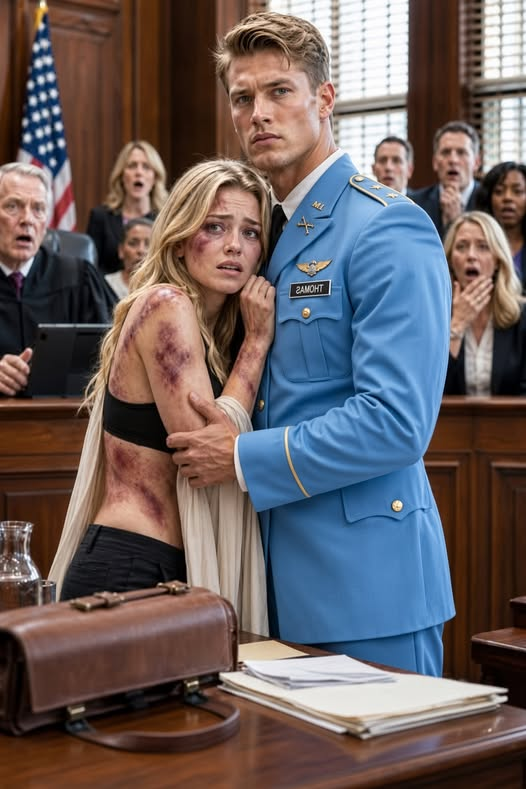
“Jess couldn’t hack it,” Emma would say with that sympathetic little smile, while my parents lowered their eyes in embarrassment.
Then I walked into her criminal trial, the clerk announced, “Brigadier General Jessica Carter,” and my sister’s face went completely white.
The courthouse looked almost ceremonial that morning.
White stone. American flags snapping in the wind. Cameras crowding the entrance, waiting for another headline about Emma Carter—the beloved charity director accused of stealing from the organization she had built her reputation around.
I stood at the bottom of the steps wearing dark glasses and watched reporters gather.
For most of my life, Emma had been the golden daughter.
Straight A’s. Perfect manners. Perfect smile.
And I had been the family disappointment.
According to her, I joined the Army at eighteen and washed out of basic training.
She repeated that story at weddings, holiday dinners, reunions—anywhere an audience might appreciate it.
“Poor Jess,” she would say. “She just couldn’t handle military life.”
Nobody ever asked me whether it was true.
Not even my parents.
They simply accepted Emma’s version because it was easy.
And I let them.
That was the part they never understood.
My silence wasn’t shame.
It was necessity.
I spent my twenties doing work I couldn’t discuss. My thirties were filled with assignments that never appeared on social media, in newsletters, or in family Christmas cards.
I learned languages.
Handled classified briefings.
Worked in places where a single careless sentence could cost lives.
While Emma was telling relatives I had failed basic training, I was moving steadily through the ranks.
By my forties, I had become Brigadier General Jessica Carter.
My family knew none of it.
That morning, I climbed the courthouse steps and entered through security.
A prosecutor’s assistant spotted me in the hallway and gave a small nod.
We had spent nearly a year helping build the case against Emma.
Not because I wanted revenge.
Because fraud leaves patterns.
And reading patterns had been part of my job for decades.
Millions of dollars had vanished from Emma’s children’s charity.
Donor funds had been redirected.
Invoices falsified.
Shell companies created.
The public case was simple.
The deeper financial trail was not.
I had helped untangle enough of it to make sure prosecutors knew where to look.
Then I entered the courtroom.
My parents sat in the second row.
Mom’s hands were locked tightly together. Dad stared straight ahead.
Neither noticed me at first.
Emma sat beside her attorneys.
Perfect hair.
Perfect suit.
Still playing the wounded victim.
Then she looked up.
Our eyes met.
Her expression changed.
Not fear yet.
Confusion.
Like she couldn’t understand why the sister who had supposedly failed at everything had any reason to be there.
The bailiff called the room to order.
A court officer approached me.
“Ma’am, we’re ready for you.”
Emma frowned.
My mother turned.
Then the clerk read my name from the witness list.
“Brigadier General Jessica Carter.”
The silence that followed was absolute.
My father’s head snapped toward me.
Mom covered her mouth.
Emma stared at the stars on my uniform like they had appeared by magic.
Then the prosecutor stood.
“General Carter,” she said, “please come forward.”
I walked toward the witness stand.
Emma had spent twenty-three years telling everyone I had failed basic training.
Now she was about to learn exactly what I had been doing while she laughed.
And why I was the witness her lawyers had been trying hardest to keep off the stand.
Advertisement
PART 2: The Truth Behind the Uniform
PublishedOctober 2, 2026
×
The prosecutor, Assistant United States Attorney Claire Donnelly, waited beside the lectern.
Claire was forty-three, sharp without being theatrical, the kind of lawyer who preferred a clean fact to a clever phrase.
That was one reason I trusted her.
The clerk held out the Bible.
I took the oath.
Then I sat.
For the first time in twenty-three years, my family was looking at me without Emma’s version of me standing in the way.
Claire approached.
“Please state your full name and occupation for the record.”
“Jessica Anne Carter. Brigadier General, United States Army.”
Behind Claire, I saw my mother close her eyes.
ContactTerms of ServicePrivacy Policy
Advertisement
PART 2: The Truth Behind the Uniform
PublishedOctober 2, 2026
×
The prosecutor, Assistant United States Attorney Claire Donnelly, waited beside the lectern.
Claire was forty-three, sharp without being theatrical, the kind of lawyer who preferred a clean fact to a clever phrase.
That was one reason I trusted her.
The clerk held out the Bible.
I took the oath.
Then I sat.
For the first time in twenty-three years, my family was looking at me without Emma’s version of me standing in the way.
Claire approached.
“Please state your full name and occupation for the record.”
“Jessica Anne Carter. Brigadier General, United States Army.”
Behind Claire, I saw my mother close her eyes.
Advertisement
My father lowered his head.
Emma stared straight ahead.
Claire continued.
“How long have you served?”
“Twenty-three years.”
There was movement in the gallery.
Not much.
A rustle of paper.
A reporter leaning forward.
Emma’s attorney stood.
“Objection. Relevance.”
Claire looked toward the judge.
“Your Honor, the witness’s professional background directly relates to the analytical assistance she provided during the financial review.”
Judge Elaine Morris glanced at me, then at Reeves.
“I’ll allow limited foundation. Keep it focused.”
“Yes, Your Honor.”
Claire turned back.
“General Carter, did you fail Army basic training after six weeks?”
Emma’s head turned.
Reeves rose immediately.
“Objection.”
Claire remained still.
Judge Morris looked over her glasses.
“Basis?”
“Relevance. Prejudicial. And frankly, unnecessary.”
Claire answered calmly.
“The defense challenged General Carter’s qualifications in its pretrial motion and described her as a family member with no relevant professional standing.
I am establishing the accuracy of that characterization.”
The judge considered.
“Overruled. Briefly.”
Claire looked at me.
I looked at Emma.
Then at my parents.
ContactTerms of ServicePrivacy Policy
Advertisement
PART 2: The Truth Behind the Uniform
PublishedOctober 2, 2026
×
The prosecutor, Assistant United States Attorney Claire Donnelly, waited beside the lectern.
Claire was forty-three, sharp without being theatrical, the kind of lawyer who preferred a clean fact to a clever phrase.
That was one reason I trusted her.
The clerk held out the Bible.
I took the oath.
Then I sat.
For the first time in twenty-three years, my family was looking at me without Emma’s version of me standing in the way.
Claire approached.
“Please state your full name and occupation for the record.”
“Jessica Anne Carter. Brigadier General, United States Army.”
Behind Claire, I saw my mother close her eyes.
Advertisement
My father lowered his head.
Emma stared straight ahead.
Claire continued.
“How long have you served?”
“Twenty-three years.”
There was movement in the gallery.
Not much.
A rustle of paper.
A reporter leaning forward.
Emma’s attorney stood.
“Objection. Relevance.”
Claire looked toward the judge.
“Your Honor, the witness’s professional background directly relates to the analytical assistance she provided during the financial review.”
Judge Elaine Morris glanced at me, then at Reeves.
Advertisement
“I’ll allow limited foundation. Keep it focused.”
“Yes, Your Honor.”
Claire turned back.
“General Carter, did you fail Army basic training after six weeks?”
Emma’s head turned.
Reeves rose immediately.
“Objection.”
Claire remained still.
Judge Morris looked over her glasses.
“Basis?”
“Relevance. Prejudicial. And frankly, unnecessary.”
Claire answered calmly.
“The defense challenged General Carter’s qualifications in its pretrial motion and described her as a family member with no relevant professional standing.
I am establishing the accuracy of that characterization.”
The judge considered.
“Overruled. Briefly.”
Claire looked at me.
I looked at Emma.
Then at my parents.
Advertisement
“No,” I said.
“I did not fail basic training.”
It was the simplest answer I gave all day.
And somehow the hardest.
Claire asked, “Did you complete it?”
“Yes.”
“Did you remain in military service afterward?”
“Yes.”
“For the full twenty-three years you just described?”
“Yes.”
Emma’s lawyer sat back slowly.
Claire did not linger.
She moved immediately into safer territory.
“Without discussing classified assignments, can you explain the nature of your experience?”
“My career has included intelligence analysis, financial pattern recognition, logistics oversight, interagency coordination, compliance review, and leadership responsibilities.”
“Have you reviewed complex financial records as part of that work?”
“Yes.”
“Have you received training in detecting unusual patterns across large amounts of data?”
“Yes.”
“Did you assist federal investigators in this case?”
“Yes.”
“In what capacity?”
“I helped organize and analyze financial records already obtained through lawful investigative processes.
I identified recurring payment structures, related entities, timing patterns, and inconsistencies that warranted further review.”
Claire paused.
“Did you make charging decisions?”
“No.”
“Did you issue subpoenas?”
“No.”
“Did you obtain records through independent access?”
“No.”
“Did you use your military authority to compel anyone involved in this case?”
“No.”
“Did you receive compensation from the prosecution?”
ContactTerms of ServicePrivacy Policy
Advertisement
PART 2: The Truth Behind the Uniform
PublishedOctober 2, 2026
×
The prosecutor, Assistant United States Attorney Claire Donnelly, waited beside the lectern.
Claire was forty-three, sharp without being theatrical, the kind of lawyer who preferred a clean fact to a clever phrase.
That was one reason I trusted her.
The clerk held out the Bible.
I took the oath.
Then I sat.
For the first time in twenty-three years, my family was looking at me without Emma’s version of me standing in the way.
Claire approached.
“Please state your full name and occupation for the record.”
“Jessica Anne Carter. Brigadier General, United States Army.”
Behind Claire, I saw my mother close her eyes.
Advertisement
My father lowered his head.
Emma stared straight ahead.
Claire continued.
“How long have you served?”
“Twenty-three years.”
There was movement in the gallery.
Not much.
A rustle of paper.
A reporter leaning forward.
Emma’s attorney stood.
“Objection. Relevance.”
Claire looked toward the judge.
“Your Honor, the witness’s professional background directly relates to the analytical assistance she provided during the financial review.”
Judge Elaine Morris glanced at me, then at Reeves.
Advertisement
“I’ll allow limited foundation. Keep it focused.”
“Yes, Your Honor.”
Claire turned back.
“General Carter, did you fail Army basic training after six weeks?”
Emma’s head turned.
Reeves rose immediately.
“Objection.”
Claire remained still.
Judge Morris looked over her glasses.
“Basis?”
“Relevance. Prejudicial. And frankly, unnecessary.”
Claire answered calmly.
“The defense challenged General Carter’s qualifications in its pretrial motion and described her as a family member with no relevant professional standing.
I am establishing the accuracy of that characterization.”
The judge considered.
“Overruled. Briefly.”
Claire looked at me.
I looked at Emma.
Then at my parents.
Advertisement
“No,” I said.
“I did not fail basic training.”
It was the simplest answer I gave all day.
And somehow the hardest.
Claire asked, “Did you complete it?”
“Yes.”
“Did you remain in military service afterward?”
“Yes.”
“For the full twenty-three years you just described?”
“Yes.”
Emma’s lawyer sat back slowly.
Claire did not linger.
She moved immediately into safer territory.
“Without discussing classified assignments, can you explain the nature of your experience?”
“My career has included intelligence analysis, financial pattern recognition, logistics oversight, interagency coordination, compliance review, and leadership responsibilities.”
“Have you reviewed complex financial records as part of that work?”
Advertisement
“Yes.”
“Have you received training in detecting unusual patterns across large amounts of data?”
“Yes.”
“Did you assist federal investigators in this case?”
“Yes.”
“In what capacity?”
“I helped organize and analyze financial records already obtained through lawful investigative processes.
I identified recurring payment structures, related entities, timing patterns, and inconsistencies that warranted further review.”
Claire paused.
“Did you make charging decisions?”
“No.”
“Did you issue subpoenas?”
“No.”
“Did you obtain records through independent access?”
“No.”
“Did you use your military authority to compel anyone involved in this case?”
“No.”
“Did you receive compensation from the prosecution?”
Advertisement
“No.”
“Why did you assist?”
That question had been discussed in preparation.
It was also the one I had dreaded.
I folded my hands.
“Because I was asked whether I could help interpret a complicated set of records, and because the organization involved served children and families who depended on those funds.”
Claire waited.
“And because the defendant is your sister?”
I looked at Emma.
“No.”
The word did not come from anger.
It came from certainty.
“My relationship to the defendant made me more cautious, not less.”
Emma finally looked at me.
There was hurt in her face now.
Real hurt.
That was what people watching the trial later would not understand.
They would see a defendant accused of stealing millions.
They would see a general testifying.
They would assume the story was about one sister exposing another.
It was not.
The truth was far messier.
I had spent most of the previous year hoping the evidence would lead somewhere else.
Claire displayed the first chart.
The Children’s Horizon Foundation had started seventeen years earlier.
Emma had founded it after volunteering at a temporary housing center during college.
At first, it was small.
Backpacks for children entering foster care.
Emergency hotel assistance for families displaced by fires.
Grants for school supplies.
Holiday meals.
I had donated anonymously for years.
Not because Emma asked me.
She did not even know.
I believed in the work.
So did thousands of other people.
Over time, Children’s Horizon grew.
Corporate sponsors arrived.
Fundraising galas became annual events.
Emma appeared on local television.
Then national morning programs.
She was photographed with governors, athletes, business leaders, and actors.
Our mother collected every article.
Our father kept recordings of interviews.
At Christmas, Emma’s achievements filled conversation before dessert.
I was usually absent.
ContactTerms of ServicePrivacy Policy
Advertisement
PART 2: The Truth Behind the Uniform
PublishedOctober 2, 2026
×
The prosecutor, Assistant United States Attorney Claire Donnelly, waited beside the lectern.
Claire was forty-three, sharp without being theatrical, the kind of lawyer who preferred a clean fact to a clever phrase.
That was one reason I trusted her.
The clerk held out the Bible.
I took the oath.
Then I sat.
For the first time in twenty-three years, my family was looking at me without Emma’s version of me standing in the way.
Claire approached.
“Please state your full name and occupation for the record.”
“Jessica Anne Carter. Brigadier General, United States Army.”
Behind Claire, I saw my mother close her eyes.
Advertisement
My father lowered his head.
Emma stared straight ahead.
Claire continued.
“How long have you served?”
“Twenty-three years.”
There was movement in the gallery.
Not much.
A rustle of paper.
A reporter leaning forward.
Emma’s attorney stood.
“Objection. Relevance.”
Claire looked toward the judge.
“Your Honor, the witness’s professional background directly relates to the analytical assistance she provided during the financial review.”
Judge Elaine Morris glanced at me, then at Reeves.
Advertisement
“I’ll allow limited foundation. Keep it focused.”
“Yes, Your Honor.”
Claire turned back.
“General Carter, did you fail Army basic training after six weeks?”
Emma’s head turned.
Reeves rose immediately.
“Objection.”
Claire remained still.
Judge Morris looked over her glasses.
“Basis?”
“Relevance. Prejudicial. And frankly, unnecessary.”
Claire answered calmly.
“The defense challenged General Carter’s qualifications in its pretrial motion and described her as a family member with no relevant professional standing.
I am establishing the accuracy of that characterization.”
The judge considered.
“Overruled. Briefly.”
Claire looked at me.
I looked at Emma.
Then at my parents.
Advertisement
“No,” I said.
“I did not fail basic training.”
It was the simplest answer I gave all day.
And somehow the hardest.
Claire asked, “Did you complete it?”
“Yes.”
“Did you remain in military service afterward?”
“Yes.”
“For the full twenty-three years you just described?”
“Yes.”
Emma’s lawyer sat back slowly.
Claire did not linger.
She moved immediately into safer territory.
“Without discussing classified assignments, can you explain the nature of your experience?”
“My career has included intelligence analysis, financial pattern recognition, logistics oversight, interagency coordination, compliance review, and leadership responsibilities.”
“Have you reviewed complex financial records as part of that work?”
Advertisement
“Yes.”
“Have you received training in detecting unusual patterns across large amounts of data?”
“Yes.”
“Did you assist federal investigators in this case?”
“Yes.”
“In what capacity?”
“I helped organize and analyze financial records already obtained through lawful investigative processes.
I identified recurring payment structures, related entities, timing patterns, and inconsistencies that warranted further review.”
Claire paused.
“Did you make charging decisions?”
“No.”
“Did you issue subpoenas?”
“No.”
“Did you obtain records through independent access?”
“No.”
“Did you use your military authority to compel anyone involved in this case?”
“No.”
“Did you receive compensation from the prosecution?”
Advertisement
“No.”
“Why did you assist?”
That question had been discussed in preparation.
It was also the one I had dreaded.
I folded my hands.
“Because I was asked whether I could help interpret a complicated set of records, and because the organization involved served children and families who depended on those funds.”
Claire waited.
“And because the defendant is your sister?”
I looked at Emma.
“No.”
The word did not come from anger.
It came from certainty.
“My relationship to the defendant made me more cautious, not less.”
Emma finally looked at me.
There was hurt in her face now.
Advertisement
Real hurt.
That was what people watching the trial later would not understand.
They would see a defendant accused of stealing millions.
They would see a general testifying.
They would assume the story was about one sister exposing another.
It was not.
The truth was far messier.
I had spent most of the previous year hoping the evidence would lead somewhere else.
Claire displayed the first chart.
The Children’s Horizon Foundation had started seventeen years earlier.
Emma had founded it after volunteering at a temporary housing center during college.
At first, it was small.
Backpacks for children entering foster care.
Advertisement
Emergency hotel assistance for families displaced by fires.
Grants for school supplies.
Holiday meals.
I had donated anonymously for years.
Not because Emma asked me.
She did not even know.
I believed in the work.
So did thousands of other people.
Over time, Children’s Horizon grew.
Corporate sponsors arrived.
Fundraising galas became annual events.
Emma appeared on local television.
Then national morning programs.
She was photographed with governors, athletes, business leaders, and actors.
Our mother collected every article.
Our father kept recordings of interviews.
At Christmas, Emma’s achievements filled conversation before dessert.
I was usually absent.
Advertisement
When I attended, my work became a joke.
“Jess is doing something mysterious again,” Emma would say.
Then someone would ask what.
Emma would smile.
“Well, after the Army didn’t work out, she bounced around government jobs. You know Jess. She likes privacy.”
That story began the first year after I enlisted.
I was nineteen.
Emma was twenty-two.
I had come home after basic training and advanced training for twelve days before reporting to my first assignment.
I was exhausted.
Thin.
Quiet.
I had cut my hair short.
One afternoon, Emma asked how long I planned to “play soldier.”
I said I didn’t know.
She asked whether basic had been difficult.
I said yes.
Then she laughed.
“You always hated being told what to do.”
I told her I had nearly been recycled during one phase because of a stress injury.
Nearly.
Not actually.
Emma remembered only the useful part.
Months later, I learned she had told our aunt that I washed out.
By the time I corrected the story, three relatives had already heard it.
Then I was assigned overseas.
Then communication became complicated.
Then my career moved into work I could not discuss.
At some point, correcting the family rumor felt less important than protecting the boundaries of my job.
So I stopped trying.
That became another kind of evidence for Emma.
Silence sounded like confirmation.
Claire advanced the financial chart.
“General Carter, directing your attention to Exhibit 42, what pattern did you observe?”
I looked toward the monitor.
Thirty-seven payments.
Different dates.
Different vendor names.
Similar amounts.
“All of these payments occurred within seventy-two hours of incoming donor transfers above a certain threshold.”
“What threshold?”
“Five hundred thousand dollars.”
“And what did the recipients have in common?”
“Initially, they appeared unrelated. But corporate registration records showed that nine of the entities used the same registered agent.
ContactTerms of ServicePrivacy Policy
Advertisement
PART 2: The Truth Behind the Uniform
PublishedOctober 2, 2026
×
The prosecutor, Assistant United States Attorney Claire Donnelly, waited beside the lectern.
Claire was forty-three, sharp without being theatrical, the kind of lawyer who preferred a clean fact to a clever phrase.
That was one reason I trusted her.
The clerk held out the Bible.
I took the oath.
Then I sat.
For the first time in twenty-three years, my family was looking at me without Emma’s version of me standing in the way.
Claire approached.
“Please state your full name and occupation for the record.”
“Jessica Anne Carter. Brigadier General, United States Army.”
Behind Claire, I saw my mother close her eyes.
Advertisement
My father lowered his head.
Emma stared straight ahead.
Claire continued.
“How long have you served?”
“Twenty-three years.”
There was movement in the gallery.
Not much.
A rustle of paper.
A reporter leaning forward.
Emma’s attorney stood.
“Objection. Relevance.”
Claire looked toward the judge.
“Your Honor, the witness’s professional background directly relates to the analytical assistance she provided during the financial review.”
Judge Elaine Morris glanced at me, then at Reeves.
Advertisement
“I’ll allow limited foundation. Keep it focused.”
“Yes, Your Honor.”
Claire turned back.
“General Carter, did you fail Army basic training after six weeks?”
Emma’s head turned.
Reeves rose immediately.
“Objection.”
Claire remained still.
Judge Morris looked over her glasses.
“Basis?”
“Relevance. Prejudicial. And frankly, unnecessary.”
Claire answered calmly.
“The defense challenged General Carter’s qualifications in its pretrial motion and described her as a family member with no relevant professional standing.
I am establishing the accuracy of that characterization.”
The judge considered.
“Overruled. Briefly.”
Claire looked at me.
I looked at Emma.
Then at my parents.
Advertisement
“No,” I said.
“I did not fail basic training.”
It was the simplest answer I gave all day.
And somehow the hardest.
Claire asked, “Did you complete it?”
“Yes.”
“Did you remain in military service afterward?”
“Yes.”
“For the full twenty-three years you just described?”
“Yes.”
Emma’s lawyer sat back slowly.
Claire did not linger.
She moved immediately into safer territory.
“Without discussing classified assignments, can you explain the nature of your experience?”
“My career has included intelligence analysis, financial pattern recognition, logistics oversight, interagency coordination, compliance review, and leadership responsibilities.”
“Have you reviewed complex financial records as part of that work?”
Advertisement
“Yes.”
“Have you received training in detecting unusual patterns across large amounts of data?”
“Yes.”
“Did you assist federal investigators in this case?”
“Yes.”
“In what capacity?”
“I helped organize and analyze financial records already obtained through lawful investigative processes.
I identified recurring payment structures, related entities, timing patterns, and inconsistencies that warranted further review.”
Claire paused.
“Did you make charging decisions?”
“No.”
“Did you issue subpoenas?”
“No.”
“Did you obtain records through independent access?”
“No.”
“Did you use your military authority to compel anyone involved in this case?”
“No.”
“Did you receive compensation from the prosecution?”
Advertisement
“No.”
“Why did you assist?”
That question had been discussed in preparation.
It was also the one I had dreaded.
I folded my hands.
“Because I was asked whether I could help interpret a complicated set of records, and because the organization involved served children and families who depended on those funds.”
Claire waited.
“And because the defendant is your sister?”
I looked at Emma.
“No.”
The word did not come from anger.
It came from certainty.
“My relationship to the defendant made me more cautious, not less.”
Emma finally looked at me.
There was hurt in her face now.
Advertisement
Real hurt.
That was what people watching the trial later would not understand.
They would see a defendant accused of stealing millions.
They would see a general testifying.
They would assume the story was about one sister exposing another.
It was not.
The truth was far messier.
I had spent most of the previous year hoping the evidence would lead somewhere else.
Claire displayed the first chart.
The Children’s Horizon Foundation had started seventeen years earlier.
Emma had founded it after volunteering at a temporary housing center during college.
At first, it was small.
Backpacks for children entering foster care.
Advertisement
Emergency hotel assistance for families displaced by fires.
Grants for school supplies.
Holiday meals.
I had donated anonymously for years.
Not because Emma asked me.
She did not even know.
I believed in the work.
So did thousands of other people.
Over time, Children’s Horizon grew.
Corporate sponsors arrived.
Fundraising galas became annual events.
Emma appeared on local television.
Then national morning programs.
She was photographed with governors, athletes, business leaders, and actors.
Our mother collected every article.
Our father kept recordings of interviews.
At Christmas, Emma’s achievements filled conversation before dessert.
I was usually absent.
Advertisement
When I attended, my work became a joke.
“Jess is doing something mysterious again,” Emma would say.
Then someone would ask what.
Emma would smile.
“Well, after the Army didn’t work out, she bounced around government jobs. You know Jess. She likes privacy.”
That story began the first year after I enlisted.
I was nineteen.
Emma was twenty-two.
I had come home after basic training and advanced training for twelve days before reporting to my first assignment.
I was exhausted.
Thin.
Quiet.
I had cut my hair short.
One afternoon, Emma asked how long I planned to “play soldier.”
Advertisement
I said I didn’t know.
She asked whether basic had been difficult.
I said yes.
Then she laughed.
“You always hated being told what to do.”
I told her I had nearly been recycled during one phase because of a stress injury.
Nearly.
Not actually.
Emma remembered only the useful part.
Months later, I learned she had told our aunt that I washed out.
By the time I corrected the story, three relatives had already heard it.
Then I was assigned overseas.
Then communication became complicated.
Then my career moved into work I could not discuss.
At some point, correcting the family rumor felt less important than protecting the boundaries of my job.
Advertisement
So I stopped trying.
That became another kind of evidence for Emma.
Silence sounded like confirmation.
Claire advanced the financial chart.
“General Carter, directing your attention to Exhibit 42, what pattern did you observe?”
I looked toward the monitor.
Thirty-seven payments.
Different dates.
Different vendor names.
Similar amounts.
“All of these payments occurred within seventy-two hours of incoming donor transfers above a certain threshold.”
“What threshold?”
“Five hundred thousand dollars.”
“And what did the recipients have in common?”
“Initially, they appeared unrelated. But corporate registration records showed that nine of the entities used the same registered agent.
Advertisement
Four shared a mailing address. Six had bank accounts opened at the same branch within an eleven-month period.”
“Why is that significant?”
“It does not prove wrongdoing by itself. But it suggests a relationship worth examining.”
That phrase mattered.
Worth examining.
Not guilty.
Not fraud.
Not theft.
Patterns are invitations to ask better questions.
They are not verdicts.
Claire displayed another chart.
The money moved from Children’s Horizon to vendors supposedly providing transportation, temporary lodging, meal services, and educational materials.
Some vendors were legitimate.
Some were not.
Several existed mostly on paper.
Reeves objected to portions of my interpretation.
Judge Morris limited certain conclusions.
Claire adjusted.
That was how the morning went.
Quietly.
Methodically.
There were no gasps.
No dramatic confession.
Only spreadsheets and invoices.
The most damaging evidence was boring.
A series of duplicate invoice numbers.
Payments approved on weekends when no one from the foundation’s accounting team was logged into the system.
Contracts supposedly signed by vendors who later testified they had never heard of Children’s Horizon.
And a consulting company called Northline Civic Solutions.
Northline had received more than $1.8 million over four years.
The company had no employees.
Its listed office was a rented mailbox.
The owner on paper was a man named Victor Hale.
Emma claimed she barely knew him.
Investigators found dozens of messages between them.
None were romantic.
None contained threats.
Most were mundane.
Scheduling.
Invoices.
Event arrangements.
That made the case harder.
And more believable.
Financial misconduct rarely announces itself in sinister language.
Often it looks like administration.
Claire asked me to explain the payment cycle.
I did.
When Northline received foundation funds, portions were transferred to two other companies.
One paid for event production.
Another covered property expenses at a lake house owned by an LLC connected to Emma.
ContactTerms of ServicePrivacy Policy
Advertisement
PART 2: The Truth Behind the Uniform
PublishedOctober 2, 2026
×
The prosecutor, Assistant United States Attorney Claire Donnelly, waited beside the lectern.
Claire was forty-three, sharp without being theatrical, the kind of lawyer who preferred a clean fact to a clever phrase.
That was one reason I trusted her.
The clerk held out the Bible.
I took the oath.
Then I sat.
For the first time in twenty-three years, my family was looking at me without Emma’s version of me standing in the way.
Claire approached.
“Please state your full name and occupation for the record.”
“Jessica Anne Carter. Brigadier General, United States Army.”
Behind Claire, I saw my mother close her eyes.
Advertisement
My father lowered his head.
Emma stared straight ahead.
Claire continued.
“How long have you served?”
“Twenty-three years.”
There was movement in the gallery.
Not much.
A rustle of paper.
A reporter leaning forward.
Emma’s attorney stood.
“Objection. Relevance.”
Claire looked toward the judge.
“Your Honor, the witness’s professional background directly relates to the analytical assistance she provided during the financial review.”
Judge Elaine Morris glanced at me, then at Reeves.
Advertisement
“I’ll allow limited foundation. Keep it focused.”
“Yes, Your Honor.”
Claire turned back.
“General Carter, did you fail Army basic training after six weeks?”
Emma’s head turned.
Reeves rose immediately.
“Objection.”
Claire remained still.
Judge Morris looked over her glasses.
“Basis?”
“Relevance. Prejudicial. And frankly, unnecessary.”
Claire answered calmly.
“The defense challenged General Carter’s qualifications in its pretrial motion and described her as a family member with no relevant professional standing.
I am establishing the accuracy of that characterization.”
The judge considered.
“Overruled. Briefly.”
Claire looked at me.
I looked at Emma.
Then at my parents.
Advertisement
“No,” I said.
“I did not fail basic training.”
It was the simplest answer I gave all day.
And somehow the hardest.
Claire asked, “Did you complete it?”
“Yes.”
“Did you remain in military service afterward?”
“Yes.”
“For the full twenty-three years you just described?”
“Yes.”
Emma’s lawyer sat back slowly.
Claire did not linger.
She moved immediately into safer territory.
“Without discussing classified assignments, can you explain the nature of your experience?”
“My career has included intelligence analysis, financial pattern recognition, logistics oversight, interagency coordination, compliance review, and leadership responsibilities.”
“Have you reviewed complex financial records as part of that work?”
Advertisement
“Yes.”
“Have you received training in detecting unusual patterns across large amounts of data?”
“Yes.”
“Did you assist federal investigators in this case?”
“Yes.”
“In what capacity?”
“I helped organize and analyze financial records already obtained through lawful investigative processes.
I identified recurring payment structures, related entities, timing patterns, and inconsistencies that warranted further review.”
Claire paused.
“Did you make charging decisions?”
“No.”
“Did you issue subpoenas?”
“No.”
“Did you obtain records through independent access?”
“No.”
“Did you use your military authority to compel anyone involved in this case?”
“No.”
“Did you receive compensation from the prosecution?”
Advertisement
“No.”
“Why did you assist?”
That question had been discussed in preparation.
It was also the one I had dreaded.
I folded my hands.
“Because I was asked whether I could help interpret a complicated set of records, and because the organization involved served children and families who depended on those funds.”
Claire waited.
“And because the defendant is your sister?”
I looked at Emma.
“No.”
The word did not come from anger.
It came from certainty.
“My relationship to the defendant made me more cautious, not less.”
Emma finally looked at me.
There was hurt in her face now.
Advertisement
Real hurt.
That was what people watching the trial later would not understand.
They would see a defendant accused of stealing millions.
They would see a general testifying.
They would assume the story was about one sister exposing another.
It was not.
The truth was far messier.
I had spent most of the previous year hoping the evidence would lead somewhere else.
Claire displayed the first chart.
The Children’s Horizon Foundation had started seventeen years earlier.
Emma had founded it after volunteering at a temporary housing center during college.
At first, it was small.
Backpacks for children entering foster care.
Advertisement
Emergency hotel assistance for families displaced by fires.
Grants for school supplies.
Holiday meals.
I had donated anonymously for years.
Not because Emma asked me.
She did not even know.
I believed in the work.
So did thousands of other people.
Over time, Children’s Horizon grew.
Corporate sponsors arrived.
Fundraising galas became annual events.
Emma appeared on local television.
Then national morning programs.
She was photographed with governors, athletes, business leaders, and actors.
Our mother collected every article.
Our father kept recordings of interviews.
At Christmas, Emma’s achievements filled conversation before dessert.
I was usually absent.
Advertisement
When I attended, my work became a joke.
“Jess is doing something mysterious again,” Emma would say.
Then someone would ask what.
Emma would smile.
“Well, after the Army didn’t work out, she bounced around government jobs. You know Jess. She likes privacy.”
That story began the first year after I enlisted.
I was nineteen.
Emma was twenty-two.
I had come home after basic training and advanced training for twelve days before reporting to my first assignment.
I was exhausted.
Thin.
Quiet.
I had cut my hair short.
One afternoon, Emma asked how long I planned to “play soldier.”
Advertisement
I said I didn’t know.
She asked whether basic had been difficult.
I said yes.
Then she laughed.
“You always hated being told what to do.”
I told her I had nearly been recycled during one phase because of a stress injury.
Nearly.
Not actually.
Emma remembered only the useful part.
Months later, I learned she had told our aunt that I washed out.
By the time I corrected the story, three relatives had already heard it.
Then I was assigned overseas.
Then communication became complicated.
Then my career moved into work I could not discuss.
At some point, correcting the family rumor felt less important than protecting the boundaries of my job.
Advertisement
So I stopped trying.
That became another kind of evidence for Emma.
Silence sounded like confirmation.
Claire advanced the financial chart.
“General Carter, directing your attention to Exhibit 42, what pattern did you observe?”
I looked toward the monitor.
Thirty-seven payments.
Different dates.
Different vendor names.
Similar amounts.
“All of these payments occurred within seventy-two hours of incoming donor transfers above a certain threshold.”
“What threshold?”
“Five hundred thousand dollars.”
“And what did the recipients have in common?”
“Initially, they appeared unrelated. But corporate registration records showed that nine of the entities used the same registered agent.
Advertisement
Four shared a mailing address. Six had bank accounts opened at the same branch within an eleven-month period.”
“Why is that significant?”
“It does not prove wrongdoing by itself. But it suggests a relationship worth examining.”
That phrase mattered.
Worth examining.
Not guilty.
Not fraud.
Not theft.
Patterns are invitations to ask better questions.
They are not verdicts.
Claire displayed another chart.
The money moved from Children’s Horizon to vendors supposedly providing transportation, temporary lodging, meal services, and educational materials.
Some vendors were legitimate.
Some were not.
Several existed mostly on paper.
Reeves objected to portions of my interpretation.
Advertisement
Judge Morris limited certain conclusions.
Claire adjusted.
That was how the morning went.
Quietly.
Methodically.
There were no gasps.
No dramatic confession.
Only spreadsheets and invoices.
The most damaging evidence was boring.
A series of duplicate invoice numbers.
Payments approved on weekends when no one from the foundation’s accounting team was logged into the system.
Contracts supposedly signed by vendors who later testified they had never heard of Children’s Horizon.
And a consulting company called Northline Civic Solutions.
Northline had received more than $1.8 million over four years.
The company had no employees.
Its listed office was a rented mailbox.
Advertisement
The owner on paper was a man named Victor Hale.
Emma claimed she barely knew him.
Investigators found dozens of messages between them.
None were romantic.
None contained threats.
Most were mundane.
Scheduling.
Invoices.
Event arrangements.
That made the case harder.
And more believable.
Financial misconduct rarely announces itself in sinister language.
Often it looks like administration.
Claire asked me to explain the payment cycle.
I did.
When Northline received foundation funds, portions were transferred to two other companies.
One paid for event production.
Another covered property expenses at a lake house owned by an LLC connected to Emma.
Advertisement
Reeves stood.
“Objection. Mischaracterizes the ownership.”
Claire nodded.
“Let me rephrase.”
The judge allowed it.
The home was legally held by an LLC.
Emma was one of three beneficiaries of the trust that owned the LLC.
The other two were our parents.
That was the first fact that had made me physically ill when investigators showed it to me.
Not because my parents had committed a crime.
There was no evidence they had.
They had signed estate-planning papers years earlier.
They did not understand how the property structure worked.
Dad thought the lake house was a foundation retreat property.
Mom believed donors had funded it for staff workshops.
Emma had told different stories to different people.
That pattern appeared everywhere.
Not enormous lies.
Small adjustments.
Whatever explanation made the current conversation easiest.
Claire finished the morning examination shortly before noon.
Judge Morris called recess.
I stepped down.
For a moment, I considered leaving through the side door.
Then I saw my mother stand.
She did not come toward me.
She seemed unable to decide whether she was allowed.
That hurt more than I expected.
So I walked to her.
“Hi, Mom.”
Her face crumpled.
ContactTerms of ServicePrivacy Policy
Advertisement
PART 2: The Truth Behind the Uniform
PublishedOctober 2, 2026
×
The prosecutor, Assistant United States Attorney Claire Donnelly, waited beside the lectern.
Claire was forty-three, sharp without being theatrical, the kind of lawyer who preferred a clean fact to a clever phrase.
That was one reason I trusted her.
The clerk held out the Bible.
I took the oath.
Then I sat.
For the first time in twenty-three years, my family was looking at me without Emma’s version of me standing in the way.
Claire approached.
“Please state your full name and occupation for the record.”
“Jessica Anne Carter. Brigadier General, United States Army.”
Behind Claire, I saw my mother close her eyes.
Advertisement
My father lowered his head.
Emma stared straight ahead.
Claire continued.
“How long have you served?”
“Twenty-three years.”
There was movement in the gallery.
Not much.
A rustle of paper.
A reporter leaning forward.
Emma’s attorney stood.
“Objection. Relevance.”
Claire looked toward the judge.
“Your Honor, the witness’s professional background directly relates to the analytical assistance she provided during the financial review.”
Judge Elaine Morris glanced at me, then at Reeves.
Advertisement
“I’ll allow limited foundation. Keep it focused.”
“Yes, Your Honor.”
Claire turned back.
“General Carter, did you fail Army basic training after six weeks?”
Emma’s head turned.
Reeves rose immediately.
“Objection.”
Claire remained still.
Judge Morris looked over her glasses.
“Basis?”
“Relevance. Prejudicial. And frankly, unnecessary.”
Claire answered calmly.
“The defense challenged General Carter’s qualifications in its pretrial motion and described her as a family member with no relevant professional standing.
I am establishing the accuracy of that characterization.”
The judge considered.
“Overruled. Briefly.”
Claire looked at me.
I looked at Emma.
Then at my parents.
Advertisement
“No,” I said.
“I did not fail basic training.”
It was the simplest answer I gave all day.
And somehow the hardest.
Claire asked, “Did you complete it?”
“Yes.”
“Did you remain in military service afterward?”
“Yes.”
“For the full twenty-three years you just described?”
“Yes.”
Emma’s lawyer sat back slowly.
Claire did not linger.
She moved immediately into safer territory.
“Without discussing classified assignments, can you explain the nature of your experience?”
“My career has included intelligence analysis, financial pattern recognition, logistics oversight, interagency coordination, compliance review, and leadership responsibilities.”
“Have you reviewed complex financial records as part of that work?”
Advertisement
“Yes.”
“Have you received training in detecting unusual patterns across large amounts of data?”
“Yes.”
“Did you assist federal investigators in this case?”
“Yes.”
“In what capacity?”
“I helped organize and analyze financial records already obtained through lawful investigative processes.
I identified recurring payment structures, related entities, timing patterns, and inconsistencies that warranted further review.”
Claire paused.
“Did you make charging decisions?”
“No.”
“Did you issue subpoenas?”
“No.”
“Did you obtain records through independent access?”
“No.”
“Did you use your military authority to compel anyone involved in this case?”
“No.”
“Did you receive compensation from the prosecution?”
Advertisement
“No.”
“Why did you assist?”
That question had been discussed in preparation.
It was also the one I had dreaded.
I folded my hands.
“Because I was asked whether I could help interpret a complicated set of records, and because the organization involved served children and families who depended on those funds.”
Claire waited.
“And because the defendant is your sister?”
I looked at Emma.
“No.”
The word did not come from anger.
It came from certainty.
“My relationship to the defendant made me more cautious, not less.”
Emma finally looked at me.
There was hurt in her face now.
Advertisement
Real hurt.
That was what people watching the trial later would not understand.
They would see a defendant accused of stealing millions.
They would see a general testifying.
They would assume the story was about one sister exposing another.
It was not.
The truth was far messier.
I had spent most of the previous year hoping the evidence would lead somewhere else.
Claire displayed the first chart.
The Children’s Horizon Foundation had started seventeen years earlier.
Emma had founded it after volunteering at a temporary housing center during college.
At first, it was small.
Backpacks for children entering foster care.
Advertisement
Emergency hotel assistance for families displaced by fires.
Grants for school supplies.
Holiday meals.
I had donated anonymously for years.
Not because Emma asked me.
She did not even know.
I believed in the work.
So did thousands of other people.
Over time, Children’s Horizon grew.
Corporate sponsors arrived.
Fundraising galas became annual events.
Emma appeared on local television.
Then national morning programs.
She was photographed with governors, athletes, business leaders, and actors.
Our mother collected every article.
Our father kept recordings of interviews.
At Christmas, Emma’s achievements filled conversation before dessert.
I was usually absent.
Advertisement
When I attended, my work became a joke.
“Jess is doing something mysterious again,” Emma would say.
Then someone would ask what.
Emma would smile.
“Well, after the Army didn’t work out, she bounced around government jobs. You know Jess. She likes privacy.”
That story began the first year after I enlisted.
I was nineteen.
Emma was twenty-two.
I had come home after basic training and advanced training for twelve days before reporting to my first assignment.
I was exhausted.
Thin.
Quiet.
I had cut my hair short.
One afternoon, Emma asked how long I planned to “play soldier.”
Advertisement
I said I didn’t know.
She asked whether basic had been difficult.
I said yes.
Then she laughed.
“You always hated being told what to do.”
I told her I had nearly been recycled during one phase because of a stress injury.
Nearly.
Not actually.
Emma remembered only the useful part.
Months later, I learned she had told our aunt that I washed out.
By the time I corrected the story, three relatives had already heard it.
Then I was assigned overseas.
Then communication became complicated.
Then my career moved into work I could not discuss.
At some point, correcting the family rumor felt less important than protecting the boundaries of my job.
Advertisement
So I stopped trying.
That became another kind of evidence for Emma.
Silence sounded like confirmation.
Claire advanced the financial chart.
“General Carter, directing your attention to Exhibit 42, what pattern did you observe?”
I looked toward the monitor.
Thirty-seven payments.
Different dates.
Different vendor names.
Similar amounts.
“All of these payments occurred within seventy-two hours of incoming donor transfers above a certain threshold.”
“What threshold?”
“Five hundred thousand dollars.”
“And what did the recipients have in common?”
“Initially, they appeared unrelated. But corporate registration records showed that nine of the entities used the same registered agent.
Advertisement
Four shared a mailing address. Six had bank accounts opened at the same branch within an eleven-month period.”
“Why is that significant?”
“It does not prove wrongdoing by itself. But it suggests a relationship worth examining.”
That phrase mattered.
Worth examining.
Not guilty.
Not fraud.
Not theft.
Patterns are invitations to ask better questions.
They are not verdicts.
Claire displayed another chart.
The money moved from Children’s Horizon to vendors supposedly providing transportation, temporary lodging, meal services, and educational materials.
Some vendors were legitimate.
Some were not.
Several existed mostly on paper.
Reeves objected to portions of my interpretation.
Advertisement
Judge Morris limited certain conclusions.
Claire adjusted.
That was how the morning went.
Quietly.
Methodically.
There were no gasps.
No dramatic confession.
Only spreadsheets and invoices.
The most damaging evidence was boring.
A series of duplicate invoice numbers.
Payments approved on weekends when no one from the foundation’s accounting team was logged into the system.
Contracts supposedly signed by vendors who later testified they had never heard of Children’s Horizon.
And a consulting company called Northline Civic Solutions.
Northline had received more than $1.8 million over four years.
The company had no employees.
Its listed office was a rented mailbox.
Advertisement
The owner on paper was a man named Victor Hale.
Emma claimed she barely knew him.
Investigators found dozens of messages between them.
None were romantic.
None contained threats.
Most were mundane.
Scheduling.
Invoices.
Event arrangements.
That made the case harder.
And more believable.
Financial misconduct rarely announces itself in sinister language.
Often it looks like administration.
Claire asked me to explain the payment cycle.
I did.
When Northline received foundation funds, portions were transferred to two other companies.
One paid for event production.
Another covered property expenses at a lake house owned by an LLC connected to Emma.
Advertisement
Reeves stood.
“Objection. Mischaracterizes the ownership.”
Claire nodded.
“Let me rephrase.”
The judge allowed it.
The home was legally held by an LLC.
Emma was one of three beneficiaries of the trust that owned the LLC.
The other two were our parents.
That was the first fact that had made me physically ill when investigators showed it to me.
Not because my parents had committed a crime.
There was no evidence they had.
They had signed estate-planning papers years earlier.
They did not understand how the property structure worked.
Dad thought the lake house was a foundation retreat property.
Advertisement
Mom believed donors had funded it for staff workshops.
Emma had told different stories to different people.
That pattern appeared everywhere.
Not enormous lies.
Small adjustments.
Whatever explanation made the current conversation easiest.
Claire finished the morning examination shortly before noon.
Judge Morris called recess.
I stepped down.
For a moment, I considered leaving through the side door.
Then I saw my mother stand.
She did not come toward me.
She seemed unable to decide whether she was allowed.
That hurt more than I expected.
So I walked to her.
“Hi, Mom.”
Her face crumpled.
Advertisement
Not dramatically.
Just enough to show twenty-three years of confusion trying to rearrange themselves at once.
“You’re a general.”
“Yes.”
Dad stood beside her.
His voice was rough.
“You stayed in.”
“Yes.”
“All this time?”
“Yes.”
He looked at my uniform.
Then at my face.
“Why didn’t you tell us?”
There it was.
The question I had imagined for years.
I could have answered with anger.
Because you never asked.
Because you believed Emma.
Because when I tried to correct you, you treated it like an uncomfortable detail.
All of those things were true.
But none were complete.
“I tried when I was younger,” I said.
Mom looked stricken.
“When?”
“After my first deployment. At Thanksgiving.”
She frowned, searching memory.
I remembered perfectly.
I had been twenty-one.
I came home for four days.
Dad asked whether I had found “something more stable.”
Mom told me not to worry because “lots of people take time to find themselves.”
Emma had laughed from the kitchen and said, “At least she learned how to make a bed properly.”
I had started to explain.
Then my pager went off.
I left the room.
Later, I decided the truth could wait.
It kept waiting.
Dad rubbed his forehead.
“I thought…”
“I know.”
“No, Jess. I thought you left the Army.”
“I know.”
“Emma said—”
“I know what Emma said.”
Mom whispered, “Why didn’t you correct us?”
“I did. A few times.”
Neither spoke.
“Then I stopped.”
“Why?”
I looked toward the courtroom doors.
“Because part of my work required discretion. And because eventually I wanted to know whether anyone would ask me directly.”
Mom’s eyes filled.
“We should have.”
“Yes.”
There was no cruelty in saying it.
No satisfaction either.
Just a fact.
Dad looked toward Emma’s defense table.
“She lied to us.”
“About my career, yes.”
“About everything?”
“No.”
That answer surprised him.
I continued.
“Emma did good work for years. Children’s Horizon helped people. The case doesn’t erase all of that.”
Mom looked confused.
“How can you say that after what she did?”
“Because truth shouldn’t depend on which truth hurts less.”
The courtroom deputy announced fifteen minutes remaining in recess.
Dad touched my sleeve.
“Can we talk after?”
“I’m under witness restrictions until my testimony is complete.”
His hand fell.
“Right.”
“We’ll talk later.”
I returned to the witness room.
Claire was waiting with two paper cups of coffee.
“You okay?”
“Yes.”
She handed me one.
“You’re lying.”
“I’m functioning.”
“That I believe.”
I sat.
“Did I sound defensive?”
“No.”
“Too personal?”
“No.”
“Too cold?”
Claire looked at me.
“Jessica, you are testifying in your sister’s criminal trial. There is no perfect emotional temperature for that.”
I stared into the coffee.
“I don’t want the jury to think I came here because of our family history.”
“Then answer exactly as you have.”
She sat across from me.
“Reeves will probably explore it on cross.”
“I expected that.”
“He may suggest bias.”
“He should.”
Claire raised an eyebrow.
“If I were him, I would.”
She smiled faintly.
“Remind me never to put you on the other side.”
The afternoon began with cross-examination.
Daniel Reeves was good.
That mattered.
Emma had not hired a bully.
He was thoughtful, careful, and clearly uncomfortable with the public appetite for turning a difficult case into spectacle.
He approached the lectern.
“General Carter, your military service is distinguished, correct?”
“I have served honorably.”
“You’ve received commendations?”
“Yes.”
“You’ve led large organizations?”
“Yes.”
“You are trained to identify irregularities?”
“Yes.”
“And yet you are not a certified public accountant.”
“No.”
“Not a forensic accountant.”
“No.”
“Not an FBI financial crimes agent.”
“No.”
“You have never worked for Children’s Horizon.”
“No.”
“You have never managed its accounting system.”
“No.”
He nodded.
“So your role was supportive.”
“Yes.”
“Not investigative command.”
“Correct.”
“And the government ultimately relied on professional forensic accountants.”
“Yes.”
That was fair.
Reeves turned a page.
“Now, General Carter, the defendant is your older sister.”
“Yes.”
“Your relationship has been strained.”
“Yes.”
“For many years.”
“Yes.”
“She misrepresented your military history to your family.”
“Yes.”
A small stir moved through the gallery.
Judge Morris glanced up.
Reeves continued.
“That hurt you.”
“Yes.”
“You resented it.”
I thought carefully.
“At times.”
“At times?”
“Yes.”
He looked at the jury.
“Would it be fair to say your sister publicly diminished your accomplishments for more than two decades?”
“I would say she described my life inaccurately.”
Reeves paused.
The answer had not given him as much as he wanted.
“But that inaccurate description caused pain.”
“Yes.”
“Then when federal investigators began examining her foundation, you volunteered to help.”
“No.”
He stopped.
“No?”
“I was approached.”
“By whom?”
“A former colleague who was consulting with an interagency financial analysis group.”
“And when asked, you agreed.”
“Yes.”
“Despite knowing your sister was the subject.”
“I disclosed the relationship immediately.”
“Why not decline?”
“Because I initially believed my role would be limited to identifying analytical methods that could help structure the review.”
“But your role expanded.”
“Yes.”
“And you stayed.”
“Yes.”
Reeves leaned against the lectern.
“General Carter, did part of you want to know whether your sister had finally been caught lying about something?”
Claire stood.
“Objection.”
Judge Morris considered.
“Overruled. The witness may answer if she can.”
I looked at Reeves.
Then at Emma.
“Yes.”
The courtroom became very still.
Reeves seemed surprised.
I continued.
“I would be dishonest if I claimed no personal feeling entered my mind.
When I first learned investigators suspected financial irregularities, I wondered whether Emma had been dishonest in other areas of her life.”
Reeves nodded.
“So there was bias.”
“There was potential bias.
That is why I documented the relationship, limited my role, and asked for independent verification of every pattern I identified.”
He stared at me.
“And if the independent analysis had cleared your sister?”
“I would have been relieved.”
Emma looked down.
That was the first time I saw her expression break.
Not because I had attacked her.
Because I had told the truth.
Reeves changed direction.
He asked about alternative explanations.
Could duplicate invoice numbers result from software errors?
Yes.
Could vendors share addresses?
Yes.
Could related companies be legitimate?
Yes.
Could transfers to property expenses have a lawful business purpose?
Yes.
Each answer mattered.
The government’s case was not one chart.
It was the accumulation.
Reeves did what a defense lawyer should do.
He separated threads.
Claire would later ask the jury to see the fabric.
Near the end of cross-examination, Reeves asked the question that shifted everything.
“General Carter, did you ever communicate with your sister about Children’s Horizon’s finances before federal investigators contacted you?”
“Yes.”
Claire looked up.
Reeves did too.
“When?”
“Approximately eighteen months before the formal investigation began.”
“What was the nature of that communication?”
“I asked Emma a question about an annual report.”
Emma’s eyes closed.
Reeves hesitated.
I realized then that he did not know.
“Which annual report?”
“The foundation’s public donor report for that year.”
“What did you notice?”
“A discrepancy.”
“What discrepancy?”
Claire rose.
“Your Honor, may we approach?”
The attorneys went to sidebar.
I remained still.
This part of the story had been legally sensitive because it involved an email Emma sent long before any investigation.
Eventually, Judge Morris allowed limited questioning.
Reeves returned.
“What did you observe in the public report?”
“A listed program expense had increased by approximately forty percent while the number of reported beneficiaries had decreased.”
“And you asked your sister about it?”
“Yes.”
“What did she say?”
“That rising housing costs explained the increase.”
“Did you believe her?”
“At the time, yes.”
That answer surprised Emma.
“Did you take further action?”
“No.”
“Why not?”
“Because it was her organization, the explanation was plausible, and I had no reason then to assume wrongdoing.”
Reeves nodded slowly.
“So eighteen months before investigators contacted you, you saw something unusual and did nothing.”
“Yes.”
Claire did not object.
Neither did I.
The truth did not need polishing.
Reeves sat down.
On redirect, Claire asked only three questions.
“General Carter, when you noticed that discrepancy eighteen months before the investigation, did you have access to the foundation’s internal records?”
“No.”
“Did the public report alone establish fraud?”
“No.”
“And when later investigators obtained additional records, did you rely on your old suspicion?”
“No. I relied on the new records.”
“Thank you.”
I stepped down just before four.
I was almost at the courtroom door when Emma spoke.
“Jess.”
Her attorney looked startled.
Judge Morris had already left.
The jury was gone.
The room was emptying.
I stopped.
Emma remained seated.
Her face looked older than it had that morning.
Not ruined.
Not defeated.
Simply tired.
“Can I talk to you?”
Reeves immediately said, “Emma.”
She shook her head.
“Not about the case.”
I looked toward Claire.
She gave the slightest shake of her head.
Not yet.
“I can’t.”
Emma nodded.
“I understand.”
I started walking.
Then she said, “I didn’t know.”
I turned.
“About what?”
“You.”
The word came quietly.
“I didn’t know you actually stayed.”
I stared at her.
“You told people I failed.”
“I thought you did.”
That stopped me.
Not because I believed her.
Because I could not understand how she could believe something she had invented.
“You started that story.”
“I know.”
“Then how could you think it was true?”
Emma looked toward our parents.
They had not left.
Neither had I realized they could hear.
Her voice dropped.
“Because after a while, everyone repeated it back to me.”
No one said anything.
Emma looked at the table.
“I remembered you coming home thin and miserable. You said basic was awful. You said you almost got recycled.
Then you disappeared again.”
“I reported to training.”
“I know that now.”
“You knew it then.”
“I knew pieces.”
Her eyes met mine.
“And I made the pieces fit the story I had already told.”
It was not an excuse.
It was something stranger.
A confession about memory.
People think lies are always carefully guarded.
Sometimes lies survive because the person who told them eventually moves into them.
Reeves touched Emma’s arm.
“We need to go.”
She nodded.
Before leaving, she looked at me.
“Did you really learn Arabic?”
I blinked.
Of all the questions.
“Yes.”
“And Dari?”
“Yes.”
A faint, sad smile touched her mouth.
“You always were better at languages than me.”
Then she left.
That evening I sat alone in my hotel room.
I had chosen not to stay with my parents.
Not as punishment.
I simply needed a place where no one could ask me to reorganize twenty-three years before I was ready.
My phone showed twelve missed calls.
Three from Mom.
Two from Dad.
One from my aunt.
Six from numbers I did not recognize.
I turned it face down.
At eight, there was a knock.
Claire stood outside holding takeout.
“I brought soup.”
“Is this prosecutorial strategy?”
“It’s vegetable soup.”
“Suspicious.”
She came in.
We ate at the small table beside the window.
The courthouse lights were visible six blocks away.
After ten minutes of silence, Claire said, “You did well.”
“I’m not worried about that.”
“I know.”
I turned the spoon in my hand.
“Did you know Reeves didn’t know about my email to Emma?”
“I suspected.”
“Why?”
“His pretrial notes barely mentioned it.”
“What does that mean?”
“It may mean Emma didn’t emphasize it to him.”
“Why wouldn’t she?”
Claire considered.
“Maybe because it didn’t help her. Maybe because she forgot. Maybe because she didn’t understand its significance.”
I stared out the window.
“Or maybe because she didn’t want anyone asking what she did after I emailed.”
Claire was quiet.
That question had bothered me for months.
The investigators had shown me records proving that within three weeks of my email, several vendor payments were reclassified.
Not deleted.
Reclassified.
The accounting description changed from “family housing assistance” to “program operations consulting.”
It could have been legitimate cleanup.
Or it could have been the moment Emma realized the public reporting structure revealed too much.
I had never known which.
“Will the jury hear about that tomorrow?” I asked.
“They already saw the reclassification evidence through the accountant.”
“But not the timing with my email.”
“Possibly in closing.”
I nodded.
Claire studied me.
“You’re still looking for a version where she didn’t understand what was happening.”
“Yes.”
“Why?”
“Because she’s my sister.”
Claire did not answer.
She did not need to.
The next morning, my testimony was complete, so I sat in the back row.
My parents were in front.
There was an empty seat beside Mom.
She looked back at me.
Then touched it.
An invitation.
I hesitated.
Then sat beside her.
For several minutes neither of us spoke.
Finally Mom whispered, “I’m sorry.”
The judge had not entered yet.
I looked at her.
“For believing Emma?”
“For not knowing you.”
My throat tightened.
“You knew me.”
“Not enough.”
Dad leaned forward from the seat on her other side.
“We thought giving you space was respecting you.”
“You also thought I had failed and was embarrassed.”
He flinched.
I wished immediately that the sentence had sounded softer.
But truth sometimes has edges even when spoken gently.
“Yes,” he said.
“I did.”
Mom wiped her eyes.
“We were afraid asking would make you feel worse.”
“So you never asked.”
“No.”
I nodded.
That explained more than I wanted it to.
Families often call silence kindness because asking difficult questions feels intrusive.
Then twenty years pass.
The government’s forensic accountant testified that afternoon.
Her name was Dr. Priya Raman.
She was brilliant, patient, and had no personal connection to anyone in the courtroom.
She confirmed most of the patterns I had identified.
Then she went further.
One group of transactions had bothered investigators from the beginning.
Money transferred from Children’s Horizon to Northline.
From Northline to another entity.
From that entity to a scholarship trust.
At first, the path looked like laundering.
But the final destination funded real scholarships.
For real students.
That complicated everything.
Reeves focused on it.
“Dr. Raman, were all the questioned funds used for personal benefit?”
“No.”
“Were some used for legitimate charitable purposes?”
“Yes.”
“Were some foundation controls bypassed to move money into those purposes?”
“Yes.”
“Why would someone steal money only to spend part of it on scholarships?”
Claire objected to speculation.
The objection was sustained.
But the question remained in the room.
I looked at Emma.
She watched Dr. Raman intently.
For the first time, I began to wonder whether the case was even more complicated than I had assumed.
The answer arrived the following day.
Victor Hale testified.
He was sixty-two.
Soft-spoken.
Former accountant.
Former volunteer treasurer for Children’s Horizon during its early years.
The supposed shell-company owner who prosecutors once suspected might be Emma’s financial partner.
Victor did not look like a mastermind.
He looked like someone who had not slept properly in months.
He had entered a cooperation agreement.
Claire asked him about Northline.
Victor explained that Emma approached him five years earlier.
Children’s Horizon was expanding quickly.
Donors wanted low administrative overhead.
Large sponsors increasingly evaluated charities by percentage spent directly on programs.
Emma became obsessed with maintaining a certain public ratio.
She feared that if administrative spending rose, donations would fall.
So she created an arrangement.
Some legitimate administrative costs were billed through Northline and described as outside program consulting.
At first, the goal was not personal enrichment.
It was presentation.
Making the numbers look better.
I felt my mother shift beside me.
Victor continued.
Over time, the arrangement became easier to use.
Too easy.
Unrestricted donor funds passed through companies with little oversight.
Emma began authorizing expenses that blurred the line between foundation work and personal convenience.
Travel surrounding fundraising events.
Property improvements at the lake house, justified as donor retreats.
Private transportation during weeks when public charity events were scheduled.
Then direct personal expenses.
Not enormous at first.
Five thousand dollars.
Seven thousand.
Twelve.
Each amount small compared with the foundation’s budget.
But habits grow.
So do explanations.
Victor’s testimony was not dramatic.
That made it devastating.
He described a system that had not begun with Emma deciding to steal millions.
It began with Emma deciding appearances were important enough to bend accounting rules.
Then each bend made the next one easier.
Claire asked him about the scholarship transfers.
Victor looked toward Emma.
His expression changed.
“Those were her idea.”
“Explain.”
“One of our original programs lost a major corporate sponsor.
Emma didn’t want to announce the reduction because several students had been promised renewals.”
“So what did she do?”
“She moved money through Northline to keep the scholarships funded without changing the foundation’s published program allocations.”
Claire paused.
“Was that authorized?”
“No.”
“Was it properly disclosed?”
“No.”
“Did she personally benefit from those transfers?”
“No.”
The jury listened carefully.
So did I.
Emma had broken rules partly to hide improper expenses.
But she had also broken them to protect programs she believed donors expected her to preserve.
One did not cancel the other.
Human beings rarely divide themselves neatly into generous and dishonest halves.
Often the same trait feeds both.
Emma cared deeply about being seen as capable.
That desire helped her build Children’s Horizon.
It also taught her to hide anything that might make the organization look weak.
Or make her look imperfect.
The connection between my sister and the case became suddenly obvious.
Emma had rewritten my life for the same reason she rewrote financial categories.
A messy truth disturbed the picture.
So she cleaned the picture.
I failed basic because it fit the family story where Emma was the accomplished one.
Administrative costs became consulting because it fit the donor story where Children’s Horizon was exceptionally efficient.
A lake house became a retreat property because it fit the story where every benefit served the mission.
None of the individual changes seemed enormous.
Together they created a life built on presentation.
That evening, my father said something I had never heard him say.
“I think we helped create that.”
We were sitting in a small restaurant near the courthouse.
Just the three of us.
Mom looked at him.
“What do you mean?”
Dad folded his napkin.
“When the girls were little, we praised Emma for everything.”
“That isn’t wrong.”
“No. But when she did badly, we acted like it was temporary.”
He looked at me.
“When Jess did badly, we acted like it was evidence.”
I did not answer.
He continued.
“Emma got a B, we told her the teacher must be difficult.
Jess got a B, we told her to work harder.”
Mom frowned.
“I don’t remember it being that clear.”
“It probably wasn’t.”
Dad stared at the table.
“But the pattern was there.”
Patterns.
Again.
Not verdicts.
Invitations to ask better questions.
Mom looked at me.
“Did you feel that?”
“Yes.”
She swallowed.
“Why didn’t you say anything?”
I almost laughed.
Then I saw how sincerely she meant it.
“I did.”
“When?”
“Lots of times. Not directly enough, probably.”
I thought back.
At sixteen, I joked that Emma could burn the house down and receive praise for warmth.
At seventeen, I told Mom it felt like Emma had a rulebook and I had a scoreboard.
At eighteen, I said I joined the Army partly because I wanted somewhere accomplishments were measured differently.
They remembered none of those conversations the way I did.
Perhaps I had buried seriousness beneath humor.
Perhaps they had heard teenage resentment and missed the truth inside it.
Family history is rarely one witness giving perfect testimony.
We all remember from inside ourselves.
“I should have been clearer,” I said.
Mom shook her head.
“And we should have listened better.”
Both could be true.
The trial moved into its third week.
The prosecution rested.
Then the defense began.
Emma did not testify immediately.
Instead, her attorneys called former employees, donors, and program directors.
They described her work.
The twelve-hour days.
The hospital visits.
The winters she personally delivered heaters to families when grants were delayed.
The fundraising skill that turned a tiny volunteer effort into a regional foundation.
Reeves was not arguing that good works erased financial misconduct.
He was building context.
Intent mattered.
So did motive.
Then he called Marisol Vega.
Marisol had served as Children’s Horizon’s operations director for eleven years.
She was also the first person from Emma’s professional life who described her without either admiration or anger.
“Emma believed every problem had a solution,” Marisol said.
“Was that positive?”
“Usually.”
“And when it wasn’t?”
Marisol looked toward Emma.
“She had trouble accepting limits.”
“What kind?”
“Budget limits. Staffing limits. Donor expectations. Her own limits.”
“Can you give an example?”
“When our emergency housing program exceeded budget, I recommended reducing the maximum number of hotel nights per family.”
“What did Ms. Carter say?”
“She said children should not lose shelter because our spreadsheet was inconvenient.”
That sounded like Emma.
“What happened?”
“She found money.”
“How?”
“I didn’t know.”
The courtroom became quiet.
Reeves asked, “Did you ever suspect financial fraud?”
“No.”
“Did you suspect accounting rules were being bypassed?”
Marisol hesitated.
“Yes.”
“When?”
“About three years ago.”
“What did you do?”
“I confronted Emma.”
“And what did she say?”
Marisol looked down.
“She told me, ‘The money is still helping people.’”
There it was.
Emma’s logic.
If the outcome was good, the process became negotiable.
Until the process began benefiting her too.
Reeves finished.
Claire rose for cross-examination.
“Ms. Vega, were you aware foundation money paid expenses associated with the lake house?”
“No.”
“Private vehicle leases?”
“No.”
“Personal travel outside foundation events?”
“No.”
“If you had known?”
“I would have objected.”
“Why?”
“Because donor money isn’t ours.”
Claire sat.
Simple.
Clear.
On the fourth day of the defense case, Emma decided to testify.
I learned ten minutes before court.
My mother gripped my hand.
“Can she do that?”
“It’s her right.”
“Is it wise?”
“I don’t know.”
Emma took the stand.
For the first hour, Reeves asked about the foundation’s beginning.
She told the story well.
Because it was true.
At twenty-four, she volunteered at a family shelter where two children arrived carrying their clothes in grocery bags.
Emma went home unable to sleep.
The next morning she bought eight backpacks.
Then twenty.
Then she asked friends.
Then local businesses.
Children’s Horizon began in our parents’ garage.
I remembered those days.
I helped pack boxes before leaving for training.
Emma had forgotten that.
Or perhaps she remembered and never mentioned it.
Reeves moved toward finances.
“Did you create Northline Civic Solutions?”
“No.”
“Did you ask Victor Hale to create it?”
“Yes.”
“Why?”
“To separate certain operational services from direct program spending.”
“Were you trying to steal money?”
“No.”
“Were you trying to mislead donors?”
Emma hesitated.
“Yes.”
The word surprised everyone.
Even Reeves.
Emma breathed in.
“I wanted the foundation to look more efficient than it was.”
“Why?”
“Because efficiency brought donations.”
“And donations helped families.”
“Yes.”
Reeves spoke carefully.
“Did you eventually use foundation-related funds for personal expenses?”
Emma closed her eyes briefly.
“Yes.”
Mom made a small sound.
Dad looked down.
Emma continued before the next question.
“I told myself they were connected to foundation work.”
“Were they?”
“Some were. Some weren’t.”
“What changed?”
She looked toward the jury.
“I stopped asking.”
That answer stayed in the courtroom.
“What do you mean?”
“At first, every unusual expense required an explanation. Then the explanations became routine.”
Her hands tightened.
“I worked constantly. The foundation was my entire life.
If I traveled somewhere for a donor meeting and stayed an extra day, I told myself the trip was still work.
If I used the lake house for planning sessions and also spent family weekends there, I told myself the foundation benefited enough to justify the cost.”
Reeves asked, “Did you believe you were entitled to donor money?”
“No.”
“Then why take it?”
Emma’s voice weakened.
“Because I kept renaming what I was doing.”
I looked at her.
So did my father.
The sentence was almost painfully precise.
Reeves turned toward another subject.
“Did you knowingly falsify invoices?”
“Yes.”
“Why?”
“To make unauthorized transfers appear consistent with foundation accounting categories.”
“Were all those transfers for personal expenses?”
“No.”
“Some were for charitable programs?”
“Yes.”
“Do you understand that good motives do not make false records lawful?”
“Yes.”
This was no longer a defense built around innocence.
It was a defense built around degree.
Scope.
Intent.
Responsibility.
Reeves was preparing the jury to distinguish among charges.
Then he asked about me.
“Ms. Carter, did you tell your family that your sister failed basic training?”
Emma looked directly at me.
“Yes.”
“Was that true?”
“No.”
“Why did you say it?”
“I was jealous.”
The answer landed so softly I almost missed it.
Reeves did not.
“Jealous of what?”
Emma looked embarrassed.
“Jess leaving.”
I frowned.
Reeves asked, “Explain.”
“She was eighteen and knew exactly what she wanted.”
I nearly laughed at the absurdity.
I had been terrified.
But Emma continued.
“I was twenty-one. Everyone thought I was the successful one, but I didn’t know what I was doing.
I had graduated college. I was applying to nonprofit jobs. Nothing felt permanent.”
She looked at me.
“Jess enlisted.”
Her voice changed.
“Dad talked about it for weeks.”
Dad looked startled.
“He was proud.”
I turned toward him.
Emma continued.
“Mom worried, but Dad kept telling people Jess was brave.”
I had no memory of that.
None.
“When Jess came home after training, everyone asked her questions.”
Emma swallowed.
“She looked different. Confident.”
I remembered feeling anything but.
“Someone at dinner asked if basic training was hard. Jess said she almost got recycled because of an injury.”
Emma looked down.
“I made a joke that she washed out. Everyone laughed.”
That part I remembered.
“Then later Aunt Rachel repeated it seriously.”
Reeves asked, “And you corrected her?”
“No.”
“Why?”
“Because for once, Jess was no longer the interesting one.”
My chest tightened.
“I kept repeating it.”
Emma’s eyes filled.
“And eventually I stopped remembering where the joke ended and the story began.”
The courtroom was absolutely silent.
Reeves approached gently.
“Why are you telling us this?”
“Because it’s the same thing.”
He waited.
Emma looked toward the jury.
“I changed a story because the changed version made me feel safer.”
Her voice trembled.
“That’s what I did with the charity too.”
Claire stood.
“Objection. Narrative beyond the question.”
Judge Morris nodded.
“Sustained. Counsel, move on.”
But the point had already been made.
Reeves asked only one more question.
“Ms. Carter, do you accept responsibility for the financial decisions you knowingly made?”
“Yes.”
He sat.
Claire’s cross-examination was firm.
Not cruel.
She walked through each false statement.
Each transfer.
Each personal benefit.
Emma admitted more than she denied.
At one point Claire asked, “Ms. Carter, you’ve described a gradual process.
But there were moments when you knew a line had been crossed, correct?”
“Yes.”
“And you continued?”
“Yes.”
“Even after your sister questioned one of the public reports?”
Emma looked toward me.
“Yes.”
“What did that email make you think?”
Reeves objected.
Overruled.
Emma answered.
“That someone might notice.”
Claire paused.
“What did you do?”
“I changed reporting categories.”
“To make the discrepancy harder to see?”
“Yes.”
That was the answer I had spent nearly a year hoping not to hear.
I lowered my eyes.
No mystery remained there.
Emma had known.
Not everything.
Not all at once.
But enough.
At the end of the day, court adjourned.
Mom and Dad left together.
I stayed behind for a moment.
Emma was being escorted through the side exit with her attorneys.
Before the door closed, she looked back.
There was no accusation in her expression.
Only exhaustion.
That night, I found an envelope under my hotel-room door.
No stamp.
My name handwritten across the front.
Inside was a single sheet of hotel stationery.
Jess,
I know you can’t talk to me during the trial.
I’m not asking you to.
There is something you should know before this ends.
When you emailed me about the annual report, I almost told you everything.
I wrote a reply.
I never sent it.
Victor still has a copy because I forwarded it to him while trying to decide what to do.
I told him to delete it.
Apparently he didn’t.
I don’t know whether the prosecution has seen it.
You deserve to.
Not because it excuses anything.
It doesn’t.
But because it is the closest I came to telling you the truth before someone forced me to.
Emma
I read the note twice.
Then called Claire.
Twenty minutes later, she was in my hotel room.
She read it.
“Did you know about this?”
“No.”
“Could Victor still have the email?”
“Yes.”
“Can you ask?”
“I can.”
The next morning, before court, investigators retrieved the archived message from Victor’s attorney.
It had been sent twenty minutes after Emma received my question eighteen months before the investigation.
The subject line read:
Jess noticed.
The body was longer.
Emma had written:
My sister asked why housing costs increased while the number of families went down.
Then:
I think we need to stop moving things around and fix the reporting.
A few lines later:
I am starting to feel like I don’t know which numbers are real anymore.
And at the bottom:
If we keep doing this because we’re afraid donors will leave, eventually there won’t be anything worth saving.
Victor’s reply had been:
Then tell the board.
Emma responded:
I can’t yet.
The final message came three hours later.
Give me until Monday.
Monday came.
Emma did not tell the board.
Instead, the reclassifications began.
Claire read the message in silence.
“So she knew.”
“Yes.”
“But she also considered stopping.”
“Yes.”
I sat beside the window.
For months, I had wanted one clean answer.
Either Emma had been knowingly dishonest from the start.
Or she had gradually lost control.
The email proved both simpler stories wrong.
She knew enough to recognize the danger.
She wanted to stop.
Then she chose not to.
Claire folded the printout.
“This may come in during rebuttal.”
I looked at the courthouse across the street.
“What happens if it does?”
“It helps establish knowledge.”
“And hurts her.”
“Yes.”
I nodded.
That was the work.
Evidence did not become less relevant because it made someone I loved look worse.
Claire studied me.
“You don’t have to attend today.”
“I know.”
“Are you going to?”
“Yes.”
She left.
I remained by the window for another minute.
Below, reporters were gathering.
Across the street, the courthouse steps were bright with morning sun.
For twenty-three years, Emma had told a false story about me because she could not tolerate what the truth made her feel.
Now, hidden inside an old email, I had discovered the moment she almost chose differently.
The question was no longer whether my sister had known what she was doing.
She had.
The harder question was why, after recognizing exactly where the road led, she had taken another step anyway.
And whether understanding that answer would change anything between us once the jury had finished deciding what the law required.
FULL STORY: The Truth Behind the Uniform
PublishedOctober 2, 2026
×
The email was admitted two days later.
Not the entire chain.
Judge Morris allowed the portions directly relevant to Emma’s knowledge and the later accounting changes.
Claire read them without emphasis.
That made them more powerful.
I think we need to stop moving things around and fix the reporting.
I am starting to feel like I don’t know which numbers are real anymore.
Give me until Monday.
Then came the evidence that Monday had passed without disclosure.
Instead, multiple accounts were relabeled.
Claire did not need to call the choice anything.
The timeline did it for her.
When court ended that afternoon, I stood near the elevators with my parents.
Dad stared at the floor numbers above the doors.
ContactTerms of ServicePrivacy Policy
Advertisement
FULL STORY: The Truth Behind the Uniform
PublishedOctober 2, 2026
×
The email was admitted two days later.
Not the entire chain.
Judge Morris allowed the portions directly relevant to Emma’s knowledge and the later accounting changes.
Claire read them without emphasis.
That made them more powerful.
I think we need to stop moving things around and fix the reporting.
I am starting to feel like I don’t know which numbers are real anymore.
Give me until Monday.
Then came the evidence that Monday had passed without disclosure.
Instead, multiple accounts were relabeled.
Advertisement
Claire did not need to call the choice anything.
The timeline did it for her.
When court ended that afternoon, I stood near the elevators with my parents.
Dad stared at the floor numbers above the doors.
Finally he said, “She almost stopped.”
“Yes.”
Mom wiped her eyes.
ContactTerms of ServicePrivacy Policy
Advertisement
FULL STORY: The Truth Behind the Uniform
PublishedOctober 2, 2026
×
The email was admitted two days later.
Not the entire chain.
Judge Morris allowed the portions directly relevant to Emma’s knowledge and the later accounting changes.
Claire read them without emphasis.
That made them more powerful.
I think we need to stop moving things around and fix the reporting.
I am starting to feel like I don’t know which numbers are real anymore.
Give me until Monday.
Then came the evidence that Monday had passed without disclosure.
Instead, multiple accounts were relabeled.
Advertisement
Claire did not need to call the choice anything.
The timeline did it for her.
When court ended that afternoon, I stood near the elevators with my parents.
Dad stared at the floor numbers above the doors.
Finally he said, “She almost stopped.”
“Yes.”
Mom wiped her eyes.
Advertisement
“Does that matter?”
I knew she meant legally.
Emotionally.
Morally.
Probably all three.
“It matters,” I said.
“But it doesn’t erase what happened next.”
Mom nodded.
The elevator arrived.
None of us entered.
We let the doors close again.
Dad looked at me.
“Do you think she’s a bad person?”
The question surprised me.
“No.”
He seemed equally surprised.
“You don’t?”
“No.”
“What do you think?”
I leaned against the wall.
FULL STORY: The Truth Behind the Uniform
PublishedOctober 2, 2026
×
The email was admitted two days later.
Not the entire chain.
Judge Morris allowed the portions directly relevant to Emma’s knowledge and the later accounting changes.
Claire read them without emphasis.
That made them more powerful.
I think we need to stop moving things around and fix the reporting.
I am starting to feel like I don’t know which numbers are real anymore.
Give me until Monday.
Then came the evidence that Monday had passed without disclosure.
Instead, multiple accounts were relabeled.
Advertisement
Claire did not need to call the choice anything.
The timeline did it for her.
When court ended that afternoon, I stood near the elevators with my parents.
Dad stared at the floor numbers above the doors.
Finally he said, “She almost stopped.”
“Yes.”
Mom wiped her eyes.
Advertisement
“Does that matter?”
I knew she meant legally.
Emotionally.
Morally.
Probably all three.
“It matters,” I said.
“But it doesn’t erase what happened next.”
Mom nodded.
The elevator arrived.
None of us entered.
We let the doors close again.
Dad looked at me.
“Do you think she’s a bad person?”
The question surprised me.
“No.”
He seemed equally surprised.
“You don’t?”
“No.”
“What do you think?”
I leaned against the wall.
Advertisement
“I think she made bad choices for long enough that they became a system.”
Mom looked toward the courtroom.
“And the good things she did?”
“Those were real too.”
For most of my childhood, our family had divided people into categories without realizing it.
Emma was successful.
I was difficult.
Mom was gentle.
Dad was practical.
Families love labels because labels reduce uncertainty.
But the older I became, the less useful they seemed.
Emma could be generous and dishonest.
Driven and insecure.
Loving and selfish.
A woman who funded children’s scholarships and falsified records.
A sister who once helped me study for algebra and later spent twenty-three years repeating a lie about my life.
One truth did not cancel the other.
That complexity was uncomfortable.
It was also human.
Closing arguments began the following week.
The prosecution did not call Emma a monster.
Claire never would have.
She stood before the jury and spoke about trust.
ContactTerms of ServicePrivacy Policy
Advertisement
FULL STORY: The Truth Behind the Uniform
PublishedOctober 2, 2026
×
The email was admitted two days later.
Not the entire chain.
Judge Morris allowed the portions directly relevant to Emma’s knowledge and the later accounting changes.
Claire read them without emphasis.
That made them more powerful.
I think we need to stop moving things around and fix the reporting.
I am starting to feel like I don’t know which numbers are real anymore.
Give me until Monday.
Then came the evidence that Monday had passed without disclosure.
Instead, multiple accounts were relabeled.
Advertisement
Claire did not need to call the choice anything.
The timeline did it for her.
When court ended that afternoon, I stood near the elevators with my parents.
Dad stared at the floor numbers above the doors.
Finally he said, “She almost stopped.”
“Yes.”
Mom wiped her eyes.
Advertisement
“Does that matter?”
I knew she meant legally.
Emotionally.
Morally.
Probably all three.
“It matters,” I said.
“But it doesn’t erase what happened next.”
Mom nodded.
The elevator arrived.
None of us entered.
We let the doors close again.
Dad looked at me.
“Do you think she’s a bad person?”
The question surprised me.
“No.”
He seemed equally surprised.
“You don’t?”
“No.”
“What do you think?”
I leaned against the wall.
Advertisement
“I think she made bad choices for long enough that they became a system.”
Mom looked toward the courtroom.
“And the good things she did?”
“Those were real too.”
For most of my childhood, our family had divided people into categories without realizing it.
Emma was successful.
I was difficult.
Mom was gentle.
Dad was practical.
Families love labels because labels reduce uncertainty.
But the older I became, the less useful they seemed.
Emma could be generous and dishonest.
Advertisement
Driven and insecure.
Loving and selfish.
A woman who funded children’s scholarships and falsified records.
A sister who once helped me study for algebra and later spent twenty-three years repeating a lie about my life.
One truth did not cancel the other.
That complexity was uncomfortable.
It was also human.
Closing arguments began the following week.
The prosecution did not call Emma a monster.
Claire never would have.
She stood before the jury and spoke about trust.
ContactTerms of ServicePrivacy Policy
Advertisement
FULL STORY: The Truth Behind the Uniform
PublishedOctober 2, 2026
×
The email was admitted two days later.
Not the entire chain.
Judge Morris allowed the portions directly relevant to Emma’s knowledge and the later accounting changes.
Claire read them without emphasis.
That made them more powerful.
I think we need to stop moving things around and fix the reporting.
I am starting to feel like I don’t know which numbers are real anymore.
Give me until Monday.
Then came the evidence that Monday had passed without disclosure.
Instead, multiple accounts were relabeled.
Advertisement
Claire did not need to call the choice anything.
The timeline did it for her.
When court ended that afternoon, I stood near the elevators with my parents.
Dad stared at the floor numbers above the doors.
Finally he said, “She almost stopped.”
“Yes.”
Mom wiped her eyes.
Advertisement
“Does that matter?”
I knew she meant legally.
Emotionally.
Morally.
Probably all three.
“It matters,” I said.
“But it doesn’t erase what happened next.”
Mom nodded.
The elevator arrived.
None of us entered.
We let the doors close again.
Dad looked at me.
“Do you think she’s a bad person?”
The question surprised me.
“No.”
He seemed equally surprised.
“You don’t?”
“No.”
“What do you think?”
I leaned against the wall.
Advertisement
“I think she made bad choices for long enough that they became a system.”
Mom looked toward the courtroom.
“And the good things she did?”
“Those were real too.”
For most of my childhood, our family had divided people into categories without realizing it.
Emma was successful.
I was difficult.
Mom was gentle.
Dad was practical.
Families love labels because labels reduce uncertainty.
But the older I became, the less useful they seemed.
Emma could be generous and dishonest.
Advertisement
Driven and insecure.
Loving and selfish.
A woman who funded children’s scholarships and falsified records.
A sister who once helped me study for algebra and later spent twenty-three years repeating a lie about my life.
One truth did not cancel the other.
That complexity was uncomfortable.
It was also human.
Closing arguments began the following week.
The prosecution did not call Emma a monster.
Claire never would have.
She stood before the jury and spoke about trust.
Advertisement
Donors had given money with instructions and expectations.
Boards had relied on accurate records.
Employees had made decisions based on financial reports.
Emma’s motives varied, Claire said, but intentional falsification was intentional falsification whether the purpose was to protect a scholarship program, hide administrative costs, or disguise a personal benefit.
Reeves took the opposite approach without denying the wrongdoing Emma herself had admitted.
He argued that the government had charged one continuous fraud scheme where the evidence actually showed several different kinds of conduct over years.
Some transfers helped Emma personally.
Some protected legitimate programs.
Some were accounting manipulations designed to preserve donor confidence.
The jury, he said, had to judge each charge separately.
Not punish Emma for becoming a symbol of institutional disappointment.
Then he said something I respected.
“Good deeds are not immunity.”
He paused.
“And bad deeds are not permission to stop thinking carefully.”
The jury began deliberations on a Thursday afternoon.
By Friday evening, no verdict.
The judge sent everyone home.
ContactTerms of ServicePrivacy Policy
Advertisement
FULL STORY: The Truth Behind the Uniform
PublishedOctober 2, 2026
×
The email was admitted two days later.
Not the entire chain.
Judge Morris allowed the portions directly relevant to Emma’s knowledge and the later accounting changes.
Claire read them without emphasis.
That made them more powerful.
I think we need to stop moving things around and fix the reporting.
I am starting to feel like I don’t know which numbers are real anymore.
Give me until Monday.
Then came the evidence that Monday had passed without disclosure.
Instead, multiple accounts were relabeled.
Advertisement
Claire did not need to call the choice anything.
The timeline did it for her.
When court ended that afternoon, I stood near the elevators with my parents.
Dad stared at the floor numbers above the doors.
Finally he said, “She almost stopped.”
“Yes.”
Mom wiped her eyes.
Advertisement
“Does that matter?”
I knew she meant legally.
Emotionally.
Morally.
Probably all three.
“It matters,” I said.
“But it doesn’t erase what happened next.”
Mom nodded.
The elevator arrived.
None of us entered.
We let the doors close again.
Dad looked at me.
“Do you think she’s a bad person?”
The question surprised me.
“No.”
He seemed equally surprised.
“You don’t?”
“No.”
“What do you think?”
I leaned against the wall.
Advertisement
“I think she made bad choices for long enough that they became a system.”
Mom looked toward the courtroom.
“And the good things she did?”
“Those were real too.”
For most of my childhood, our family had divided people into categories without realizing it.
Emma was successful.
I was difficult.
Mom was gentle.
Dad was practical.
Families love labels because labels reduce uncertainty.
But the older I became, the less useful they seemed.
Emma could be generous and dishonest.
Advertisement
Driven and insecure.
Loving and selfish.
A woman who funded children’s scholarships and falsified records.
A sister who once helped me study for algebra and later spent twenty-three years repeating a lie about my life.
One truth did not cancel the other.
That complexity was uncomfortable.
It was also human.
Closing arguments began the following week.
The prosecution did not call Emma a monster.
Claire never would have.
She stood before the jury and spoke about trust.
Advertisement
Donors had given money with instructions and expectations.
Boards had relied on accurate records.
Employees had made decisions based on financial reports.
Emma’s motives varied, Claire said, but intentional falsification was intentional falsification whether the purpose was to protect a scholarship program, hide administrative costs, or disguise a personal benefit.
Reeves took the opposite approach without denying the wrongdoing Emma herself had admitted.
He argued that the government had charged one continuous fraud scheme where the evidence actually showed several different kinds of conduct over years.
Advertisement
Some transfers helped Emma personally.
Some protected legitimate programs.
Some were accounting manipulations designed to preserve donor confidence.
The jury, he said, had to judge each charge separately.
Not punish Emma for becoming a symbol of institutional disappointment.
Then he said something I respected.
“Good deeds are not immunity.”
He paused.
“And bad deeds are not permission to stop thinking carefully.”
The jury began deliberations on a Thursday afternoon.
By Friday evening, no verdict.
The judge sent everyone home.
Advertisement
My parents asked me to stay at their house.
I hesitated.
Then agreed.
I had not slept in my childhood bedroom in fifteen years.
Mom had converted it partly into a sewing room.
My old dresser remained.
So did a faded photograph above the desk.
Emma and me at the beach.
I was twelve.
She was fifteen.
Both of us sunburned.
Both laughing.
That photograph belonged to a time before either of us had learned how useful stories could be.
ContactTerms of ServicePrivacy Policy
Advertisement
FULL STORY: The Truth Behind the Uniform
PublishedOctober 2, 2026
×
The email was admitted two days later.
Not the entire chain.
Judge Morris allowed the portions directly relevant to Emma’s knowledge and the later accounting changes.
Claire read them without emphasis.
That made them more powerful.
I think we need to stop moving things around and fix the reporting.
I am starting to feel like I don’t know which numbers are real anymore.
Give me until Monday.
Then came the evidence that Monday had passed without disclosure.
Instead, multiple accounts were relabeled.
Advertisement
Claire did not need to call the choice anything.
The timeline did it for her.
When court ended that afternoon, I stood near the elevators with my parents.
Dad stared at the floor numbers above the doors.
Finally he said, “She almost stopped.”
“Yes.”
Mom wiped her eyes.
Advertisement
“Does that matter?”
I knew she meant legally.
Emotionally.
Morally.
Probably all three.
“It matters,” I said.
“But it doesn’t erase what happened next.”
Mom nodded.
The elevator arrived.
None of us entered.
We let the doors close again.
Dad looked at me.
“Do you think she’s a bad person?”
The question surprised me.
“No.”
He seemed equally surprised.
“You don’t?”
“No.”
“What do you think?”
I leaned against the wall.
Advertisement
“I think she made bad choices for long enough that they became a system.”
Mom looked toward the courtroom.
“And the good things she did?”
“Those were real too.”
For most of my childhood, our family had divided people into categories without realizing it.
Emma was successful.
I was difficult.
Mom was gentle.
Dad was practical.
Families love labels because labels reduce uncertainty.
But the older I became, the less useful they seemed.
Emma could be generous and dishonest.
Advertisement
Driven and insecure.
Loving and selfish.
A woman who funded children’s scholarships and falsified records.
A sister who once helped me study for algebra and later spent twenty-three years repeating a lie about my life.
One truth did not cancel the other.
That complexity was uncomfortable.
It was also human.
Closing arguments began the following week.
The prosecution did not call Emma a monster.
Claire never would have.
She stood before the jury and spoke about trust.
Advertisement
Donors had given money with instructions and expectations.
Boards had relied on accurate records.
Employees had made decisions based on financial reports.
Emma’s motives varied, Claire said, but intentional falsification was intentional falsification whether the purpose was to protect a scholarship program, hide administrative costs, or disguise a personal benefit.
Reeves took the opposite approach without denying the wrongdoing Emma herself had admitted.
He argued that the government had charged one continuous fraud scheme where the evidence actually showed several different kinds of conduct over years.
Advertisement
Some transfers helped Emma personally.
Some protected legitimate programs.
Some were accounting manipulations designed to preserve donor confidence.
The jury, he said, had to judge each charge separately.
Not punish Emma for becoming a symbol of institutional disappointment.
Then he said something I respected.
“Good deeds are not immunity.”
He paused.
“And bad deeds are not permission to stop thinking carefully.”
The jury began deliberations on a Thursday afternoon.
By Friday evening, no verdict.
The judge sent everyone home.
Advertisement
My parents asked me to stay at their house.
I hesitated.
Then agreed.
I had not slept in my childhood bedroom in fifteen years.
Mom had converted it partly into a sewing room.
My old dresser remained.
So did a faded photograph above the desk.
Emma and me at the beach.
I was twelve.
She was fifteen.
Both of us sunburned.
Both laughing.
That photograph belonged to a time before either of us had learned how useful stories could be.
Advertisement
At dinner, Dad made spaghetti.
He had cooked the same meal every Friday when we were children.
For the first twenty minutes, conversation stayed safe.
Weather.
A cousin’s new job.
A roof repair.
Then Mom set down her fork.
“Jess, can I ask you something?”
“Yes.”
“Were you ever in danger?”
I knew immediately what she meant.
My career.
Sometimes the hardest part of classified work is not secrecy.
It is deciding how much truth can be safely given to the people who love you.
ContactTerms of ServicePrivacy Policy
Advertisement
FULL STORY: The Truth Behind the Uniform
PublishedOctober 2, 2026
×
The email was admitted two days later.
Not the entire chain.
Judge Morris allowed the portions directly relevant to Emma’s knowledge and the later accounting changes.
Claire read them without emphasis.
That made them more powerful.
I think we need to stop moving things around and fix the reporting.
I am starting to feel like I don’t know which numbers are real anymore.
Give me until Monday.
Then came the evidence that Monday had passed without disclosure.
Instead, multiple accounts were relabeled.
Advertisement
Claire did not need to call the choice anything.
The timeline did it for her.
When court ended that afternoon, I stood near the elevators with my parents.
Dad stared at the floor numbers above the doors.
Finally he said, “She almost stopped.”
“Yes.”
Mom wiped her eyes.
Advertisement
“Does that matter?”
I knew she meant legally.
Emotionally.
Morally.
Probably all three.
“It matters,” I said.
“But it doesn’t erase what happened next.”
Mom nodded.
The elevator arrived.
None of us entered.
We let the doors close again.
Dad looked at me.
“Do you think she’s a bad person?”
The question surprised me.
“No.”
He seemed equally surprised.
“You don’t?”
“No.”
“What do you think?”
I leaned against the wall.
Advertisement
“I think she made bad choices for long enough that they became a system.”
Mom looked toward the courtroom.
“And the good things she did?”
“Those were real too.”
For most of my childhood, our family had divided people into categories without realizing it.
Emma was successful.
I was difficult.
Mom was gentle.
Dad was practical.
Families love labels because labels reduce uncertainty.
But the older I became, the less useful they seemed.
Emma could be generous and dishonest.
Advertisement
Driven and insecure.
Loving and selfish.
A woman who funded children’s scholarships and falsified records.
A sister who once helped me study for algebra and later spent twenty-three years repeating a lie about my life.
One truth did not cancel the other.
That complexity was uncomfortable.
It was also human.
Closing arguments began the following week.
The prosecution did not call Emma a monster.
Claire never would have.
She stood before the jury and spoke about trust.
Advertisement
Donors had given money with instructions and expectations.
Boards had relied on accurate records.
Employees had made decisions based on financial reports.
Emma’s motives varied, Claire said, but intentional falsification was intentional falsification whether the purpose was to protect a scholarship program, hide administrative costs, or disguise a personal benefit.
Reeves took the opposite approach without denying the wrongdoing Emma herself had admitted.
He argued that the government had charged one continuous fraud scheme where the evidence actually showed several different kinds of conduct over years.
Advertisement
Some transfers helped Emma personally.
Some protected legitimate programs.
Some were accounting manipulations designed to preserve donor confidence.
The jury, he said, had to judge each charge separately.
Not punish Emma for becoming a symbol of institutional disappointment.
Then he said something I respected.
“Good deeds are not immunity.”
He paused.
“And bad deeds are not permission to stop thinking carefully.”
The jury began deliberations on a Thursday afternoon.
By Friday evening, no verdict.
The judge sent everyone home.
Advertisement
My parents asked me to stay at their house.
I hesitated.
Then agreed.
I had not slept in my childhood bedroom in fifteen years.
Mom had converted it partly into a sewing room.
My old dresser remained.
So did a faded photograph above the desk.
Emma and me at the beach.
I was twelve.
She was fifteen.
Both of us sunburned.
Both laughing.
That photograph belonged to a time before either of us had learned how useful stories could be.
Advertisement
At dinner, Dad made spaghetti.
He had cooked the same meal every Friday when we were children.
For the first twenty minutes, conversation stayed safe.
Weather.
A cousin’s new job.
A roof repair.
Then Mom set down her fork.
“Jess, can I ask you something?”
“Yes.”
“Were you ever in danger?”
I knew immediately what she meant.
My career.
Sometimes the hardest part of classified work is not secrecy.
It is deciding how much truth can be safely given to the people who love you.
Advertisement
“Yes,” I said.
Mom’s face changed.
“Often?”
“I can’t answer that precisely.”
She nodded quickly.
“Of course.”
Dad looked at me.
“Were you overseas all those times Emma said you were contracting?”
“Some of them.”
“Afghanistan?”
I was silent.
He stopped.
“Sorry.”
“It’s okay.”
Mom whispered, “I feel like I missed your whole life.”
“You didn’t.”
“I missed promotions.”
“Yes.”
“Ceremonies.”
“Yes.”
“Where you lived.”
“Some places.”
“People important to you.”
“Yes.”
Her eyes filled.
“That sounds like missing your life.”
I looked at her.
“You knew other things.”
“What things?”
“You knew I hate coconut.”
Dad smiled faintly.
“You still do?”
“Yes.”
“You used to throw it out of cookies.”
“I still would.”
Mom laughed through tears.
I continued.
“You knew I call Dad every year on his birthday even when I’m overseas.”
“You always did.”
ContactTerms of ServicePrivacy Policy
Advertisement
FULL STORY: The Truth Behind the Uniform
PublishedOctober 2, 2026
×
The email was admitted two days later.
Not the entire chain.
Judge Morris allowed the portions directly relevant to Emma’s knowledge and the later accounting changes.
Claire read them without emphasis.
That made them more powerful.
I think we need to stop moving things around and fix the reporting.
I am starting to feel like I don’t know which numbers are real anymore.
Give me until Monday.
Then came the evidence that Monday had passed without disclosure.
Instead, multiple accounts were relabeled.
Advertisement
Claire did not need to call the choice anything.
The timeline did it for her.
When court ended that afternoon, I stood near the elevators with my parents.
Dad stared at the floor numbers above the doors.
Finally he said, “She almost stopped.”
“Yes.”
Mom wiped her eyes.
Advertisement
“Does that matter?”
I knew she meant legally.
Emotionally.
Morally.
Probably all three.
“It matters,” I said.
“But it doesn’t erase what happened next.”
Mom nodded.
The elevator arrived.
None of us entered.
We let the doors close again.
Dad looked at me.
“Do you think she’s a bad person?”
The question surprised me.
“No.”
He seemed equally surprised.
“You don’t?”
“No.”
“What do you think?”
I leaned against the wall.
Advertisement
“I think she made bad choices for long enough that they became a system.”
Mom looked toward the courtroom.
“And the good things she did?”
“Those were real too.”
For most of my childhood, our family had divided people into categories without realizing it.
Emma was successful.
I was difficult.
Mom was gentle.
Dad was practical.
Families love labels because labels reduce uncertainty.
But the older I became, the less useful they seemed.
Emma could be generous and dishonest.
Advertisement
Driven and insecure.
Loving and selfish.
A woman who funded children’s scholarships and falsified records.
A sister who once helped me study for algebra and later spent twenty-three years repeating a lie about my life.
One truth did not cancel the other.
That complexity was uncomfortable.
It was also human.
Closing arguments began the following week.
The prosecution did not call Emma a monster.
Claire never would have.
She stood before the jury and spoke about trust.
Advertisement
Donors had given money with instructions and expectations.
Boards had relied on accurate records.
Employees had made decisions based on financial reports.
Emma’s motives varied, Claire said, but intentional falsification was intentional falsification whether the purpose was to protect a scholarship program, hide administrative costs, or disguise a personal benefit.
Reeves took the opposite approach without denying the wrongdoing Emma herself had admitted.
He argued that the government had charged one continuous fraud scheme where the evidence actually showed several different kinds of conduct over years.
Advertisement
Some transfers helped Emma personally.
Some protected legitimate programs.
Some were accounting manipulations designed to preserve donor confidence.
The jury, he said, had to judge each charge separately.
Not punish Emma for becoming a symbol of institutional disappointment.
Then he said something I respected.
“Good deeds are not immunity.”
He paused.
“And bad deeds are not permission to stop thinking carefully.”
The jury began deliberations on a Thursday afternoon.
By Friday evening, no verdict.
The judge sent everyone home.
Advertisement
My parents asked me to stay at their house.
I hesitated.
Then agreed.
I had not slept in my childhood bedroom in fifteen years.
Mom had converted it partly into a sewing room.
My old dresser remained.
So did a faded photograph above the desk.
Emma and me at the beach.
I was twelve.
She was fifteen.
Both of us sunburned.
Both laughing.
That photograph belonged to a time before either of us had learned how useful stories could be.
Advertisement
At dinner, Dad made spaghetti.
He had cooked the same meal every Friday when we were children.
For the first twenty minutes, conversation stayed safe.
Weather.
A cousin’s new job.
A roof repair.
Then Mom set down her fork.
“Jess, can I ask you something?”
“Yes.”
“Were you ever in danger?”
I knew immediately what she meant.
My career.
Sometimes the hardest part of classified work is not secrecy.
It is deciding how much truth can be safely given to the people who love you.
Advertisement
“Yes,” I said.
Mom’s face changed.
“Often?”
“I can’t answer that precisely.”
She nodded quickly.
“Of course.”
Dad looked at me.
“Were you overseas all those times Emma said you were contracting?”
“Some of them.”
“Afghanistan?”
I was silent.
He stopped.
“Sorry.”
“It’s okay.”
Mom whispered, “I feel like I missed your whole life.”
“You didn’t.”
“I missed promotions.”
“Yes.”
“Ceremonies.”
“Yes.”
“Where you lived.”
“Some places.”
Advertisement
“People important to you.”
“Yes.”
Her eyes filled.
“That sounds like missing your life.”
I looked at her.
“You knew other things.”
“What things?”
“You knew I hate coconut.”
Dad smiled faintly.
“You still do?”
“Yes.”
“You used to throw it out of cookies.”
“I still would.”
Mom laughed through tears.
I continued.
“You knew I call Dad every year on his birthday even when I’m overseas.”
“You always did.”
Advertisement
“You knew I send Nora books because she refuses to buy them for herself.”
Dad looked surprised.
“You and Nora talk?”
“All the time.”
My cousin Nora, not my sister Emma.
Mom shook her head.
“I didn’t know.”
“You knew I never missed Christmas unless I truly couldn’t be here.”
“Yes.”
“You knew enough to know me.”
I paused.
“You just believed the wrong story about one part.”
Dad looked ashamed.
“It was a pretty large part.”
“Yes.”
“But not everything.”
No family can know every version of a person.
The problem was not that my parents failed to know classified details.
The problem was that when Emma supplied an explanation, they stopped asking.
Dad twisted his napkin.
“I remember the Thanksgiving you mentioned.”
I looked at him.
“When you came home after that deployment.”
“Yes.”
“You tried to tell us.”
My throat tightened.
“What do you remember?”
“You said you were still in the Army.”
ContactTerms of ServicePrivacy Policy
Advertisement
FULL STORY: The Truth Behind the Uniform
PublishedOctober 2, 2026
×
The email was admitted two days later.
Not the entire chain.
Judge Morris allowed the portions directly relevant to Emma’s knowledge and the later accounting changes.
Claire read them without emphasis.
That made them more powerful.
I think we need to stop moving things around and fix the reporting.
I am starting to feel like I don’t know which numbers are real anymore.
Give me until Monday.
Then came the evidence that Monday had passed without disclosure.
Instead, multiple accounts were relabeled.
Advertisement
Claire did not need to call the choice anything.
The timeline did it for her.
When court ended that afternoon, I stood near the elevators with my parents.
Dad stared at the floor numbers above the doors.
Finally he said, “She almost stopped.”
“Yes.”
Mom wiped her eyes.
Advertisement
“Does that matter?”
I knew she meant legally.
Emotionally.
Morally.
Probably all three.
“It matters,” I said.
“But it doesn’t erase what happened next.”
Mom nodded.
The elevator arrived.
None of us entered.
We let the doors close again.
Dad looked at me.
“Do you think she’s a bad person?”
The question surprised me.
“No.”
He seemed equally surprised.
“You don’t?”
“No.”
“What do you think?”
I leaned against the wall.
Advertisement
“I think she made bad choices for long enough that they became a system.”
Mom looked toward the courtroom.
“And the good things she did?”
“Those were real too.”
For most of my childhood, our family had divided people into categories without realizing it.
Emma was successful.
I was difficult.
Mom was gentle.
Dad was practical.
Families love labels because labels reduce uncertainty.
But the older I became, the less useful they seemed.
Emma could be generous and dishonest.
Advertisement
Driven and insecure.
Loving and selfish.
A woman who funded children’s scholarships and falsified records.
A sister who once helped me study for algebra and later spent twenty-three years repeating a lie about my life.
One truth did not cancel the other.
That complexity was uncomfortable.
It was also human.
Closing arguments began the following week.
The prosecution did not call Emma a monster.
Claire never would have.
She stood before the jury and spoke about trust.
Advertisement
Donors had given money with instructions and expectations.
Boards had relied on accurate records.
Employees had made decisions based on financial reports.
Emma’s motives varied, Claire said, but intentional falsification was intentional falsification whether the purpose was to protect a scholarship program, hide administrative costs, or disguise a personal benefit.
Reeves took the opposite approach without denying the wrongdoing Emma herself had admitted.
He argued that the government had charged one continuous fraud scheme where the evidence actually showed several different kinds of conduct over years.
Advertisement
Some transfers helped Emma personally.
Some protected legitimate programs.
Some were accounting manipulations designed to preserve donor confidence.
The jury, he said, had to judge each charge separately.
Not punish Emma for becoming a symbol of institutional disappointment.
Then he said something I respected.
“Good deeds are not immunity.”
He paused.
“And bad deeds are not permission to stop thinking carefully.”
The jury began deliberations on a Thursday afternoon.
By Friday evening, no verdict.
The judge sent everyone home.
Advertisement
My parents asked me to stay at their house.
I hesitated.
Then agreed.
I had not slept in my childhood bedroom in fifteen years.
Mom had converted it partly into a sewing room.
My old dresser remained.
So did a faded photograph above the desk.
Emma and me at the beach.
I was twelve.
She was fifteen.
Both of us sunburned.
Both laughing.
That photograph belonged to a time before either of us had learned how useful stories could be.
Advertisement
At dinner, Dad made spaghetti.
He had cooked the same meal every Friday when we were children.
For the first twenty minutes, conversation stayed safe.
Weather.
A cousin’s new job.
A roof repair.
Then Mom set down her fork.
“Jess, can I ask you something?”
“Yes.”
“Were you ever in danger?”
I knew immediately what she meant.
My career.
Sometimes the hardest part of classified work is not secrecy.
It is deciding how much truth can be safely given to the people who love you.
Advertisement
“Yes,” I said.
Mom’s face changed.
“Often?”
“I can’t answer that precisely.”
She nodded quickly.
“Of course.”
Dad looked at me.
“Were you overseas all those times Emma said you were contracting?”
“Some of them.”
“Afghanistan?”
I was silent.
He stopped.
“Sorry.”
“It’s okay.”
Mom whispered, “I feel like I missed your whole life.”
“You didn’t.”
“I missed promotions.”
“Yes.”
“Ceremonies.”
“Yes.”
“Where you lived.”
“Some places.”
Advertisement
“People important to you.”
“Yes.”
Her eyes filled.
“That sounds like missing your life.”
I looked at her.
“You knew other things.”
“What things?”
“You knew I hate coconut.”
Dad smiled faintly.
“You still do?”
“Yes.”
“You used to throw it out of cookies.”
“I still would.”
Mom laughed through tears.
I continued.
“You knew I call Dad every year on his birthday even when I’m overseas.”
“You always did.”
Advertisement
“You knew I send Nora books because she refuses to buy them for herself.”
Dad looked surprised.
“You and Nora talk?”
“All the time.”
My cousin Nora, not my sister Emma.
Mom shook her head.
“I didn’t know.”
“You knew I never missed Christmas unless I truly couldn’t be here.”
“Yes.”
“You knew enough to know me.”
I paused.
“You just believed the wrong story about one part.”
Dad looked ashamed.
“It was a pretty large part.”
Advertisement
“Yes.”
“But not everything.”
No family can know every version of a person.
The problem was not that my parents failed to know classified details.
The problem was that when Emma supplied an explanation, they stopped asking.
Dad twisted his napkin.
“I remember the Thanksgiving you mentioned.”
I looked at him.
“When you came home after that deployment.”
“Yes.”
“You tried to tell us.”
My throat tightened.
“What do you remember?”
“You said you were still in the Army.”
Advertisement
I stared at him.
Dad rubbed his face.
“I told you I thought you meant the Reserve.”
For years, I had believed they simply ignored me.
The reality was almost worse in its ordinariness.
They heard.
Then fit my words into the version they already believed.
“I’m sorry,” he said.
“I know.”
“No. I don’t want you to say that to make me feel better.”
“I’m not.”
He looked at me.
“I believe you’re sorry.”
That was different from absolution.
He understood.
The next morning, Mom showed me a box.
Inside were newspaper clippings.
Certificates.
Programs from Emma’s charity events.
Decades of the family story.
Then, near the bottom, one envelope with my name.
“What’s that?”
“I don’t know.”
I opened it.
Inside was a photograph.
Me at twenty-four.
Standing in uniform beside three other soldiers.
Mom touched the corner.
“You sent that from Germany.”
“I forgot.”
ContactTerms of ServicePrivacy Policy
Advertisement
FULL STORY: The Truth Behind the Uniform
PublishedOctober 2, 2026
×
The email was admitted two days later.
Not the entire chain.
Judge Morris allowed the portions directly relevant to Emma’s knowledge and the later accounting changes.
Claire read them without emphasis.
That made them more powerful.
I think we need to stop moving things around and fix the reporting.
I am starting to feel like I don’t know which numbers are real anymore.
Give me until Monday.
Then came the evidence that Monday had passed without disclosure.
Instead, multiple accounts were relabeled.
Advertisement
Claire did not need to call the choice anything.
The timeline did it for her.
When court ended that afternoon, I stood near the elevators with my parents.
Dad stared at the floor numbers above the doors.
Finally he said, “She almost stopped.”
“Yes.”
Mom wiped her eyes.
Advertisement
“Does that matter?”
I knew she meant legally.
Emotionally.
Morally.
Probably all three.
“It matters,” I said.
“But it doesn’t erase what happened next.”
Mom nodded.
The elevator arrived.
None of us entered.
We let the doors close again.
Dad looked at me.
“Do you think she’s a bad person?”
The question surprised me.
“No.”
He seemed equally surprised.
“You don’t?”
“No.”
“What do you think?”
I leaned against the wall.
Advertisement
“I think she made bad choices for long enough that they became a system.”
Mom looked toward the courtroom.
“And the good things she did?”
“Those were real too.”
For most of my childhood, our family had divided people into categories without realizing it.
Emma was successful.
I was difficult.
Mom was gentle.
Dad was practical.
Families love labels because labels reduce uncertainty.
But the older I became, the less useful they seemed.
Emma could be generous and dishonest.
Advertisement
Driven and insecure.
Loving and selfish.
A woman who funded children’s scholarships and falsified records.
A sister who once helped me study for algebra and later spent twenty-three years repeating a lie about my life.
One truth did not cancel the other.
That complexity was uncomfortable.
It was also human.
Closing arguments began the following week.
The prosecution did not call Emma a monster.
Claire never would have.
She stood before the jury and spoke about trust.
Advertisement
Donors had given money with instructions and expectations.
Boards had relied on accurate records.
Employees had made decisions based on financial reports.
Emma’s motives varied, Claire said, but intentional falsification was intentional falsification whether the purpose was to protect a scholarship program, hide administrative costs, or disguise a personal benefit.
Reeves took the opposite approach without denying the wrongdoing Emma herself had admitted.
He argued that the government had charged one continuous fraud scheme where the evidence actually showed several different kinds of conduct over years.
Advertisement
Some transfers helped Emma personally.
Some protected legitimate programs.
Some were accounting manipulations designed to preserve donor confidence.
The jury, he said, had to judge each charge separately.
Not punish Emma for becoming a symbol of institutional disappointment.
Then he said something I respected.
“Good deeds are not immunity.”
He paused.
“And bad deeds are not permission to stop thinking carefully.”
The jury began deliberations on a Thursday afternoon.
By Friday evening, no verdict.
The judge sent everyone home.
Advertisement
My parents asked me to stay at their house.
I hesitated.
Then agreed.
I had not slept in my childhood bedroom in fifteen years.
Mom had converted it partly into a sewing room.
My old dresser remained.
So did a faded photograph above the desk.
Emma and me at the beach.
I was twelve.
She was fifteen.
Both of us sunburned.
Both laughing.
That photograph belonged to a time before either of us had learned how useful stories could be.
Advertisement
At dinner, Dad made spaghetti.
He had cooked the same meal every Friday when we were children.
For the first twenty minutes, conversation stayed safe.
Weather.
A cousin’s new job.
A roof repair.
Then Mom set down her fork.
“Jess, can I ask you something?”
“Yes.”
“Were you ever in danger?”
I knew immediately what she meant.
My career.
Sometimes the hardest part of classified work is not secrecy.
It is deciding how much truth can be safely given to the people who love you.
Advertisement
“Yes,” I said.
Mom’s face changed.
“Often?”
“I can’t answer that precisely.”
She nodded quickly.
“Of course.”
Dad looked at me.
“Were you overseas all those times Emma said you were contracting?”
“Some of them.”
“Afghanistan?”
I was silent.
He stopped.
“Sorry.”
“It’s okay.”
Mom whispered, “I feel like I missed your whole life.”
“You didn’t.”
“I missed promotions.”
“Yes.”
“Ceremonies.”
“Yes.”
“Where you lived.”
“Some places.”
Advertisement
“People important to you.”
“Yes.”
Her eyes filled.
“That sounds like missing your life.”
I looked at her.
“You knew other things.”
“What things?”
“You knew I hate coconut.”
Dad smiled faintly.
“You still do?”
“Yes.”
“You used to throw it out of cookies.”
“I still would.”
Mom laughed through tears.
I continued.
“You knew I call Dad every year on his birthday even when I’m overseas.”
“You always did.”
Advertisement
“You knew I send Nora books because she refuses to buy them for herself.”
Dad looked surprised.
“You and Nora talk?”
“All the time.”
My cousin Nora, not my sister Emma.
Mom shook her head.
“I didn’t know.”
“You knew I never missed Christmas unless I truly couldn’t be here.”
“Yes.”
“You knew enough to know me.”
I paused.
“You just believed the wrong story about one part.”
Dad looked ashamed.
“It was a pretty large part.”
Advertisement
“Yes.”
“But not everything.”
No family can know every version of a person.
The problem was not that my parents failed to know classified details.
The problem was that when Emma supplied an explanation, they stopped asking.
Dad twisted his napkin.
“I remember the Thanksgiving you mentioned.”
I looked at him.
“When you came home after that deployment.”
“Yes.”
“You tried to tell us.”
My throat tightened.
“What do you remember?”
“You said you were still in the Army.”
Advertisement
I stared at him.
Dad rubbed his face.
“I told you I thought you meant the Reserve.”
For years, I had believed they simply ignored me.
The reality was almost worse in its ordinariness.
They heard.
Then fit my words into the version they already believed.
“I’m sorry,” he said.
“I know.”
“No. I don’t want you to say that to make me feel better.”
“I’m not.”
He looked at me.
“I believe you’re sorry.”
Advertisement
That was different from absolution.
He understood.
The next morning, Mom showed me a box.
Inside were newspaper clippings.
Certificates.
Programs from Emma’s charity events.
Decades of the family story.
Then, near the bottom, one envelope with my name.
“What’s that?”
“I don’t know.”
I opened it.
Inside was a photograph.
Me at twenty-four.
Standing in uniform beside three other soldiers.
Mom touched the corner.
“You sent that from Germany.”
“I forgot.”
Advertisement
“So did I.”
There was a note on the back in my handwriting.
Still here. Still working. Still okay. Love, Jess.
Mom covered her mouth.
For several seconds neither of us spoke.
Finally she whispered, “You did tell us.”
I looked at the photograph.
“Yes.”
“I put it in the box.”
“With Emma’s things.”
“Yes.”
She started crying.
I put my arm around her.
Not because the discovery excused anything.
Because grief sometimes needs companionship more than explanation.
The jury returned Monday morning.
Seventeen counts.
The verdict was mixed.
Emma was found guilty on multiple counts involving false records, wire fraud, and improper conversion of foundation funds.
She was acquitted on several charges where the government had alleged broader fraudulent intent tied to legitimate program expenditures.
No one in the courtroom celebrated.
Claire closed her folder.
Reeves put a hand on Emma’s shoulder.
My mother bowed her head.
My father stared toward the ceiling.
Emma remained still.
When the clerk finished, Judge Morris thanked the jury.
Sentencing would occur later.
Until then, Emma remained under existing release conditions.
Outside, reporters filled the courthouse steps.
We did not exit together.
That was deliberate.
Emma left with counsel.
My parents used a side entrance.
I waited.
Eventually, Claire joined me.
“You okay?”
“Yes.”
“You’re allowed a different answer.”
“I don’t know yet.”
“That’s also allowed.”
She looked toward the front entrance.
“You don’t owe anyone a statement.”
“I know.”
“Good.”
I left through the underground garage.
No cameras.
No questions.
No headline photograph of the general sister after the verdict.
That mattered to me.
I had never come for a public reckoning.
The justice system had done what it was supposed to do.
Now came the part the law could not decide.
What happened to a family afterward.
Sentencing was four months away.
Children’s Horizon entered restructuring under an independent board.
Its programs did not disappear.
That was important.
The foundation had been larger than Emma.
Hundreds of families still needed services.
Donors needed transparency.
Employees needed stability.
Marisol returned temporarily as chief operating officer under outside supervision.
She accepted only after the new board agreed to publish audited financial reports in full.
The scholarship program survived.
So did emergency housing assistance.
Northline closed.
The lake house was sold.
Proceeds attributable to foundation funds were returned through court-supervised restitution arrangements.
Emma resigned from every position.
For the first time since her twenties, she had no title.
No organization.
No gala calendar.
No public image to maintain.
I wondered who she would be without those things.
Then I realized the question sounded familiar.
For years, she had reduced me to someone who failed because my actual life did not fit the family’s easy narrative.
Now it would have been just as easy for me to reduce her to “the sister convicted of fraud.”
I did not want to repeat the same mistake in reverse.
That did not mean pretending.
It meant allowing identity to remain larger than failure.
Three weeks after the verdict, Emma asked to meet.
Her lawyer contacted mine—not because one was legally required, but because everyone had learned the value of boundaries.
I agreed.
We met in a quiet botanical garden on a weekday morning.
Public.
Neutral.
No reporters.
Emma arrived first.
She wore jeans and a green sweater.
I had not seen her dressed casually in years.
For a moment she looked like the sister I remembered from college summers.
We walked without speaking.
Late roses still bloomed along one path.
Eventually Emma said, “I hated that uniform.”
I looked at her.
“Why?”
“Not because of the Army.”
She kept walking.
“Because when you walked into court, I realized there was an entire life you had built without needing any of us to recognize it.”
“That wasn’t why I kept it private.”
“I know.”
She smiled faintly.
“But it was still true.”
We reached a bench.
Emma sat.
I stayed standing for a moment, then joined her.
She looked toward the pond.
“I need to apologize.”
“You already did in court.”
“No. I explained.”
She rubbed her palms together.
“That isn’t the same thing.”
I waited.
“I lied about you.”
“Yes.”
“I kept lying after I knew better.”
“Yes.”
“I made you smaller in the family because I was afraid of feeling smaller myself.”
I said nothing.
“I’m sorry.”
There were no qualifiers.
No “but.”
No explanation attached afterward.
Just the sentence.
I looked at the water.
“Do you remember Aunt Rachel’s wedding?”
Emma laughed once, sadly.
“Yes.”
“You told the table I lasted six weeks.”
“I know.”
“Dad left the table afterward.”
Her smile vanished.
“I didn’t know that.”
“He went outside.”
“Why?”
“He was embarrassed.”
Emma closed her eyes.
“I’m sorry.”
“I was angry at him for years.”
“I understand.”
“No. You don’t.”
She opened her eyes.
“I wasn’t angry because he was embarrassed by me.”
I looked at her.
“I was angry because he never asked if the story was true.”
That was the wound.
Not the joke.
Not even the lie.
The absence of curiosity.
Emma’s eyes filled.
“I taught them what not to ask.”
I had never thought of it that way.
Neither had she, apparently.
We sat quietly.
Finally Emma said, “I wish I could fix it.”
“You can’t.”
“I know.”
That answer mattered.
No promise to repair twenty-three years.
No demand that I forgive her because she felt regret.
Just reality.
After a while, I asked, “Why didn’t you tell the board that Monday?”
Emma knew immediately what I meant.
The email.
She folded her hands.
“I planned to.”
“What happened?”
“Nothing dramatic.”
That was somehow reassuring.
“I got to the office early. I wrote notes. I called Victor.
I told him I was going to request an emergency board meeting.”
“And?”
“A donor called.”
I frowned.
“Our biggest corporate sponsor.”
They had been considering a three-year commitment worth nearly nine million dollars.
“They wanted updated overhead figures before final approval.”
Emma stared ahead.
“If I told the board what we had done, the audit would happen immediately. I assumed the sponsor would leave.”
“So you delayed.”
“Yes.”
“One day?”
“That’s what I told myself.”
She looked at me.
“Then we got the commitment.”
Nine million dollars.
Enough to expand shelters.
Fund scholarships.
Hire staff.
Help thousands of children.
Emma had probably believed that money proved she made the right choice.
“At the time,” she said, “it felt like confirmation.”
“Of what?”
“That the numbers mattered more than the method.”
She swallowed.
“After that, stopping became harder because disclosure would mean admitting the sponsor had signed based partly on misleading information.”
“So the lie got expensive.”
“Yes.”
“Then more expensive.”
“Yes.”
“Until you couldn’t imagine paying the cost.”
She looked at me.
“Exactly.”
I thought about my own silence.
Not equivalent.
Not remotely.
But psychologically familiar.
I let Emma’s false story about my Army career remain because correcting it became more difficult every year.
At twenty, it was one embarrassing conversation.
At thirty, it would have required explaining a decade.
At forty, the family had built memory around the lie.
Silence accumulates interest too.
“The difference,” I said, “is that yours involved other people’s money.”
“I know.”
“And legal obligations.”
“I know.”
“I’m not comparing them.”
“I didn’t think you were.”
We kept walking.
At the exit, Emma stopped.
“Do you forgive me?”
It was the first selfish thing she had said that day.
Perhaps she knew it.
Her face tightened.
“Sorry. I shouldn’t ask that.”
“No.”
She looked at me.
“I don’t know yet.”
Emma nodded.
“That’s fair.”
“I don’t know if forgiveness is one decision.”
“What do you think it is?”
“Probably a series of smaller ones.”
She looked toward the parking lot.
“Are you willing to make any of them?”
I considered.
“Yes.”
Her eyes filled.
“But slowly.”
“Yes.”
“And forgiveness doesn’t mean pretending.”
“I don’t want pretending anymore.”
For once, I believed her.
Sentencing occurred in early winter.
Judge Morris considered restitution, cooperation, Emma’s admissions, the duration of the conduct, the personal benefits, the legitimate charitable work, and the distinction among the jury’s verdicts.
The sentence included incarceration.
Not decades.
Not a symbolic slap.
Something in between.
There were also financial penalties, restitution obligations, restrictions on future fiduciary roles, and supervised release.
My parents cried.
Emma did too.
I did not.
Not in court.
I cried later in my car.
Not because I believed the sentence was unjust.
Because justice can still hurt.
People imagine accountability feels clean when deserved.
It often doesn’t.
A consequence can be appropriate and painful at the same time.
Emma reported voluntarily several weeks later.
Before she left, our family gathered for dinner.
Her idea.
No extended relatives.
Just Mom, Dad, Emma, and me.
Mom made roast chicken.
Dad overcooked the potatoes.
For an hour, we discussed everything except the next morning.
Then Emma brought out a box.
“I found these while clearing my office.”
Inside were letters.
Old photographs.
Children’s drawings sent to Children’s Horizon.
Thank-you notes.
A picture of the first eight backpacks she bought.
She handed one photograph to me.
I stared at it.
Children’s Horizon’s first volunteer packing day.
Emma stood in the garage surrounded by boxes.
Behind her, half hidden, was me.
Eighteen years old.
Army haircut.
Holding tape.
“I forgot you were there,” Emma said.
“So did I.”
“You stayed all afternoon.”
“I remember now.”
“You wrote labels because my handwriting was terrible.”
“It still is.”
Emma laughed.
Mom looked between us.
“So you helped start the foundation?”
“No,” I said.
Emma shook her head.
“She helped me that day.”
She looked at me.
“I turned that into a story where I did everything alone.”
I looked at the photo.
“You did start it.”
“Yes.”
“But nobody starts anything completely alone.”
“No.”
Dad said quietly, “That seems to be a family problem.”
We all looked at him.
He raised both hands.
“I’m learning.”
The following morning, I drove Emma.
She could have gone with her attorney.
Or Mom and Dad.
She asked me.
I said yes.
The drive took two hours.
For the first hour, we listened to music.
Old songs from high school.
At one point Emma laughed.
“You still listen to this?”
“You made me a cassette.”
“You remember that?”
“You wrote ‘Jess’s Very Serious Driving Music’ on it.”
“You were fifteen.”
“I didn’t drive.”
“That was the joke.”
I smiled.
Then silence returned.
Near the destination, Emma said, “Are you disappointed in me?”
I almost told her the question did not matter.
But it did.
“Yes.”
She nodded.
“So am I.”
“That matters more.”
“What?”
“Whether you’re disappointed in yourself for the right reasons.”
She looked out the window.
“I used to think being sorry meant feeling terrible.”
“It doesn’t?”
“No.”
“What does it mean?”
“I think it means becoming someone who would choose differently.”
I glanced at her.
“That sounds difficult.”
“It probably is.”
We arrived.
Before getting out, Emma turned toward me.
“Tell Mom I’m okay.”
“I won’t lie to her.”
A faint smile.
“Right.”
“I’ll tell her whatever you tell me I can tell her.”
“Thank you.”
She reached for the door.
Then paused.
“Jess?”
“Yes?”
“I’m proud of you.”
For twenty-three years, I had imagined hearing something like that.
In some versions, I felt triumphant.
In reality, I felt sad.
And grateful.
And older.
“Thank you.”
She waited.
I knew what she wanted.
Not praise for the charity.
Not reassurance about the case.
Something personal.
“I’m proud of the part of you that finally told the truth,” I said.
Her eyes filled.
“That’s enough.”
Then she left.
The following year changed our family slowly.
No miracle occurred.
Mom attended counseling.
So did Dad.
At first, they went because they believed Emma’s conviction had broken the family.
Eventually, they admitted the family had fractures long before the trial.
My father called me every Sunday.
Not to ask whether I was safe.
He learned that question usually could not be answered.
Instead he asked ordinary things.
What are you reading?
Did you eat?
How is your knee?
Are you sleeping?
At first the calls felt awkward.
Then they became something I expected.
Mom began asking about my career without demanding classified details.
She learned rank structure.
She mailed me a card after discovering the date of my promotion to brigadier general.
The front said:
Congratulations, approximately two years late.
Inside:
I intend to improve.
I kept it.
The strangest adjustment came when extended family learned the truth.
Some relatives apologized.
Some acted confused.
A few claimed they had “always suspected” Emma’s story was inaccurate.
That made me laugh.
I did not correct everyone individually.
I no longer needed the family record repaired in every room.
My life existed whether they understood it or not.
Emma wrote letters.
At first, every week.
Then every two weeks.
The early letters contained too many apologies.
I told her so.
Her next letter began:
Fine. No apology this time. The cafeteria coffee is terrible and I have rediscovered crossword puzzles.
That was the first letter that sounded like my sister.
We talked about books.
Mom’s tomatoes.
Dad’s blood pressure.
A documentary she thought I would hate and correctly predicted I would watch anyway.
She enrolled in financial ethics courses offered through a reentry education program.
Not because anyone required it.
Because, she wrote, she wanted to understand how governance systems should work when people inside organizations cared too much about results.
That phrase interested me.
Cared too much about results.
Emma had once believed strong commitment justified bypassing weak processes.
She was learning that ethical systems matter most when good intentions are strongest.
A year after sentencing, I visited her.
We sat in a supervised visiting room at a small table.
Emma’s hair was shorter.
She looked healthy.
Quieter.
“You look tired,” she said.
“So do you.”
“That’s rude.”
“You started it.”
She smiled.
For a moment, we were sisters before we were anything else.
Then she asked, “Are you still angry?”
“Sometimes.”
“At me?”
“Yes.”
She nodded.
“Good.”
I laughed.
“Good?”
“I was afraid you’d forgiven me because you thought you were supposed to.”
“No.”
“Excellent.”
“You have strange standards now.”
“I’ve had time to think.”
“So I’ve heard.”
She leaned back.
“I finally understand something about the Army story.”
“What?”
“I thought I lied because I was jealous.”
“You said that.”
“That was true.”
She paused.
“But not complete.”
I waited.
“I also liked knowing something about you that everyone else believed.”
I frowned.
“What do you mean?”
“You were becoming private.”
Her voice softened.
“You stopped telling us things. Your world got bigger and further away.”
“That was partly the job.”
“I know.”
“But I felt left behind.”
She looked embarrassed.
“So the fake story gave me control over the blank space.”
That sentence stayed with me.
Control over the blank space.
People often fill silence with whatever story makes them most comfortable.
My parents did.
Emma did.
Sometimes I had too.
“Why didn’t you ask me?”
Emma smiled sadly.
“Because I was afraid you’d answer.”
I understood.
A real answer might have revealed how little she knew.
Or how far I had gone.
I looked at her.
“I was afraid to answer sometimes too.”
That surprised her.
“Why?”
“Because the more serious my work became, the more different I felt from everyone at home.”
“You thought we wouldn’t understand?”
“Sometimes.”
“Were you right?”
“Probably.”
She laughed.
“Fair.”
“But I also made privacy into a shield.”
Emma studied me.
“From what?”
“Disappointment.”
I had never said that aloud.
“Whose?”
“Mine.”
She waited.
“I convinced myself I didn’t care whether the family understood me.”
“But you did.”
“Yes.”
“Do you now?”
“Less.”
Emma smiled.
“That sounds healthier.”
“Careful. You’re becoming insightful.”
“I’m insufferable.”
“You always were.”
The visit ended.
As I stood to leave, Emma said, “Jess?”
“Yes?”
“When I get out, I don’t want to run another charity.”
“I assumed.”
“I don’t want to be in charge of anything for a while.”
“That may be wise.”
“I was thinking about bookkeeping.”
I stared at her.
She burst out laughing.
“Your face.”
“Bookkeeping?”
“Not nonprofit bookkeeping.”
“Thank God.”
“I might take a job helping small businesses organize records.”
“That sounds dangerously close to irony.”
“I deserve a little irony.”
“You said it, not me.”
She became serious.
“I think I want work where accuracy matters more than image.”
That sounded like growth.
Not because bookkeeping was humble.
Because she had finally chosen a goal no one would applaud at a gala.
Two years after the trial, I was promoted again.
The ceremony was held at a military installation several states away.
For the first time in my career, my parents attended.
Dad wore a suit that was too heavy for the weather.
Mom cried before the ceremony started.
When my name was called, I stepped forward.
I had been promoted before.
I knew the rhythm.
The words.
The handshake.
The photograph.
But this time, when I looked toward the audience, my parents were there.
Not because they suddenly understood every assignment.
Not because the past had been repaired.
Because they had decided to witness the present.
Afterward, Mom hugged me.
“We should have been here years ago.”
I held her.
“You’re here now.”
Dad stood beside us.
He touched the insignia.
“I don’t actually know what half of this means.”
I laughed.
“I know.”
“But I’m learning.”
“You’ve mentioned that.”
He smiled.
Then said, “I’m proud of you.”
I believed him.
That was new.
Later, we took a photograph.
The three of us.
I sent it to Emma.
Her reply arrived the next day.
Dad’s tie is crooked.
Then:
You look happy.
A third message followed.
I’m glad they came.
I wrote back:
Me too.
There was no jealousy in her response.
At least none she needed to turn into a story.
When Emma completed her sentence and returned home, we did not organize a party.
She asked us not to.
Mom made dinner.
Dad picked her up.
I arrived later.
Emma stood in the kitchen wearing an old sweatshirt and cutting carrots.
“General.”
“Convict.”
She looked at me.
I immediately winced.
“Too soon?”
Emma started laughing.
Mom turned from the stove.
“What did I say about courthouse humor?”
“You said nothing,” I replied.
“I should have.”
Emma wiped her eyes.
“It’s fine.”
Then she handed me a knife.
“Help.”
We chopped vegetables side by side.
There was no symbolic speech.
No family declaration.
The evening was almost aggressively normal.
After dinner, Emma showed us a rental apartment she had found.
Small.
Two bedrooms.
Near a bookkeeping firm willing to consider applicants with her record.
Dad offered to help with rent.
Emma said no.
Mom looked worried.
Emma explained.
“I need to know what my life actually costs.”
That sentence made Dad smile.
“Call if you need help.”
“I will.”
I believed her.
Several months later, she got the job.
She began at twenty hours a week.
No management duties.
No donor meetings.
No public-facing role.
She loved it more than anyone expected.
Numbers had become something different to her.
Not a picture to arrange.
A reality to respect.
One Sunday, our parents hosted lunch.
Emma arrived early.
I arrived late.
Some things never change.
Aunt Rachel was there.
So were two cousins.
At dessert, one cousin asked about my work.
Before I could answer, Aunt Rachel smiled.
“I still can’t believe we thought you left the Army.”
The table quieted.
Emma set down her fork.
For a moment, the old pattern waited.
A joke.
A deflection.
A softer version.
Instead she said, “That was because of me.”
Aunt Rachel looked uncomfortable.
Emma continued.
“I told everyone something that wasn’t true.”
No drama.
No self-punishment.
Just correction.
“I’m sorry I let it go on so long.”
Then she looked at me.
“Jess stayed in. She built a remarkable career. Whatever she chooses to tell us about it is her business.”
The conversation moved on.
That was all.
For twenty-three years, the lie had expanded through repeated little moments.
Its correction was almost disappointingly small.
One honest sentence.
Then another.
Perhaps that is how families change too.
Not through grand reconciliations.
Through enough accurate sentences repeated over time.
Years from now, people may remember the courthouse story.
The cameras.
The uniform.
The clerk announcing my rank.
Emma turning pale.
That is the version strangers prefer because it has symmetry.
The sister who mocked the failure discovered the failure had become a general.
The charity director who controlled the family narrative faced a witness she had underestimated.
But that was never the part that mattered most to me.
I did not walk into court to prove I had succeeded.
My career did not become meaningful because Emma finally saw the stars on my uniform.
They had been meaningful the day before.
And the year before.
And every year my family believed the wrong thing.
What mattered came later.
My father admitting he had heard me but fitted my words into a story he already believed.
My mother finding the photograph she had forgotten.
Emma admitting jealousy without pretending jealousy excused dishonesty.
The email she almost sent.
The Monday she chose fear over disclosure.
The conviction.
The consequences.
The work of becoming someone different afterward.
And my own realization that silence, even when necessary, can leave blank spaces other people will fill.
I still believe privacy matters.
Some truths belong only to the people responsible for protecting them.
But there is a difference between privacy and disappearance.
I learned to tell my family more of the ordinary things.
Not classified work.
Not sensitive assignments.
Ordinary things.
That I was tired.
That I missed them.
That I was proud of a promotion.
That I had been scared once.
That I needed Mom to stop introducing Emma first at family events as if birth order were a ranking system.
Mom laughed.
Then stopped doing it.
Emma and I never became inseparable.
That would have been another false story.
We had missed too many years.
We had different lives.
Different friends.
Different ways of moving through the world.
But we became sisters again.
Real sisters.
Not symbols in each other’s narratives.
When she succeeded at something, I no longer assumed she wanted an audience.
When I disappeared for months, she no longer supplied an explanation.
She simply sent:
You okay?
When I could, I answered:
Yes.
Sometimes that was enough.
Three years after the trial, Children’s Horizon published its first major independent impact report under new leadership.
The foundation was smaller.
More transparent.
Administrative costs were higher on paper.
No one hid them.
Donations had dropped during the scandal.
Then slowly returned.
Not to previous levels.
Enough.
Marisol mailed Emma a printed copy of the report.
Emma showed it to me over coffee.
On the first page, in large letters, was a sentence from the new board chair:
Trust is not preserved by appearing perfect. It is preserved by being accountable when reality is imperfect.
Emma read it twice.
Then handed it to me.
“Annoying.”
“Why?”
“Because it took an entire federal case for me to learn something that fits on one page.”
I smiled.
“Most important lessons are badly inefficient.”
She laughed.
We sat outside the café.
No cameras.
No court officers.
No uniforms.
Emma stirred her coffee.
“Do you know what I remember most about the day you testified?”
“What?”
“Not your rank.”
I raised an eyebrow.
“The courtroom?”
“No.”
“The evidence?”
“No.”
“What, then?”
“You saying you would have been relieved if the independent review cleared me.”
I looked at her.
“You meant it.”
“Yes.”
“I didn’t understand that at the time.”
“What did you think?”
“That you wanted me punished.”
“No.”
“I know.”
She looked down.
“I spent so much of my life thinking love meant protecting the picture.”
She met my eyes.
“You loved me enough to let the picture break.”
I considered the sentence.
“No.”
Emma frowned.
“I loved you enough not to repair it with another lie.”
She smiled.
“That’s better.”
And it was.
Because truth had never been the punishment.
The punishment came from choices made before truth arrived.
Truth was simply what remained when the stories stopped working.
For years, Emma had told everyone that I lasted six weeks in the Army.
For years, my parents believed her.
For years, I let the misunderstanding remain because I thought silence protected the important things.
Then one morning, a clerk said my name aloud in a courtroom.
Brigadier General Jessica Carter.
My mother covered her mouth.
My father stared.
My sister turned white.
Strangers would later describe that as the moment everything changed.
They were wrong.
That moment only exposed what had already been true.
The real changes took much longer.
A father learning to ask.
A mother learning that regret could become attention.
A sister learning that controlling a story could eventually destroy trust in the person telling it.
And me learning that being misunderstood did not require me to become unreachable.
The trial determined what Emma had done.
The sentence determined part of what she owed.
Neither determined who she would become afterward.
That choice remained hers.
The same way my life had always remained mine.
Not Emma’s story.
Not my parents’ assumption.
Not the family joke.
Mine.
And that, more than rank or verdict or vindication, was the truth I had waited twenty-three years to understand.
“I’m proud of you.”
For twenty-three years, I had imagined hearing those words.
But when they finally came, I didn’t feel victorious.
I just looked at my sister and said, “Thank you.”
Emma stepped out of the car.
Before she closed the door, she looked back at me.
“I know I can’t change what I did.”
“I know.”
“But maybe someday… you’ll remember me as more than my worst mistake.”
I nodded.
“Maybe someday.”
She closed the door and walked inside.
I stayed in the car for several minutes, staring at the empty passenger seat.
The truth had finally come out.
The lies were exposed.
The court had made its decision.
But I realized something that day:
Not every ending is about revenge.
Sometimes, the ending is simply learning to live with the truth.
When I returned home, Mom was waiting.
She looked at me and asked, “Did she say anything?”
I smiled through the tears in my eyes.
“She said she was proud of me.”
Mom started crying.
And for the first time in twenty-three years, nobody in our family needed a story to explain who I was.
I was Jess.
A daughter.
A sister.
A soldier.
And finally, I was no longer the person hidden behind someone else’s version of the truth.
The uniform had never been the lie.
The lie was believing that my life needed anyone else’s permission to be real.
