Part 1: The Funeral That Was Never Supposed to End This Way
For two days, I had been forcing myself to accept that my six-year-old daughter, Sophia, was dead. My ex-husband Fernando told me she had suffered a sudden respiratory arrest in her sleep, yet I was never allowed to see her at the hospital, and every request I made for complete medical records or an independent autopsy was blocked.
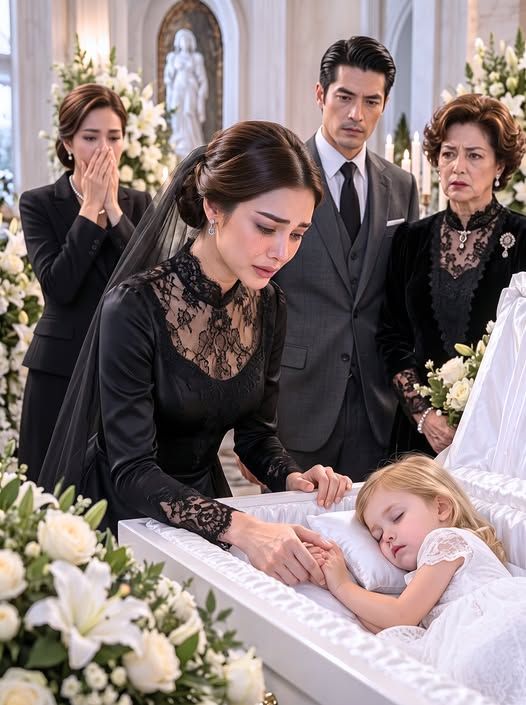
Fernando’s mother, Claudia, accused me publicly of turning our daughter’s death into another bitter custody battle. They arranged the funeral with disturbing speed and planned to cremate Sophia almost immediately, but until I stood beside her small white casket, I still had no proof that anything was wrong.
Then I heard a whisper from inside.
“Mommy… don’t let Daddy lock me up again.”
I froze, convinced grief had finally broken something inside my mind. Then Sophia’s eyelids fluttered.
I opened the casket and found my daughter pale, drenched in cold sweat, and barely breathing. When I reached beneath her to lift her out, my fingers struck hard plastic restraints securing her wrists beneath the lining.
“Mommy… I’m so cold.”
Fear gave way to the kind of clarity I had learned during my career as a Medical Corps Colonel in the U.S. Army. I examined Sophia quickly and noticed fresh puncture marks along her arm, consistent with repeated injections.
“Who did this to you?”
Sophia struggled to answer.
“Daddy said it was sleeping medicine. Grandma held me down… Natalia locked the door.”
Three years earlier, Fernando had won sole custody after portraying me as an unstable mother who cared more about military service than my child. After that, every scheduled visit came with another excuse: Sophia was sick, she did not want to see me, or some therapist had recommended emotional distance.
I had spent years believing my daughter was being turned against me. Now I understood something far worse had been happening behind the walls of Fernando’s house.
I found a small key taped beneath the casket padding, released Sophia’s restraints, and pulled her into my arms. Footsteps suddenly thundered down the hallway, followed by Fernando’s voice demanding to know what I was doing.
I carried Sophia into an adjoining room, locked the door, and called 911.
“This is Colonel Valerie Serrano. My six-year-old daughter was declared dead forty-eight hours ago. She is alive, heavily sedated, and was restrained inside a casket scheduled for cremation. I need emergency medical personnel and armed officers at San Gabriel Funeral Home immediately.”
Fernando began pounding on the door. Then Claudia shouted something from the hallway that the emergency dispatcher heard just as clearly as I did.
“Nobody was supposed to open that casket before the furnace!”
Sophia buried her face against my uniform.
“Mommy… Daddy said if I slept long enough, he wouldn’t have to give back Grandpa’s money.”
That sentence made everything shift.
My father, retired General Arturo Serrano, had created a substantial irrevocable trust for Sophia’s future. Fernando was currently its legal trustee.
Sirens began approaching in the distance while I held my daughter tighter. I thought I had just discovered the most horrifying thing Fernando could possibly have done.
I was wrong.
Within hours, police would search his home and uncover a hidden room that no one outside that family was ever supposed to see.
Part 2: The Room Behind the Basement Wall
Sophia reached the military medical center alive, but the doctors quickly confirmed how close she had come to dying. Her system contained a dangerous mixture of prescription sedatives, and the concentration suggested she had been repeatedly dosed for several days rather than given one accidental medication.
While doctors worked to stabilize her, state police secured the funeral home and detained Fernando, Claudia, and Natalia for questioning. Their explanations began contradicting one another almost immediately.
Fernando insisted Sophia’s supposed death had resulted from a catastrophic medical error. Claudia claimed the restraints inside the casket had been used during transportation, while Natalia swore she had never seen Sophia restrained at all.
Their story became even less believable when a nurse discovered a high-potency fentanyl patch attached to Sophia’s upper back. The prescription could be traced by batch number, giving investigators a direct path toward whoever had supplied the medication.
Within an hour, a judge authorized an emergency search of Fernando’s house.
I was standing outside the pediatric ICU when the lead detective approached carrying a tablet. His expression told me he was about to show me something worse than I had prepared myself to see.
“Colonel Serrano, we need you to look at this.”
The first photograph showed Fernando’s basement. Behind what appeared to be an ordinary wall panel, officers had discovered a hidden room with no windows and soundproofed walls.
Inside was a child-sized cot, surveillance equipment, and a reinforced door that could only be locked from the outside. On a shelf, investigators found prescription bottles matching the sedatives discovered in Sophia’s bloodstream.
Then the detective swiped to another photograph.
A small desk sat against the wall, and on top of it were several school notebooks bearing the name Maya Beltran. She was six years old and had disappeared three months earlier in a case that had received national attention.
I recognized the name immediately. Maya’s father, Marcus Beltran, was a prominent defense contractor who had recently filed a major fraud lawsuit against Fernando’s construction company.
“Was Maya kept in that room?”
The detective nodded grimly.
“Forensics found hair, clothing, and a school ID matching her. We also recovered forged passports prepared under another identity.”
The evidence suggested that whatever had happened to Sophia was connected to something far larger than one desperate attempt to gain access to a trust fund.
My father, retired General Arturo Serrano, joined us outside the ICU. He explained that Sophia’s trust contained provisions that could temporarily place millions of dollars under Fernando’s control if she died while he remained her legal guardian.
“Not permanently,” Dad said. “But long enough to liquidate assets, satisfy creditors, and disappear before a full audit.”
Investigators had already detained Dr. Sergio Reyes, Natalia’s brother and the physician responsible for signing Sophia’s death certificate. Records showed he had certified her death without ever conducting a proper examination.
Police also discovered certified copies of Sophia’s trust documents, life insurance policies, and instructions explaining how to begin expedited probate proceedings after the death of a minor. Nothing about the plan appeared spontaneous.
Then, just before dawn, an investigator hurried toward us.
“We found Maya Beltran.”
I stood immediately.
“Is she alive?”
“Yes. Troopers raided a rented safehouse two hours away. She’s alive, and the person guarding her is cooperating.”
Relief lasted only a second before I noticed the investigator’s expression.
“There’s something else,” he said. “The caretaker says Fernando wasn’t the one giving the orders.”
I looked through the ICU glass at Sophia sleeping beneath the monitors. If my ex-husband was not the person controlling everything, then someone else had planned both girls’ suffering from the beginning.
When the investigator told me the name, it was the last person I expected.
Part 3: The Woman Behind Everything
The caretaker guarding Maya was a fifty-eight-year-old former private nurse named Grace. When state troopers raided the secluded safehouse, they found Maya weak and sedated but alive, and during questioning Grace finally revealed who had been paying her.
It was not Fernando.
It was Claudia.
For a moment, I could barely process what I was hearing. Fernando’s mother had always despised me, and during our divorce she repeatedly testified that I cared more about my military career than motherhood, but I had never imagined she was capable of orchestrating something this calculated.
Investigators soon reconstructed the larger plan. Maya had been targeted because her father, Marcus Beltran, discovered evidence that Fernando had been embezzling millions through his construction company and was preparing to expose him.
Claudia arranged for Maya to be taken in order to pressure Marcus into withdrawing his accusations. When he refused, she began preparing forged identity documents and a plan to move the child out of the country.
Sophia required no kidnapping because Fernando already had legal custody of her. My father’s trust contained a provision allowing Sophia’s guardian limited temporary access to certain funds if she died, and Fernando was drowning in more than twelve million dollars of debt.
If I regained custody, that access would disappear completely.
So Claudia decided Sophia had to die before my custody appeal reached court.
Dr. Sergio Reyes signed a false death certificate, Natalia obtained the sedatives, and Fernando administered them over several days. Their plan nearly failed when Sophia survived the intended dose and slipped into a deep unconscious state instead.
Reyes detected a weak pulse and warned them that she needed immediate medical treatment.
Claudia refused.
“If she wakes up in a hospital and talks, we all go to federal prison.”
She never realized Fernando’s home security system had recorded the conversation. Federal agents recovered another recording in which Natalia panicked and insisted she had agreed only to falsify documents, not hurt a child.
Claudia reminded her that she was already implicated in Maya’s kidnapping.
Then Fernando’s voice entered the recording.
“The cremation is set for eight in the morning. Once she’s in the furnace, there’s nothing left to audit.”
Hearing the man I had once loved speak so calmly about destroying every trace of our daughter nearly broke something inside me.
I demanded to see him.
Fernando sat inside the interrogation room looking older than he had the day before. Without his expensive suit and confidence, he seemed smaller, but nothing about his appearance could erase what he had done.
“Valerie, I never wanted it to go this far.”
I sat across from him.
“You restrained our six-year-old daughter inside a sealed casket.”
He claimed Claudia had told him Sophia was effectively gone and that everything would somehow be temporary. Then he admitted the truth about his debts, the frozen accounts, and his desperate belief that Sophia’s trust could save him from financial ruin.
For three years, he had convinced a court that I was the dangerous parent. He had blocked my visits, bribed professionals to support his story, and taught Sophia to fear the mother who kept fighting to reach her.
Now the evidence showed that the court-appointed therapist who repeatedly recommended limiting my contact with Sophia had accepted more than $150,000 from Fernando’s company. The system had not failed because of one bad judgment; it had been deliberately manipulated by people willing to sell their authority.
I looked at Fernando across the metal table and realized something with absolute certainty.
He had not simply tried to take my daughter from me once.
He had been doing it for years.
Part 4: The Years They Stole From Us
Sophia remained in specialized pediatric care for two weeks. During the first several days, she barely spoke, and when she did sleep, she often woke screaming that the white box was locked again or begging someone not to turn off the lights.
One night, a nurse entered to adjust her IV line, and Sophia panicked the moment she saw the medication equipment. She began crying and begging not to be given any more “sleeping medicine,” so I immediately moved to her bedside and took her face gently in my hands.
“Look at me, Sophia. Nobody is ever going to give you medicine without explaining it to you. Nobody is ever going to lock you up again. And nobody is taking you away from me.”
She stared at me through her tears.
“Not even Grandma?”
“Not ever again.”
Her voice became even smaller.
“Not even Daddy?”
That question nearly broke me, but I refused to let her see hesitation.
“Not even Daddy.”
Sophia studied my face for several seconds before throwing her arms around me.
“Then you really are my real mommy.”
While Sophia slowly began recovering, investigators uncovered the full extent of what had been done to her during the years I had been kept away. Whenever she asked about me, Claudia sometimes locked her inside the hidden basement room, and when I called for scheduled video visits, they frequently sedated Sophia and told me she was too sick to speak.
The therapist who had repeatedly recommended suspending my visitation rights was arrested after financial records showed she had accepted more than $150,000 from Fernando’s company. What I had once believed was a custody system making terrible mistakes was revealed to be something much uglier: a coordinated network of bribery, falsified reports, medical fraud, and deliberate manipulation.
Maya Beltran was also reunited with her father. Months of isolation had left deep emotional wounds, but she was alive, and with intensive therapy and the support of her family, she slowly began reclaiming the childhood that had nearly been stolen from her.
Natalia eventually agreed to cooperate with prosecutors and described the entire financial scheme, the forged paperwork, and the plans involving both girls. Dr. Sergio Reyes lost his medical license and received a lengthy prison sentence for his role in falsifying Sophia’s death and assisting the attempt on her life.
The court-appointed therapist was convicted of bribery and judicial fraud.
Fernando and Claudia faced the most serious charges. Federal prosecutors built cases involving attempted murder, kidnapping, child abuse, conspiracy, and financial fraud, supported by recordings, medical evidence, bank records, and testimony from multiple accomplices.
Claudia received life in prison without parole.
Fernando was sentenced to forty-five years.
The day family court permanently restored my full parental rights, I expected to feel victorious. Instead, I felt exhausted.
Before closing the case, the judge addressed me directly.
“Colonel Serrano, no ruling from this court can undo what was done to you and your daughter.”
I looked at Sophia sitting beside me and answered without hesitation.
“No, Your Honor. But we can make sure the people who enabled it never do it again.”
I believed the nightmare was finally ending.
But rebuilding Sophia’s life would require something far more difficult than winning in court.
She would have to learn that safety could exist again.
Part 5: Not Cold Anymore
After the criminal cases ended, my father and I turned our attention to the thing that had helped make Sophia a target in the first place: the trust fund. We completely restructured it under strict judicial oversight, requiring multiple independent signatures so that no single guardian, relative, or trustee could ever gain unchecked control of the money again.
We also redirected a significant portion of the funds into a nonprofit foundation. Its purpose was simple: to provide independent legal and psychological representation for children trapped in high-conflict custody cases where abuse, manipulation, or coercion might otherwise be hidden behind money and influence.
None of that made Sophia’s recovery easy.
Healing did not happen because a judge signed an order or because the people responsible were sent to prison. It came slowly, through months of therapy, patient reassurance, and hundreds of small moments in which Sophia tested whether the world around her was truly safe.
For a long time, she refused to sleep with her bedroom door closed. She needed lights left on in the hallway, and some nights she woke frightened and came searching for me just to make sure I was still there.
Every time, I reminded her of the same thing.
“You never have to be afraid to come find me.”
Gradually, the nightmares became less frequent. The fear in her eyes did not disappear all at once, but little pieces of the child she had been before everything happened began returning.
One afternoon in late spring, I took Sophia to a neighborhood park. The sun was bright, the air was crisp, and for the first time in months she seemed more interested in running across the grass than in checking whether I was still within reach.
She tripped, landed on her knees, and immediately pushed herself back up.
Then she laughed.
The sound stopped me.
After everything we had survived, something as ordinary as my daughter laughing in the sunlight felt almost impossible.
My father was sitting beside me on a park bench, watching her race across the grass. His eyes filled with tears.
“I thought that trust fund was going to secure her future.”
I reached over and took his hand.
“Money doesn’t protect anyone by itself, Dad. People do.”
Sophia suddenly turned and ran toward us, her cheeks flushed from playing. She wrapped her arms tightly around my neck, and I held her against me for several seconds longer than usual.
“Are you cold, baby?”
She pulled back and smiled.
“Not anymore, Mommy.”
For so long, I had imagined justice as something dramatic: convictions, prison sentences, ruined reputations, and the truth finally becoming public. But none of those things felt as important as watching Sophia sleep peacefully with her bedroom door open.
Justice was knowing she no longer flinched every time medicine appeared.
It was watching her laugh without checking who might punish her for it.
It was seeing her learn that my arms were not another place of control, but somewhere she could always feel safe.
Fernando and Claudia had tried to erase my daughter for money and silence. They had nearly succeeded.
But Sophia survived.
And so did the part of her that could still laugh, trust, and believe that home was supposed to feel safe.
That was the future worth protecting.
